Smartphone as style advisor
Möbel Pfister has completely revamped its website and, with 14,000 products available, is Switzerland’s largest online retailer in the home furnishings sector. An interview with CMO Carlos Friedrich.


WW: You have just come from Milan from the furniture fair. What new things have you seen?
Carlos Friedrich: Trends in furnishings are always difficult to predict. What we can definitely say is that the retro trend is not over yet. There are interesting innovations in glass and marble. In addition, the Scandinavian style is still very much in vogue.
Which designers does Möbel Pfister refer to?
We also buy in Milan, our buyers are still at the fair. There it is about textiles and furnishings. But we also have ourselves manufactured and partly we buy directly.
Do you also employ your own designers who are looking for a specific "Pfister look"?
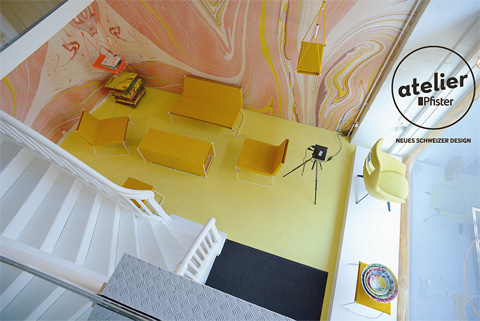
That's what we do with our "Atelier Pfister" line. Young Swiss designers get their chance there. They design furniture and objects on our behalf. For example, Atelier Oï, Claudia Caviezel, This Weber. The project is curated by Alfredo Häberli. He helps us not only design products with these young designers, but actually make them. This is our contribution to the new Swiss interior design.
Are customers currently in a good buying mood to refurnish their homes?
The furnishings market is saturated. Demographically, Switzerland is not growing as fast as other countries. But consumer sentiment is positive. In general, it can be said that beautifying one's home is still an important need. And we are trying to inspire more and more people that it is important to feel at home.
You were responsible for marketing at Ikea in a rather young furniture store and now at Pfister. Surely not a coincidence. To what extent is "rejuvenation" your task?
Not a rejuvenation. Of course I would like to be able to attract more young people to Pfister, that's true. But the Pfister brand is a traditional brand that stands for quality and service. I certainly won't change that, together with all the partners I have. It's about putting Pfister in the right light and showing that we are a modern and innovative company.
How do you experience the market conditions?
In terms of sales, we are number 2 with around 610 million. Ikea is ahead of us in terms of sales. No one comes after us for a relatively long time. Then other competitors with significantly lower sales.
Online business is currently causing a stir in the market. Since when has this been an issue for furniture?
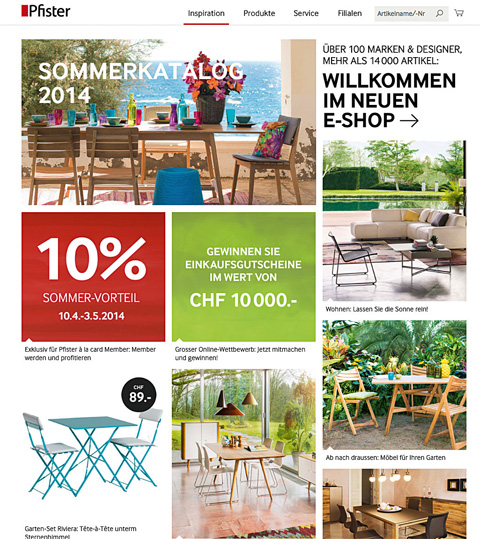
It's been interesting for a while. But the question is: What is online? We are just learning that online is more than just an information channel. Pfister has had a website since 1996, and we've been operating a web store since 2007. At that time, Pfister started with 3000 products. Since 2010 we have increased to 10,000 and now we present 14,000 products on our portal. At the same time as the relaunch, we also introduced a responsive design, i.e. one that adapts to all devices.
For many couples, shopping together is part of the ritual. Online can't offer that.
That's where you're wrong. Visiting the store is still a very important pillar. When you spend several hundred francs, you also want to be able to touch, feel and compare something. But you can also compare online. At least visually. The prices even easier. You can also see what material properties a chair has. A couple can sit together in front of the screen. You can also make lists and then look at the selected objects in detail in the store.
Last year, Pfister doubled its online sales and you have the same goal again for 2014. What can the new website contribute to this?
With the renewal of the website and the further development of the e-commerce channel, the cross-channel strategy is consistently implemented. We worked on this project for several months. It is above all the intuitive and the inspirational that we are trying to present simply. Depending on their preferences, users should be able to decide whether they want to find something relatively quickly or whether they prefer to be inspired. If he is specifically looking for a chair, he should quickly be presented with a selection of chairs. Who wants to be inspired more and look, what there is in the living room so, gets presented on the platform corresponding images with an inspirational pre-selection of the most diverse furnishings. We live today in a society with very many possibilities. Whoever types in "chair" on Google today will find over a million hits. Everyone is overwhelmed. That's where we as the Pfister brand want to provide orientation and communicate our competencies - among other things, by showing which styles go together.
Are there comparable models abroad for Pfister's new website or is this a pioneering achievement?
We are relatively far along on the online side. In the furnishings sector, I don't know of anyone who has gone so far and is trying to link several channels. But it has to be said that there are pure online players who are certainly further along in this area. But they only operate in the online channel. What we are looking for is a deliberate combination of different channels. If someone visits the "mattresses" section online, they are automatically invited to make an appointment for a mattress consultation at the nearest Pfister store.
Buying clothes online is likely to become the norm. Will that come to furniture as well?
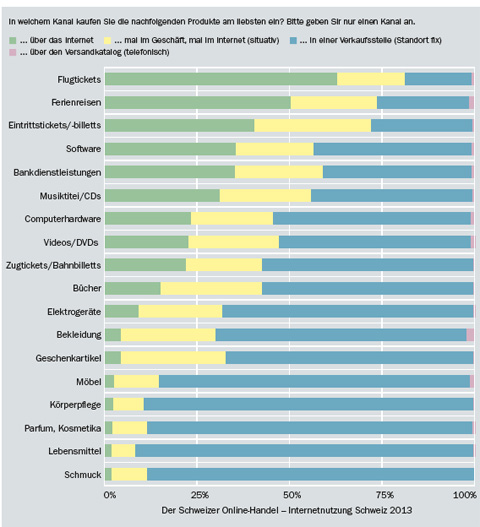
I am convinced that the furniture online market will continue to grow. It is already growing at double-digit or even triple-digit rates, but at a low level at the moment. In my view, however, it will not become any bigger than bricks-and-mortar retail in the furniture sector. The online channel is primarily inspiration and information in the furnishing sector. If you compare it with the fashion business, there is another crucial difference. A blouse can easily be ordered in three colors or different sizes, tried on and returned if necessary. You don't have a wardrobe delivered and assembled twice. That's why trust in the brand is so important in the furnishing sector.
How does your online business work logistically?
That is one of our core strengths. Pfister has been doing this for many years. We have our own logistics team with several hundred employees. 160 vehicles that fan out every morning. In each case the driver together with a specialist, so that the furniture can also be assembled. That is a decisive point of differentiation from other competitors. Many delegate this to outside companies and these logistics companies usually only deliver to the front door. Then the customer has to carry the cabinet up to the third floor and assemble it himself.
What will the relationship between stores and online be like in the future?
Today, people talk about the online sector accounting for 1 to 5 percent of the total furnishings market. That is relatively low. Other experts believe that up to 20 percent of the furniture market will be generated online in the future. I am convinced that it will grow. But in the long term, brick-and-mortar retail will still be the mainstay. Especially when it comes to the big things.
Will Pfister open more stores?
We have been in Switzerland for over 133 years. We have 20 brick-and-mortar stores and just recently reopened and modernized our 21st and largest store with our webshop. Every customer in Switzerland can reach the physical Pfister stores within 30 minutes.
On Rämistrasse in Zurich, there is an "Atelier Pfister" as a pop-up store. An experiment?
The idea of "pop up" means that a store disappears again. "Atelier Pfister" is our avant-garde and young line. Where you can also test what works. For many decades we were only dealers. With Atelier Pfister we are learning to become manufacturers as well.
What accompanying measures will be used to communicate the offensive with the new online store?
We will promote the new web presence in the first phase by investing more in the online area. We are investing more in digital marketing than in previous years. Digital communication means search engine marketing and SEO marketing. We do this with partners, in digital marketing together with Webrepublic.
Is there also a classic campaign?
We work with various agencies when it comes to external communication. For catalogs, we do this with Strebel Juon and rentahess, and we buy other services from independent creatives.
How important are catalogs in a digital age?
As a marketing manager, you are always responsible for where investments are made. We try to make our media measurable. For that, we have the ROAS. With that, we analyze advertising spend and measure it for impact. We know what we have in the till on a given day after advertising. The media are planned accordingly. Our four catalogs per year enjoy a very high return on advertising. In other words, the catalog remains an important medium. At the brand level, moving images are particularly well suited for image because they can arouse emotions. For product communication, print measures with several pages are suitable because you can send more information than normally just a poster with one idea. For action communication, media that can be produced relatively quickly and inexpensively are suitable. For us, radio is one of the most suitable media. Basically, we always have to ask critically: Which channels do we invest in during the pre-purchase phase, the purchase phase and the post-purchase phase?
Is there a great synergy between catalog and online?
Yes, we try to do that. For us, the catalog is the source. It indirectly controls our range. We work there with our teams to be seasonally relevant. Because we have the privilege of selling over 10,000 products that can be touched, we actually have more of a problem: we have too many products for our advertising. So Pfister has to try to generate styles and shape styles. We do this by also trying to set seasonal themes. We present these with the four catalog issues and then, of course, digitally .
You've been with Möbel Pfister for four years. How far have you come with your goals?
We are still on the journey. We are moving the Pfister brand. The online approach with cross-channel communication and cross-channel marketing is in its infancy. The field is being rewritten and we get to be a part of it because we are a multi-channel provider and we are trying to connect these channels. To rejuvenate the brand and find younger target groups, online is of course also an important channel for this.
How do you distinguish yourself in the market?
As the Pfister brand, we stand for quality and service. Service includes competent advice and also quality products. In the long term, this is a strength of Pfister that will become even more important. Switzerland is getting older, we have more and more smaller households and prosperity remains high by international standards, and more and more people have less time. That speaks for brands that are service-oriented, but also innovative.
Are there online-only retailers in the furniture market?
Home24 has been in Switzerland for a few weeks, Beliani has been around for three years. Zalando's investors are indirectly involved in Westwing and Home24. Zalando has changed the fashion market in Switzerland. I'm curious to see whether Home24 or other pure online players can move the market in Switzerland. The interesting thing is that pure online players are now going the other way. The online provider "fashion for home" has now opened its first stationary stores, for example in Munich. However, they still have to learn how to do stationary merchandising, just as we still have to learn how to sell better online.
Where do you see construction sites?
We have only just begun the journey into digital. Digitization is not that easy because you have several interfaces. It's like building a house, there are also several craftsmen involved. In digitization, we have the web agency that programs and designs, an information management system, plus internal IT, networks and digital communication measures. Bringing all this together on one portal and linking it to other channels is a challenge. Before, it was the cross-media journey. Now it's the cross-channel journey. Advertising tries to connect cross-media. Now we're trying to connect cross-media and also sell.
What are your target groups?
Women's perceptions are different from those of men. Men focus more, women like to have the ambience. But there is still little advertising research that shows how women really work. So we've developed a few approaches ourselves. "Images are shots to the brain ", according to Professor Kroeber-Riel. We take that into account in store design. Here we know that women not only react more emotionally, but also perceive more holistically than we men do. The impulse giver for a purchase in the furniture store is the woman. Often, it is also she who clearly decides what to buy.
That's why a clever car dealer wanted to put up posters on vacation islands.
A good idea. We will show our presence at the airport and also on the plane, because: When do you have time? Around flying, e-commerce is a wonderful tool. You take these gadgets with you, smartphones and tablets. And then you order something on the way, so you can look forward to coming home again.
What are other ideas for the future? Developing means learning. Shortly after I joined, we launched the "Atelier Pfister" app with augmented reality almost four years ago. You could click on a piece of furniture and project it into a photo of your living room. You could change the colors of the sofa, move it across the room. The app isn't perfect, nor is it as in demand as we'd hoped. But it's a gimmick that underscores our role in setting the trends. We only do that for "Atelier Pfister." It would be too expensive for all products. We were a bit too early. But the gimmick gives an image. It shows: We are moving.
Interview: Andreas Panzeri