
Selfies: advertising for self-promoters
Everyone takes selfies. Could these digital self-portraits also be used as a database for personalized advertising and marketing? And is it permissible to simply exploit private photos for commercial purposes? *Werbewoche* asked around.


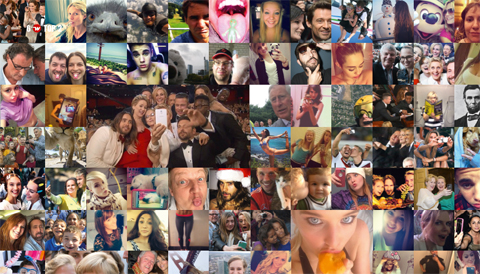
Some people indulge in this new passion to excess, others find it annoying: selfies. The fact is: selfies are being snapped, uploaded and shared everywhere, by women and men, young and old, secretaries and federal councillors, celebrities and cervelat celebrities. Often with embarrassing consequences. Selfies, or classically: self-portraits, are actually nothing new. Even in ancient times, artists portrayed themselves; the self-portraits of Albrecht Dürer, Rembrandt, Lovis Corinth and Vincent van Gogh are among the most famous works of art ever created. And just as artists back then consciously wielded a paintbrush to stage themselves, a selfie is usually preceded by a lengthy styling process and the search for the right background - because even if the selfie suggests spontaneity, it is a deliberate self-staging of the person depicted, in which they have everything under control. And only then takes the picture. And only then uploads the picture. Selfies represent a new need for self-presentation, for a controlled, idealized image of others: I'll show you how you should perceive me. "Selfies have a very unique, new visual aesthetic that strongly reflects today's zeitgeist," says David Schärer, co-founder and managing director of the Zurich agency Rod. "They look random and create a feeling of closeness to the person depicted, which is particularly true of celebrity selfies. After all, the person so far away from us took the picture themselves, and you can often still see the arm holding the smartphone." Whether celebrity or normal person: the controlled shots give everyone the opportunity to present themselves in the desired light. And they give even the smallest number the feeling of being interesting to others. Exhibitionism for a society of voyeurs - whatever you like is allowed.
Look, that's me
The first digital portraits under the name "selfie" appeared on Flickr and MySpace in 2002. Since then, pseudo-snaps have conquered the internet. Every day, around 1.8 billion photos are uploaded to Facebook, Instagram, Flickr, Snapchat and WhatsApp, and no longer just by teenagers. This is confirmed by a study by venture capital firm Kleiner Perkins Caufield & Byers. "When even National Councillor Geri Müller posts a nude selfie of himself, selfies have obviously become common sense," says Schärer. Selfies are so trendy that they are probably more than just a brief, fashionable twitch. And new trends often hold new potential for advertising and marketing. Does this also apply to selfies? Opinions are divided. Schärer clearly says: "Yes!" Martina Schorn, research associate at the Vienna Institute for Youth Culture Research and co-director of the recently published study "Generation Selfie", also says "yes". Andrea Iltgen, co-founder and managing partner of the Zurich-based online marketing and social media agency Xeit, thinks: not so much. And then there are also genuine legal concerns. Because not everything that works is allowed.
Expense versus income
Anyone who posts a selfie reveals information about themselves: when the photo is taken, the location where the picture was taken and the device used is saved. The photo itself also reveals a lot: is the photographer on the ski slopes or on the beach, in the changing room or buying a car, on the playground or in the office? Once image recognition technology has matured to the point where millions of selfies can be analyzed within a very short time, the way would be clear for advertising tailored to consumers: one person receives offers for ski resorts and ski equipment, another for bikinis and beach fashion. The next receives shopping tips, the fourth offers for the cheapest leasing rates. Almost anything is possible.
"To do that, you would first have to develop software for image analysis," Andrea Iltgen from Xeit points out. "In my opinion, that's not the smartest way to go. There are already very good targeting options today, such as behavioral targeting or Facebook. A lot of information about users is readily available there. Analyzing selfies would be a huge detour to get information that we have had for a long time." Iltgen considers selfies to be a current trend that will soon be over again. "In Switzerland, a very limited group takes selfies," she says. "There are around 500,000 people on Twitter, only some of whom take selfies and upload them. The effort involved in evaluating these images is simply not worth it."
The future of advertising
David Schärer sees things differently: "The great thing about today's world is that any vision you have is probably already technically feasible. You can certainly take selfies as an indication of a certain lifestyle, which can then be used for advertising and marketing. I do believe that this will happen." The analysis of image data for potential advertising customers could be particularly interesting for social networks such as Instagram, Pinterest and Snapchat, which have so far provided comparatively little data about their users.
Scientist Martina Schorn, who recently co-published a study on "Generation Selfie", says: "Selfies are no longer just a youth culture phenomenon, but are also a marketing gimmick." And she goes even further: "As soon as there is software that systematically evaluates selfies for certain aspects, it is quite realistic that the data obtained will be used as a basis for advertising and marketing. Someone who takes a photo of themselves in a bar with a bottle of vodka would then receive advertising for spirits, and someone who takes a selfie on the beach would receive advertising from travel providers. Technically, this would all be feasible, if not now then in a few months' time. From an ethical perspective, however, such a use of selfie image data would be controversial."
According to Lucerne advertising and media law expert Ueli Grüter, the analysis of images for advertising purposes is not only controversial, but not permitted at all. "Purpose limitation plays a major role in data protection," explains Grüter. "The law prohibits data processing that is not earmarked for a specific purpose. If Geri Müller and his girlfriend send photos with the purpose of showing them to each other, no one is allowed to use them for anything else, not even for data analysis. The terms and conditions of WhatsApp, for example, stipulate that the data is only used for this transmission." In theory. In practice, cookies already collect various data about different users on the internet. That's why the author is still receiving maternity wear ads when her sons are already out of the house - just because she clicked on mommy clothes at some point. According to Grüter, this is not allowed, but it is done anyway. Until someone complains. Which, however, rarely happens, as Grüter confirms. It will probably be similar with the advertising analysis of selfies.
Closer instead of on the outside
The use of selfies as advertising subjects is permitted and apparently popular. They create closeness between the person depicted and the viewer. For example, the selfie medium brings companies into contact with their customers and turns them into stakeholders. Two examples: in 2011, Rod initiated a campaign with user-generated content for Hotelplan: the agency called on people to share their vacation photos with others. Two weeks after the campaign was launched, 4,000 people had already uploaded more than 70,000 vacation photos to the Hotelplan website, including a number of selfies. Rod is currently running a campaign for SBB that uses selfies of train passengers as subjects. This campaign is also going well: around 600 selfies were uploaded to the SBB platform in the first week.
It is very likely that the selfie trend will continue. It is already reflected in the hardware: camera manufacturer Rollei has just launched a "selfie stick" with a smartphone holder, a kind of arm extension that allows you to take selfies without twisting.
If advertising and marketing want to take advantage of the new openness of potential consumers, they need to be clever about it and accompany advertising with exclusive discounts, for example. Because once selfie-takers feel harassed or even abused by advertisers, they will migrate to other platforms, create new channels, withdraw or - worst case scenario - sue. That's the beginning of the end. "The biggest risk for a company is reputational damage, especially in social media," says lawyer Grüter. Because the path to another platform is very short.
Anne-Friederike Heinrich


