
No-go or best practice?
Amid the battle for the attention of media consumers, dwindling advertising revenues, and digital challenges, native ads are gaining ground as a content-oriented advertising medium in Switzerland as well. A recent study by the University of Fribourg examines this innovative marketing technique and critically evaluates its impact on journalism.


Native advertising is expected to account for more than half of all digital advertising as early as 2020. This is the prediction of the study "Native Advertising in Europe to 2020" by Yahoo and Enders Analysis. However, the ongoing discussion in Switzerland shows that even industry experts disagree on what is meant by native advertising and how such campaigns are to be implemented. As a new type of content creation and in competition with journalism, the debate revolves around the question of the extent to which profit-oriented companies can use native advertising to influence the editorial design of media. This discussion is characterized by the growing importance of economic exploitability of journalistic products. A recent thesis at the University of Fribourg and one of the few scientific studies on the topic has taken up the task of determining the current status of the phenomenon of native advertising. In interviews, three players each from the media, advertising and communications industries (including Tamedia, Dreicom, Volvo Car Switzerland) were asked what they understand by native advertising, what recommendations they give for implementation and how they assess the influence of this form of advertising on journalism.
Between self-promotion and journalism
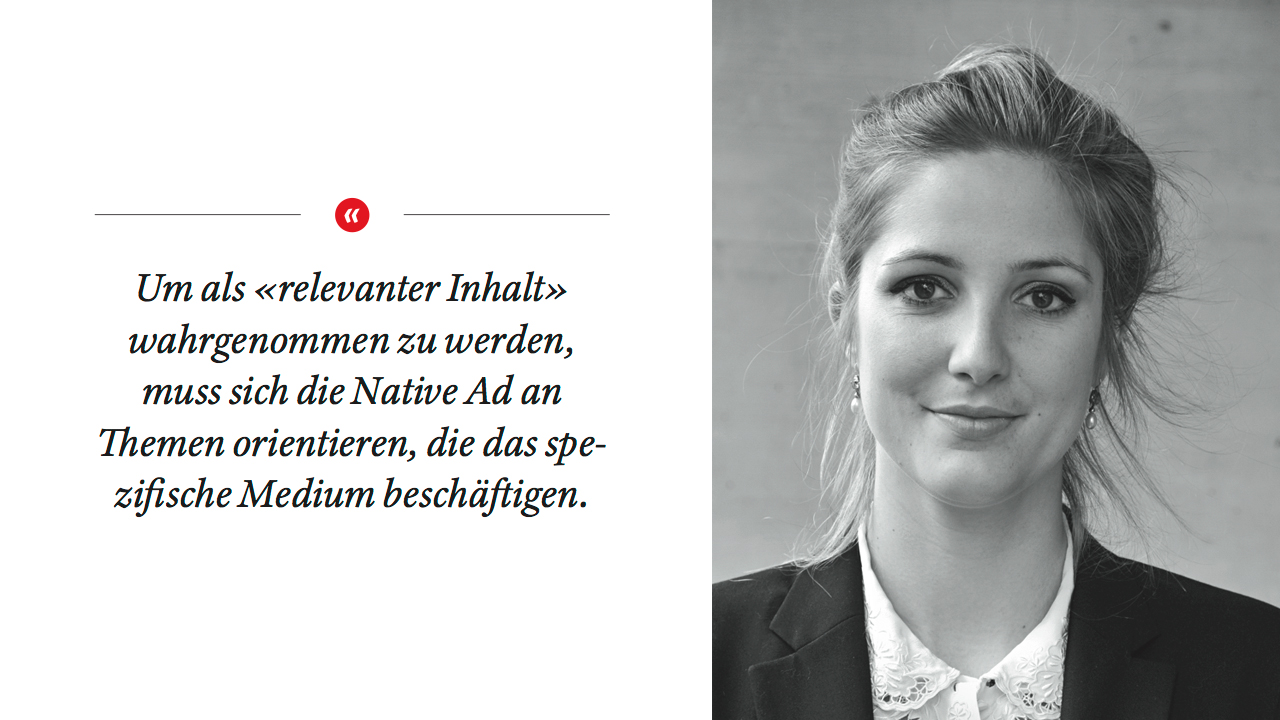
The majority of the data analysis shows similar assessments by the various interview partners: They unanimously see native advertising as an advertising medium that adapts to the layout, tonality and functionality of the carrier medium and conveys added value in terms of content. The stakeholders involved state that native ad campaigns pay into the brand presence and perception of an advertising company, but are not suitable for promoting sales of individual products and services. Accordingly, pure promotion has no place in native ads. Content that is relevant to media recipients and of high quality is cited as the defining characteristic of native ads. In order to be perceived as "relevant content," the Native Ad must be oriented to topics that occupy the specific medium and accordingly guarantee the attention of media users. By "high-quality content", the majority of the interview partners understand that journalistic stylistic means are used in the editing of the Native Ad and that, at best, content experts from the publisher - compulsorily separated from regular editorial staff - or freelance journalists are used. It is essential in the orientation to the medium that the brand or specific brand values are not lost in the process. It is important to link the topics that interest media users with the brand's own topics. In doing so, advertisers can emphasize their expertise in an information-oriented manner or tell entertaining stories; depending on the company, products or services, the goals pursued and the orientation of the medium. Native advertising is therefore about marketing through content. This reflects the marketing technique's affiliation with content marketing.
As a new type of financing model, native ads are thus intended to meet content-driven needs of the advertising industry and media business activities. Despite stylistic elements of journalism, however, native advertising is a commercially motivated advertising medium. Advertising is not a component of journalistic trade and accordingly does not claim to present information comprehensively and objectively. Precisely because of this hybrid role, media-ethical aspects in the sense of institutional and professional ethics must also be taken into account. Advertising must always be recognizable as such for the media recipient. This means that profit-oriented media companies must also uphold the ideals of social responsibility with regard to commercial orientation, specifically the principle of transparency or the principle of separation. In the paper, two case studies provide an interesting insight into the current state of media ethics guidelines and illustrate the discussion surrounding the challenge and opportunity of native ads.
Credibility through separation of content
The stakeholders involved agree on the formal characteristics. Native ads must be labeled as advertising media in the sense of the transparency requirement, and the separation of editorial and commercial content must be maintained. Otherwise, the credibility of all those involved and of the advertising form would be ruined.
The advantages of a cleanly prepared native ad campaign: you can convey a broad image of your brand, the content-oriented preparation of the advertising medium guarantees the attention of media users and the results are easily measurable.
However, divergent views have emerged in the discussion about the measurability of such campaigns, which can be attributed to the different embedding variants of native ads on publisher websites. On some platforms, native ads are embedded and published in the publisher's content management system, while others use ad server technologies along the lines of programmatic advertising, where the ads are seamlessly integrated into the intended editorial environment as a contribution. The latter is recommended, as it allows for fully automated selection by audience and context, as well as real-time monitoring to optimize ongoing campaigns. Moreover, this approach preserves the separation principle and credibility. The differences outlined above cannot be assigned to any particular industry, but generally underline the inconsistency that still prevails in the planning and implementation of native ads.
The disadvantages of native ads are characterized above all by the challenge of alienating brand values. This is emphasized above all by representatives of the advertising industry (advertisers and advertising agencies). In contrast, the representatives of the media companies see the role of the advertising customer primarily as an enabler of content and sometimes strongly abstract the topics discussed together with the advertising customer.
Native advertising - new source of revenue
The exchange with various experts from the media, advertising and communications industries shows that the importance of native advertising is increasing, especially for revenues in the digital advertising industry, at a time when the advertising market is struggling in the wake of digitization and globalization. However, according to the respondents, journalism will not be undermined, provided the articles are written by external authors with a journalistic background, offer added value in terms of content, and are clearly labeled as such, i.e., understandable even for laypersons. This creates the necessary credibility and builds trust.
The results of the work show that industry-wide market standards and detailed framework conditions are required. The individual associations and institutions are called upon to act here. Many of the experts interviewed are unsure whether the industry will still be talking about native advertising in 2020. But they agree that content-oriented advertising measures will determine the digital advertising market in the medium to longer term and redefine the hierarchy around the leading revenue sources.
The author: Lara Février studied communication science and media research at the University of Fribourg. In addition, she worked as a communications and PR consultant in various agencies, where she gained experience in media and public relations, online marketing and corporate communications, among other things.
The study
The paper "Native Advertising: No-Go or Best Practice - an explorative study on the separation of commercial and editorial content" can be sent on request: Send an e-mail to [email protected], keyword "Study Advertising Week". This article was already published in Werbewoche 18/2016.


