New dimension between photo and film
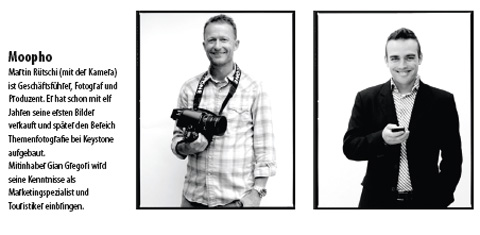
Martin Rütschi has recently begun specializing in moving images for the Internet and digital advertising spaces, and founded the company Moopho together with Walter Grolimund and Gian Gregori.


Martin Rütschi is a very mobile person. As a photographer, he travels a lot. Once, however, a torn ligament tied him to a chair for three months. The visual artist, who has spent around a third of his time abroad so far, still wanted to make creative use of this enforced downtime. Rütschi had his doctor allow him to travel to Cuba, at least for his convalescence. He then sat there. In the same chair every day. And let the images pass him by. "That fascinated me. I photographed the daily routine with a small camera. Always from the same angle. I discovered that: Something was moving within these pictures." That was six years ago. Martin Rütschi has since been confronted with such "moving images" again in Milan. He discovered a Japanese artist at a design fair. He was showing images of a forest on three screens. Always the same setting. But in different times and moods. "Wisps of mist crept in between the trees. Shadows descended over the foliage. After thirty seconds, I had the feeling that I was in Japan and standing in a forest."
The rest can be told in fast motion. Award-winning photographer Martin Rütschi founded the company Moopho AG on September 19. He is joined by Walter Grolimund, former CEO and Chairman of the Board of Directors of Switzerland's largest photo agency, Keystone, and Gian Gregori. The latter started out as a polygraph, then studied tourism and organized "countless photo shoots" for Martin Rütschi at Zurich Tourism. Gregori is responsible for marketing at Moopho.
Versatile use
Who is Moopho aimed at? "These are moving images that combine photography with film," summarize Rütschi and Gregori. "With Moopho, we breathe life into the images. On platforms such as tablets or electronic advertising spaces, people have the opportunity to experience the natural movements of a subject at any time. This allows us to make the images breathe, bring them to life and let them speak for our customers," explains Rütschi. In terms of price, Moophos is much cheaper than film production - and thanks to 4K technology, the individual images can even be used in the print sector. This also requires Moophos on the web. An ideal length of seven to ten seconds has become the standard. A Moopho is moved like a movie at 25 frames per second. Suitable subjects can be found in the tourism sector, for example. "On the websites of a tourist region or a hotel, potential guests want to be able to feel the uniqueness of a landscape, a city or the ambience. An image has a more emotional impact if it moves in a subtle but surprising way," says Rütschi. Other clients come from the fashion, landscape architecture and watch advertising sectors. An unusual project was filmed for the Zurich-based media company You Productions. On iPhone and Android apps, the gently moving images accompany the viewer during concentration and relaxation exercises at home, on the move or in the office. These Moopho apps can be downloaded free of charge from You-Productions.com. "In the beginning, we were looking for images with the most spectacular movements possible. But the most exciting things are these very subtle movements where surprisingly little happens."
A Moopho has photographic qualities. But no dramaturgical plot. "The moving image shouldn't be a distraction," explains Rütschi. Although he has already attended a film school in New York "out of curiosity" as part of a sabbatical, Martin Rütschi consciously sees himself as a photographer. "I think in single images. That's what I can do and what I'm good at. But if I wanted to make films at the level I'm used to photographing, it would take a lot more effort. What has always fascinated me is authenticity. If you can tell a story with a picture, I've already achieved a lot as a designer. And the image becomes even more authentic if we bring it to life now."
First own agency at the age of 15
Martin Rütschi came into contact with photography at a very early age. "My grandmother was a very good photographer," recalls the son of a teacher. He noticed how his grandmother only took a simple camera with a 50 mm lens with her on her numerous trips, while his grandfather, who was also crazy about pictures, wanted to lug around countless lenses and other knick-knacks in a heavy photo bag. Nevertheless, his grandmother brought home much better pictures. At the age of eleven, grandson Martin was also caught out. "A farmer came by with a potato. It looked like a mouse with ears and a little tail. The farmer told me to make sure I captured this freak of nature in a photograph. " So Martin Rütschi put the tuber in front of a camera and sent the picture to all three newspapers that still existed in Zug at the time. And all three printed the potato. "That taught me a lot: you can earn money with a picture. And if you can sell it several times, it's more profitable because the basic costs remain the same." That was the start "and not much has actually changed since then". At the age of 15, Rütschi founded his first agency together with a colleague. With their "Pictura", the young entrepreneurs photographed sports images and sold them to all the newspapers in Central Switzerland. "We cycled to football and ice hockey matches in the region and then developed the films in our own laboratory in the basement."
At the same time, Rütschi also wanted to make his knowledge "official" with an apprenticeship as a photographer. This was followed by a first job at the Luzerner Tagblatt. As all his colleagues were now in the process of becoming doctors or lawyers, the photo reporter also wanted to broaden his horizons a little. Rütschi emigrated to America and studied political science in San Diego. "I deliberately chose to study in a foreign language because I wanted to force myself to improve my English at the same time." After two years in the land of opportunity, Rütschi felt confident enough to return to Switzerland. He contacted Keystone. "I had always wanted to work for this agency because it was an ideal model for me." For the next two years, Rütschi rushed from scene to scene as a news photographer. Then his curiosity about the world got the better of him once again. Rütschi sent himself on a two-year photo safari across the American continent.
On his second return, however, Rütschi no longer wanted to photograph the news. Hansueli Blöchliger, "who made Keystone the most important Swiss press photo agency", hired him anyway and "gave the photographer, who was now focused on carefully designed images, total freedom". The result was themed photography. "News photography was too fast-moving for me. Photographed today and in the waste paper tomorrow. I wanted to spend more time on a topic and take a good picture. You don't create a photo like this overnight. But it is printed not once, but a hundred times. This concept then developed into a successful model at Keystone."
Martin Rütschi currently employs six people at his own company. Moopho is still looking for talented freelancers in the creative field. In the technical area, the aim is to further perfect the offering with permanently employed specialists from the film post-production department.
Andreas Panzeri