
Lead management and sales in B2B


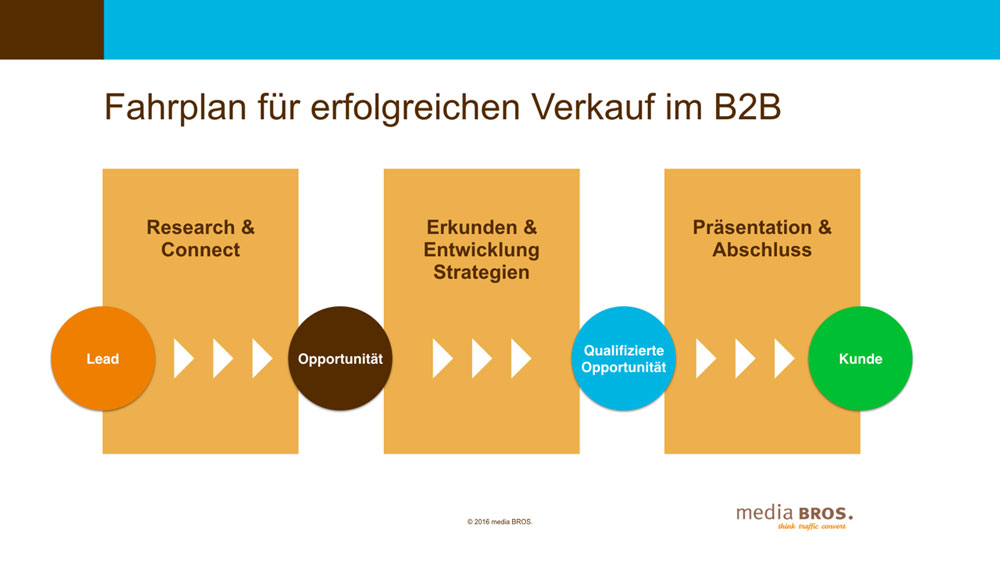
1. research & connect
The first phase starts with generated new leads or existing contacts. The best ones are contacted and qualified. Prospects who have been contacted and qualified sufficiently to make an initial appointment for a presentation or approach are considered opportunities. It is worth working with so-called lead lists to make this process structured and measurable. How to best structure such lead lists and with which characteristics is part of this article series and will be published in a separate article. In the first contact phase, it is important to open the dialog for your own topic and create a sustainable dialog platform. In the connect phase, it is crucial to what extent your own company, products and services stand out from the market and are offered in a targeted manner.
2. explore & develop strategies
In this second phase, an opportunity is converted into a qualified opportunity. A qualified opportunity differs from a non-qualified opportunity in that the following criteria have been checked and fulfilled:- Prospect needs our help/product/service- We can help- Prospect is interested in our helpMost companies only buy "must have" products and services. So the first thing you should do is focus on clarifying this question. This saves your own time and that of the prospect. Consultants and salespeople should find out to what extent they can help a potential buyer/customer and whether they want help at all. This definition is based on the self-conception that not every prospect must also be a potential customer and buyer and that there must be a basic matching of these criteria in order to sell successfully. Philosophically and strategically, I am convinced that this is the only way to ensure sustainable growth through sales/acquisition in the B2B sector. At least, if the buying process is to be a pleasant and positive experience for everyone involved. Buying should be fun, especially for the customer! So I'm talking about anything other than a pitch here. For me, pitching is pretty much the opposite of what I am trying to convey in this series of articles. My appeal is therefore; "Stop pitching and start helping!" Pitching has and has always had a pale aftertaste for me and is not logical if all three of the above criteria are met. More on structuring this process in the next installment of this article series.
3. presentation & conclusion
In the third and final phase, qualified opportunities are closed with customers. This is the topic that most salespeople/consultants and their superiors are ultimately most interested in. Your own product/service as well as pricing and conditions certainly play a key role in a successful deal in this phase. It goes without saying that only mature products can be sold at market-driven prices. Anything else is unrealistic these days. Depending on how elaborate presentations and/or concepts have been created, it is important to place/present this preparation, understanding, qualification, commitment, know-how and time investment appropriately. This point is also examined more closely in this series of articles.Self-assessmentWhere does your company stand in terms of capturing leads and how specifically is the sales process or business development defined? Here are three simple questions to ask yourself about your company:1. is there a written list of desired customers or prospects that are currently being pursued?2. is there a written definition of a desired customer or which criteria make a prospect/opportunity interesting and which do not?Is there a well-formulated story or hook that resonates with desired customers? The answers to these questions are a good indicator to understand how targeted and focused your own business development or sales process is.in the next article we will look at the sales basics in more detail as a prerequisite for the implementation of this leads & sales roadmap presented here.



