Customer service is more important than price


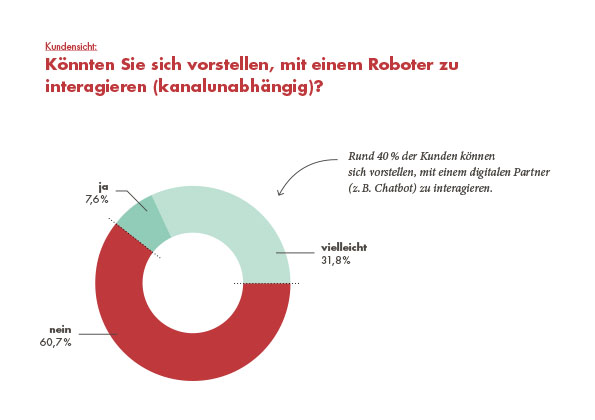
How do customers prefer to communicate with companies? What role do chatbots play in customer service? Which brands generate enthusiasm? In collaboration with the international service provider PIDAS, ZHAW researchers have conducted the most comprehensive study to date on customer service in German-speaking Europe. More than 3,500 consumers and 100 representatives from various companies and industries participated in the survey.Telephone most common - e-mail most popularThe most common channels for contacting a company or public agency are still the phone (50%), email (21%), or in-person interaction at the point of sale (17%). This is despite the fact that the customers surveyed indicate that they prefer email over all other possible contact channels. «If this contact channel were given more prominence, it could certainly offer added value for customers and help improve the service experience,» says study director Kurt Ackermann of the Institute for Marketing Management at the ZHAW School of Management and Law. «From a business perspective, digital media such as live chats, video calls, and messaging services will clearly gain in importance as contact channels in the future.» Companies need to clearly communicate the added value of these new channels and deliver on this promise with a positive service experience.Acceptance of digital communication partnersHowever, many customers remain very skeptical of non-human communication partners. Only 40 percent of respondents can imagine interacting with digital partners such as chatbots or voice robots (of these, 7.6 % said «yes» and 31.8 % said «maybe»). Acceptance is particularly high when the initial contact is made via a digital channel and the issue can be easily resolved. “When it comes to robotics in customer service, channels such as email, chat, and messaging apps should be automated first, before complex and costly voice portals and voice robots are offered,” says Frédéric Monard, CEO of PIDAS. “Robots are largely not accepted because, so far, they have been unable to take more complex emotional needs into account.”
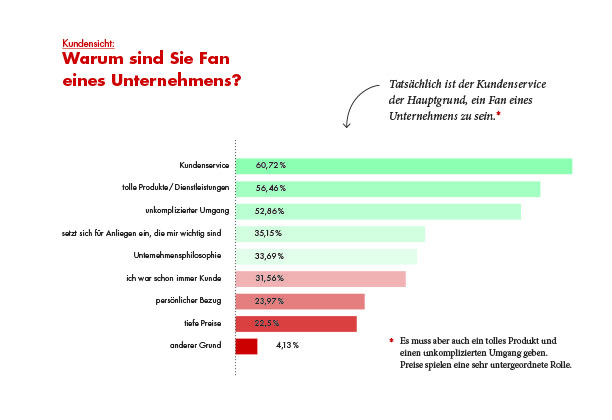
However, it is precisely the emotional component that plays a central role in customer loyalty. Only 21 percent of respondents are enthusiastic about a company or feel a strong sense of identification with it. Customers who describe themselves as fans of a company do so primarily because of customer service (61 %), even more so than because of the products and services (56%). Price, on the other hand, plays a secondary role (23%). Companies sometimes massively overestimate their fan base. «Both the companies surveyed and individuals who do not yet describe themselves as fans of a company believe that it is primarily great products and services that turn customers into fans,» says study director Kurt Ackermann. «In fact, however, good customer service appears to be the decisive factor in turning customers into fans.»In Switzerland, Swisscom, Migros and Sunrise have the most fans among the respondents. In contrast to Germany and Austria, only national companies occupy the top three places in this country. Another indication of the fan rate is the Net Promoter Score (NPS), an index for recommending companies to others. In Switzerland, the banking sector achieves the highest NPS (+43), followed by insurance companies (+34). The energy services industry brings up the rear (+2), probably due to the slow pace of market opening.
Digitization is a matter for the bossPIDAS CEO Frédéric Monard is convinced that consistent digitalization in customer service opens up great opportunities: «Companies that adapt their service model with the right customer focus and intelligently leverage the latest technologies will deliver excellent customer experiences while also gaining significant efficiency advantages.» For Frédéric Monard, however, this transformation doesn’t come without a cost: «Sustainable digital transformation in customer service is challenging; it demands leadership and requires clear priorities that are oriented toward customer value and also address major cost drivers.».For just under 40 percent of the company representatives surveyed, senior management is responsible for driving forward the digital transformation. Nevertheless, responsibility is not clearly defined in one in five of the companies surveyed. Companies see the greatest challenges in reconciling automation and personal customer service, in the compatibility of different technical systems, in the development of corresponding expertise on the part of employees, and in the increasing speed and complexity of developments in this area.