Home shopping sells well in Europe according to study
A study on the home shopping industry in Europe conducted by ERA Europe and Goldmedia shows that, despite fierce competition in e-commerce, the industry continues to grow.


Throughout Europe, home shopping is on a stable growth course: Providers of live shopping, auction TV, and direct response TV (DRTV) are taking advantage of the opportunities offered by digitization and have developed into modern multichannel providers. While classic television was long the most important sales channel in home shopping, the Internet - especially via mobile devices - is becoming increasingly important for sales. Another factor here is that around a quarter of home shopping customers are already motivated to make a purchase by social media. New smart home technologies and, above all, virtual reality (VR) are likely to keep the industry on a growth course: 78 percent of home shopping users in Europe are already interested in product presentations with VR.
These are the findings of the study "The Multichannel Home Shopping Industry in Europe. Market Overview, Key Trends and Forecasts to 2022". The study was prepared by the Goldmedia consulting and research group on behalf of the Electronic Retailing Association. The industry report analyzes current and future developments in home shopping in ten European countries (Austria, France, Germany, Italy, the Netherlands, Russia, Spain, Sweden, Switzerland and the UK). The study also includes an extensive survey of 1777 home shopping users throughout Europe.
The study was first presented at the ERA Europe Electronic Home Shopping Conference in Venice on June 21, 2017.
"The results not only show that the home shopping industry continues to be very strong in terms of sales," emphasizes Julian Oberndörfer, CEO of ERA Europe. "Above all, they prove that their business model, expertise and customers are well equipped for the digital multichannel business and that the industry will continue to be a real growth market in the future."
Market volume: by 2022, sales in the home shopping industry will increase by one-third
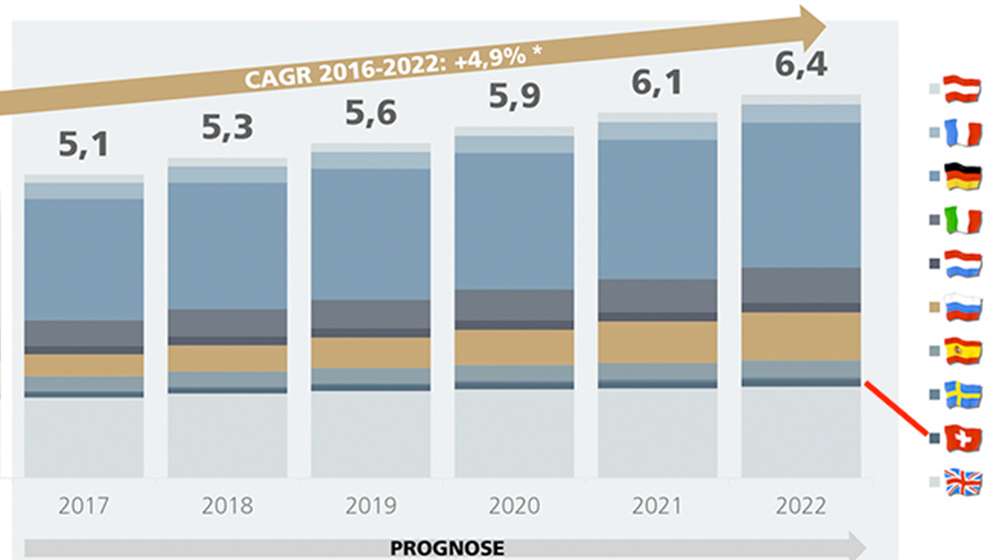
In the ten countries surveyed, providers generated total revenues of around EUR 4.8 billion in 2016. By 2022, revenues will increase by 34 percent to EUR 6.4 billion - a compound annual growth rate (CAGR) of 4.9 percent (see Figure 1).
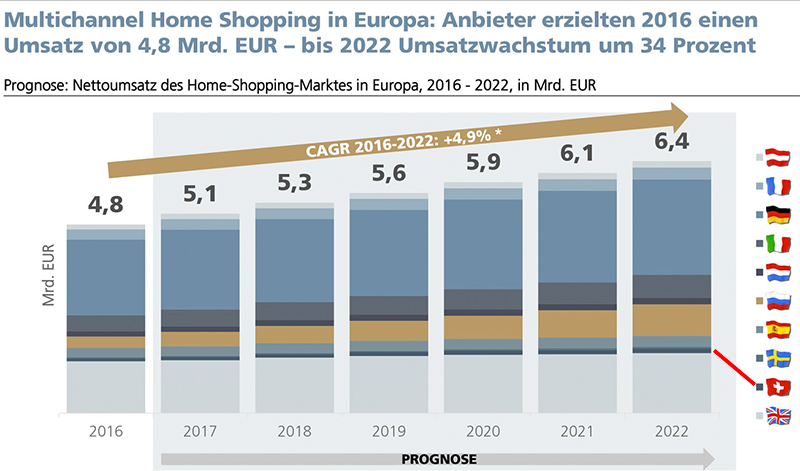
While growth rates of two to four percent are expected in future in the home shopping markets with the highest sales, the UK and Germany, markets with high development potential, such as Russia, will see double-digit growth in the next few years.
Average home shopping sales per inhabitant in the European core markets amounted to 9.20 euros in 2016. Germany leads the way here with 23.40 euros, followed by the United Kingdom.
The study shows that the home shopping industry in the countries surveyed employed around 15,400 people at the end of 2016. This figure also includes indirect employees, for example in call centers.
Distribution channels: shift from traditional TV shopping to interactive multichannel shopping
Today, home shopping providers address their users and buyers via many channels: in addition to TV, primarily via the Internet, via mobile or smart TV app, and through social media. But the retail presence is also important.
The importance of the individual channels varies from provider to provider: While phone calls are still the most important ordering channel for customers of the big live shopping channels, other providers use DRTV shows and infomercials to boost their stationary retail sales.
E-commerce and mobile commerce are increasingly increasing their market share in home shopping. This trend is also intensifying because social media and smart devices are becoming increasingly important: Online business will already account for more than half (55 percent) of the net sales of home shoppers in 2022. 34 percent of orders will then come via mobile channels - more than via TV (33 percent). Although the importance of the TV sales channel and telephone orders via call centers will decline in the future, they will remain an important pillar for all multichannel providers.
Use: Social media is becoming increasingly important for product purchasing
Home shopping is increasingly becoming a digital business. As a result, providers are facing growing competition both from the big players in e-commerce and from the large portfolio of specialized web stores. In addition, more and more typical home shopping elements are finding their way into e-commerce, such as product presentations via video.
Despite a wide range of competition, home shopping retains its great appeal. According to the user survey, customers particularly appreciate the high entertainment value of the offers, the likeability factor of the shows, the information value and the personal character.
As the study shows, the social media presence of suppliers offers great potential for customer loyalty. Social media channels excellently serve typical home shopping characteristics such as personal advice or entertaining product presentation in the home environment. 84 percent of the companies included in the study already pursue social media activities.
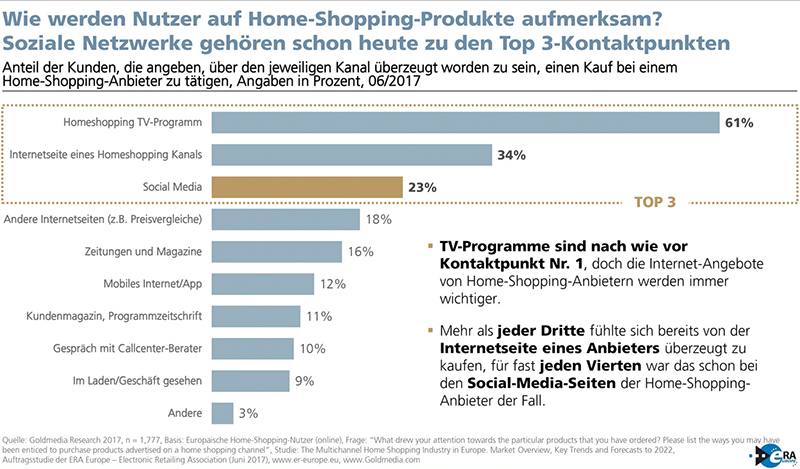
Of the users surveyed, 23 percent said they had been motivated to make a purchase via social media (see chart 2). In addition, the analysis revealed that users who have interacted once with a home shopping provider on social media platforms frequently return, with around 80 percent doing so at least weekly. Facebook is the most-used social medium among home shopping customers across Europe, followed by YouTube.
Home shopping users interested in new technological developments
The study shows that home shopping users across Europe are very open to new trends: 87 percent would like to receive mobile product offers, 84 percent are interested in information via smart TV, and for 78 percent of respondents, ordering by voice control is attractive.
In addition, the user survey proves the relevance of virtual reality for the shopping experience: 78 percent said they were interested in product presentations via virtual reality.