Good harvest in the local market
Since the launch of its new free weekly newspaper regio.ch, Zürcher Oberland Medien has generated 20 to 30 percent more revenue from the local advertising market. But of course the project also generates additional costs.


Konrad Müller, publishing director of Zürcher Oberland Medien, is under no illusions. "Hardly any regional newspaper publisher will be in the black in 2008," he says thoughtfully. The figures in the VSW advertising statistics do not look rosy for the in-house flagship Zürcher Oberländer either: in 2008, the ZO advertising volume fell by 8.4 percent compared to the previous year, and in the first quarter of this year it was even minus 13.6 percent. Of the three regional newspapers that make up the Zürcher Landzeitung association, the ZO is thus suffering the most from the advertising slump.
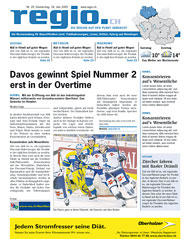
At least that's what it looks like at first glance. However, the VSW advertising statistics do not present the whole truth in the case of ZO. Although the ZO actually had 13.6 percent fewer advertisements from January to April, the title, which generates a good 60 percent of its advertising volume from the regional and local market, ceded some of its local advertisements to its sister title regio.ch, which is only seven months old. regio.ch is the free weekly newspaper in tabloid format that ZOM launched last November in each of the five Oberland regions of Illnau-Effretikon, Uster, Pfäffikon, Wetzikon and Rüti as an independent edition - with exclusively local information and, of course, local advertisements. Right from the start, Konrad Müller had therefore expected that some of the local ZO advertisers would migrate to the new paper. He therefore budgeted the cannibalization effect of regio.ch at 10 to 12 percent.
However, the loss has not been that severe so far. According to Müller, the ZO only lost 5.7 percent of its local commercial volume to regio.ch from January to April 2009. If May is also included, the figure is 7.3 percent, says Müller. However, Müller is particularly pleased: "In the first third of the year, ZO and regio.ch together were able to acquire 29 percent more commercial advertising pages from the local market than ZO and the discontinued regio.ch predecessor titles Kiebitz and Wetziker Spiegel a year ago, and in Swiss francs the figure was 22 percent higher." Even with the rather weak May, the increase in turnover was still 20 percent. And for the first half of the year as a whole, Müller is even expecting 30 percent more local advertising and 25 percent higher sales, because June is going particularly well. regio.ch alone, which deliberately competes with ZO in the local market, has generated an average of CHF 43,000 to 46,000 in revenue per week to date."
However, this does not hide the fact that the 32-page regio.ch, with its five weekly editions, a total circulation of 89,502 copies, its own five-person editorial team and an advertising team with 4.5 jobs, is not self-supporting. Müller is therefore still expecting a loss this year. "But we are making good progress," he says. "I'm certainly surprised at what we're achieving with the paper. I have to pay a huge compliment to the entire regio.ch team." However, he doesn't want to draw a definitive conclusion for another two years or so.
Just how much the ZOM publishing director believes in his youngest child is also shown by the fact that regio.ch will appear on June 18 with a new, more professional-looking layout. "This gives regio.ch more of a newspaper character, and we now have the opportunity to not only open with the main article on the front page, but also to tease additional content," says Müller.
regio.ch is based on an idea that has existed at ZOM for some time. However, the newspaper was launched not least because of the Tages-Anzeiger's regional strategy. "We want to bind the reader market to us and gain additional market share in the advertising sector, especially among small businesses, SMEs and associations. This is how we want to distance ourselves from our competitors in the city of Zurich," Müller explained his project last fall.
At the ZO partners ZürichseeZeitung and Zürcher Unterländer, where the commercial advertising volume from the local market only remained roughly stable in contrast to the ZO, Managing Director Erland Herkenrath is observing the ZO experiment with interest, but also with skepticism. "Apparently, the ZO can exploit the local market much better with regio.ch than before. But it remains to be seen whether the additional turnover of around 20 percent will be enough to cover the additional costs for staff, printing and distribution," he says. A positive aspect, however, is that the joint printing center in Oetwil is better utilized thanks to regio.ch, adds Herkenrath.
Markus Knöpfli
Consideration for the neighbors
ZOM does not distribute regio.ch throughout the entire ZO circulation area: the lower district of Uster and the Tösstal are excluded. The reason: there are similar newspapers in both areas, the Glattaler and the Tössthaler. The Glattaler (46,000 copies) is owned by Zürcher Unterland Medien, with which ZOM is closely associated with the Zürcher Landzeitung. And the Tössthaler, which is published three times a week, is owned by the Turbenthal book printing company. It remains to be seen whether they will one day want to be integrated into the regio.ch concept. Incidentally, a four-color 1/1 advertisement in all five regio.ch editions together costs CHF 2811. (mk)