Television: Breakout from the living room
The digitization of television broadcasting is leading to significant changes in viewing habits. This is shown by the IGEM-digiMonitor, released on December 2 by the Interest Group for Electronic Media (IGEM) and the WEMF.


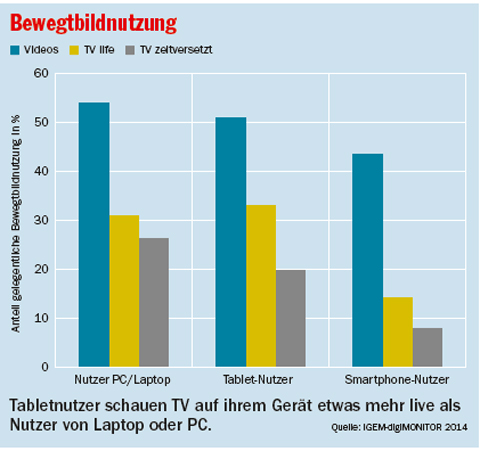
TV programs have finally broken out of the living room. Today, they can be accessed via almost any device and at virtually any time. This is one of the reasons why 90 percent of the population in German- and French-speaking Switzerland watch TV at least once a week via some kind of device. 18 percent do so via their PC or laptop, half as many still via a tablet, and a third as many via smartphone. Of those who use the internet on a smartphone, as many as 14 percent say they watch live TV programs via streaming. This behavior is significantly more popular in French-speaking Switzerland and in the young age group. Among those who access the internet via a tablet, around a third say they watch live TV. Here, there are only significant downward deviations in the 55+ age group. The use of live TV is slightly lower among those who do so via PC or laptop (see chart "Moving picture use") PC or laptop most often serve as a second device because the normal TV set is used by other people. When it comes to watching TV via a tablet, this argument takes second place. Here, it is primarily a matter of being able to watch TV in places or rooms where no TV set is available. The few who watch TV via smartphone do so far most often on the move. But those who have a choice clearly prefer the classic TV set. Among young people, however, a good 15 percent say they prefer to watch TV via laptop or PC.
64 percent of boys also see foreign
Virtually all respondents watch TV at home at least occasionally. Which is hardly surprising. But 42 percent also watch TV with friends and acquaintances. Among boys between the ages of 15 and 34, the figure is as high as 64 percent, while only a good quarter of people aged 55 and older watch TV. But here, too, attention is not always focused on what's happening on the screen. Because the TV set has received competition from the screens of laptops, tablets and smartphones. Around 44 percent use such a second screen at least once a week in parallel to watching TV. Among boys aged 15 to 34, the figure is even more than two-thirds. 40 percent of boys even do this practically every day. However, content related to the TV program being broadcast is rarely found on these second screens. And this is the case in practically all segments of the population. What we already know from the Mediapulse TV panel is that time-shifted use of TV programs is becoming increasingly popular. This is primarily due to the fact that it is becoming easier and easier to use. With Swisscom TV 2.0 plus, more than 250 programs can be used up to 7 days after their first broadcast, without having to make any prior arrangements. As an article by Luca Bringold in the new Media Trend Journal (to be published shortly before Christmas) shows, this is resulting in a major change in usage behavior.
Young people very often watch TV time-shifted
The IGEM-digiMonitor shows that in August/September 2014, just under 40 percent of the population in German and French-speaking Switzerland said they watch time-shifted TV at least once a week. Among young people, the figure is even well over half. Around one-fifth of those who use the Internet via a tablet watch time-shifted TV on it. More than a third of them do this because they do not have a TV set. Those who use the Internet via a smartphone, on the other hand, watch significantly less time-shifted TV. As with live TV consumption on the small screen, the proportion here is also significantly higher in French-speaking Switzerland and among young people. In the use of video on demand, computers are very popular in all sizes. Around a third of the population watches such a video at least once a week on YouTube, an online video store or as a podcast (see "Video on demand usage" chart). The fact that usage via smartphones is higher than via tablet is due to the fact that there are more smartphones than tablets. If you take the effective users of the corresponding devices, the tablet is slightly ahead of the smartphone. If we combine live and time-shifted TV, it becomes clear that usage via alternative devices is still rather low. However, the corresponding chart shows that 18 percent of the total population state that they watch live or time-shifted TV on a PC or laptop at least once a week (see chart "TV usage live or time-shifted via alternative devices").
Ueli Custer