Emotional branding pays off
Emotional branding - the creation of positive brand emotions - is a challenging but also very promising advertising strategy.


A new Australian study, for which Murdoch University, the University of Wollongong and the Interactive Television Research Institute surveyed 1025 consumers, shows that only relatively few brands succeed in arousing strong emotions in buyers. However, brands that manage to do this are clearly preferred - they achieve above-average market success.
The first part of the study looked at the extent to which brands evoke positive feelings in buyers. Brands were surveyed in four different product categories: Men were asked about beer and petrol brands, women about coffee and detergent brands. It was analyzed whether customers trust the brands they buy, whether they feel a connection to the brands, identify with them, see the brands as friends or even love them.
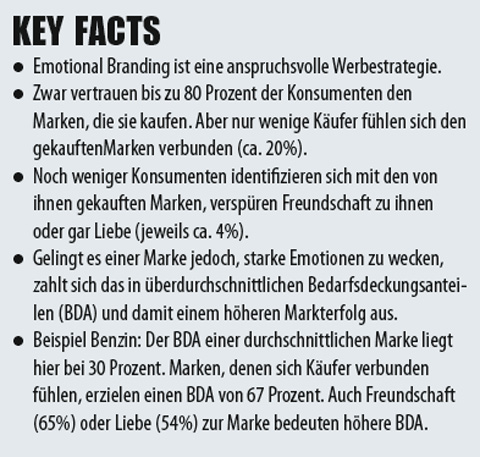
It turns out that only a few brands manage to arouse the stronger emotions - attachment, identification, friendship or love. Only around 20 percent of study participants feel connected to the brands they buy, i.e. they describe the brands they buy as "theirs". Identification, friendship and love are even rarer, with only around 4% of customers feeling these for the brands they buy. The situation is different when it comes to trust in a brand. Four out of five women surveyed trust their detergent brand, for example. Similarly, 69 percent of men have confidence in the beer brands they buy. In short: comparatively many consumers trust the brands they buy. However, only a few brands are able to arouse stronger emotions.
Emotional branding is therefore clearly a sophisticated advertising strategy. This raises the question of whether it is worth pursuing such an approach at all? The second part of the Australian study, which examines how emotions affect consumers' purchasing behavior, provides some clues. The study participants were asked to allocate their total purchasing volume to different brands in the product categories examined. For example, they had to indicate how their expenditure on beer was distributed across different beer brands (= demand coverage percentage, BDA).
The answers show that consumers clearly prefer brands with which they feel connected, which they regard as friends or for which they feel something like love. These brands clearly achieve above-average shares of demand coverage. Brands that are "only" trusted or with which consumers identify, on the other hand, do not achieve above-average BDA. An example: according to the study, men spread their spending on petrol over three brands on average, i.e. the BDA of an average petrol brand is 30 percent. In comparison, petrol brands that arouse strong emotions achieve significantly higher shares of demand coverage: Brands that men feel connected to achieve a BDA of 67 percent, feelings such as friendship or love also result in above-average BDAs (65% and 54% respectively). Strong emotions also have a similar effect in the other product categories. Overall, it can be seen that the degree of positive emotions a brand arouses correlates to a high degree with the extent to which a brand meets demand (correlation coefficient 0.67).
Clemens Koob