The image wizards
Remo Burkhard and Michael Meier can visualize any idea with Vasp.


Vasp is a young, owner-managed visualization agency in Zurich that specializes in complexity reduction and visualization. Behind the label Vasp is the concept "Visual Approaches to Solving Problems". The specialties of the agency with 15 visualization experts are the representation of knowledge and the implementation of unique images. "We can represent anything you can imagine," promise the two heads of Vasp.
Remo Burkhard and Michael Meier studied architecture together in Zurich. In a joint project, they found out "that it works better together than alone". Burkhard was good at simplifying. Meier was good at visualizing. The duo came up with "images and visualizations that are really convincing." To bring this idea to market, they founded a company.
Burkhard always wanted to study architecture, but never wanted to build. During an internship in New York, where he was able to work in the most renowned office for virtual architecture, his enthusiasm took him elsewhere. After seven months in the Big Apple, he knew: "I'm going to do something like that in Switzerland, too!"
Meier chose to study architecture because of his enthusiasm for the versatility of education. He also quickly knew, "I'm interested in revolutionary thinking, not building." You work a lot for the trash in the construction process. In addition, there are very long processes, while Meier was more enthusiastic about the quick projects. One of these was the Arteplage in Yverdon, where Meier was able to build the entire pavilion in 3D during his internship for Expo 02.
So their business idea "to make the best pictures" eventually captivated the two more and more. They were spurred on by the times in which 3D and new computer technologies were becoming more sophisticated all the time. "We became completely immersed in that world." In order to specialize even more, Burkhard added a doctorate on the topic of "knowledge visualization."
To earn the money for his studies, Burkhard did a lot of programming and worked for IBM and in banks. "There I saw that people worked almost exclusively with Excel, PowerPoint and Word," says the then career changer, comparing the business world to the much more visual world of architects. "Here, we worked with sketches, plans, models, 3D images, schematics, films and renderings to develop and communicate knowledge." That's why Burkhard and Meier quickly agreed: "The architects' methods can also be used in other industries - in advertising agencies, government agencies and banks."
How to simplify content? How can you pull the methods of architects into business? How can this lead to greater efficiency and more sales? Around these questions, the business idea of bringing methods from architecture into companies like IBM, ABB, or even banks was born. "We called our approach knowledge visualization." By this, the founders of Vasp Datatecture mean more than just an expanded definition of infographics and illustration. "We are first about complexity reduction, then about using the best visualization method." The megatrend of knowledge visualization, the two are convinced, will soon acquire a similar importance and duty for companies as corporate identity once did.
For Meier and Burkhard, their own company was "a start-up with a dream. Both were only able to inject start-up capital of 1,500 francs each. But the young entrepreneurs quickly got ahead. "We wanted a real company under the Swiss Code of Obligations. Not just a tinkering workshop with a kitchen table and unpaid night shifts and weekend work." Remo Burkhard learned what it takes to position a company properly beforehand in St. Gallen. There, he led the development of a competence center at the university for three years. For their own company, Meier and Burkhard knew: The dotcom crisis was still prevailing - and customers demanded security. Despite the crisis, they opted for permanent employees rather than freelancers and founded a limited liability company in 2003. The first office was a sublet in a consultant network in a prime location in Zurich Stadelhofen. "That's where we got to talk to management consultants during breaks and learned their language on a daily basis."
A first assignment was a 3D game around the Digital Divide. As part of the CH21 impulse program, a learning program for dealing with the Internet had to be designed. The solution was a computer animation as a Flash game. The successful project led to further requests from the training sector. The staff was expanded. "With five people, our customers felt: We are stable and not a one-day wonder." They received requests from corporations and provided internal training. This resulted in a major project for UBS, whereby they developed a modern training concept for training more than 1,000 client advisors. The key was the combination of complexity reduction and visualization. For ETH, their strategy had to be condensed from 100 pages of text to a double page spread. "Big Pictures" is the name given to this technique, in which the essence is presented with complex interrelationships on a poster, true to the motto "A picture is worth a thousand words".
With the growing success, advertising agencies such as Jung von Matt, SFLB, Matter & Gretener, Wirz or Publicis also discovered the creative services of the visualizers. They commissioned the company to implement unconventional image ideas, or seek advice when products that don't even exist yet need to be effectively depicted for a sales brochure. For example, prototypes for advertising in a car showroom or images in the real estate sector with which an architect or developer wants to attract investors for planned projects.
To handle all these growing demands, Vasp soon expanded to ten employees. "Suddenly we were a large company in the eyes of some customers," Burkhard noted with a smile. The growing success eventually led to today's ideal staff of 15 specialists. Because this size also requires a different structure and must be managed differently, Martin Vögele joined Vasp as CEO last November. The final kick in this development was a major project for the Klett publishing house, which is still in progress and involves 400 "completely new types of images.
The versatile agency now has its offices in a loft in Zurich's West End. In addition to 3D specialists and graphic designers, four scientific illustrators and a product designer also work here. It is striking that the young entrepreneurs have integrated "older hands" into their team. The head of consulting has thirty years of management consulting experience. The accountant has weathered a variety of economic storms. "With such a lineup, we simply have broader knowledge," the two young entrepreneurs are convinced. And by taking the pressure off management, they have more time for conceptual and visual work.
Remo Burkhard and Michael Meier are actively involved in all projects. "It's important for our customers that they can have a direct dialogue with us." For example, Vasp can not only explain the possible techniques to an advertiser, but also point out in conversation "how their idea could perhaps be made even more pointed with new techniques." Burkhard and Meier are competent to do this because their company is licensed to distribute "some of the best software programs for 3D" in Switzerland. "This gives us insight into future techniques that our competitors are not yet aware of." For example, in the area of modeling and exposure.
Of course, it is ideal if Vasp is involved in a project as early as possible and is not allowed to deliver "a finished picture" only at the end. "If we can bring in a possible solution with a sketch at the beginning, you're faster later and lose less time and money."
To help interested customers understand this paradigm shift and become better at visualizing themselves, the agency offers courses. In seminars with titles such as "Drawing for Non-Drawers" or "Power Point Doctor," participants learn easy-to-use techniques. "Of course, we also show the worldwide state of the art with current examples, which customers can implement not on their own, but together with us, if they can't get any further with Power Point and Co.", say Burkhard and Meier about their equally useful and ingenious sales idea.
The two also see a future market for their ideas in Asia. As a result of the bank orders, Vasp opened a branch office in Singapore last year. Because of the current financial crisis, however, it is only being run on a shoestring at the moment. Nevertheless, the accounts show that their earlier "dream" of being able to earn money with 3D images has turned into a company in a niche market. The Zurich pioneers are convinced that this is also due to the fact that they had added complexity reduction to the offer early on, which today guarantees half of the revenue. "I believe in our company, otherwise I wouldn't have started a family with three children," says Michael Meier when asked if there is room for anything else in his life besides work. Remo Burkhard cites "travel" as a compensation. But only to big cities and not to nature. "In the big cities, I find this fascinating overlap of endless cultures, information and impressions," he says. And the ideas have to come from somewhere, after all.
Andreas Panzeri
Remo Burkhard and Michael Meier studied architecture together in Zurich. In a joint project, they found out "that it works better together than alone". Burkhard was good at simplifying. Meier was good at visualizing. The duo came up with "images and visualizations that are really convincing." To bring this idea to market, they founded a company.
Burkhard always wanted to study architecture, but never wanted to build. During an internship in New York, where he was able to work in the most renowned office for virtual architecture, his enthusiasm took him elsewhere. After seven months in the Big Apple, he knew: "I'm going to do something like that in Switzerland, too!"
Meier chose to study architecture because of his enthusiasm for the versatility of education. He also quickly knew, "I'm interested in revolutionary thinking, not building." You work a lot for the trash in the construction process. In addition, there are very long processes, while Meier was more enthusiastic about the quick projects. One of these was the Arteplage in Yverdon, where Meier was able to build the entire pavilion in 3D during his internship for Expo 02.
So their business idea "to make the best pictures" eventually captivated the two more and more. They were spurred on by the times in which 3D and new computer technologies were becoming more sophisticated all the time. "We became completely immersed in that world." In order to specialize even more, Burkhard added a doctorate on the topic of "knowledge visualization."
To earn the money for his studies, Burkhard did a lot of programming and worked for IBM and in banks. "There I saw that people worked almost exclusively with Excel, PowerPoint and Word," says the then career changer, comparing the business world to the much more visual world of architects. "Here, we worked with sketches, plans, models, 3D images, schematics, films and renderings to develop and communicate knowledge." That's why Burkhard and Meier quickly agreed: "The architects' methods can also be used in other industries - in advertising agencies, government agencies and banks."
How to simplify content? How can you pull the methods of architects into business? How can this lead to greater efficiency and more sales? Around these questions, the business idea of bringing methods from architecture into companies like IBM, ABB, or even banks was born. "We called our approach knowledge visualization." By this, the founders of Vasp Datatecture mean more than just an expanded definition of infographics and illustration. "We are first about complexity reduction, then about using the best visualization method." The megatrend of knowledge visualization, the two are convinced, will soon acquire a similar importance and duty for companies as corporate identity once did.
For Meier and Burkhard, their own company was "a start-up with a dream. Both were only able to inject start-up capital of 1,500 francs each. But the young entrepreneurs quickly got ahead. "We wanted a real company under the Swiss Code of Obligations. Not just a tinkering workshop with a kitchen table and unpaid night shifts and weekend work." Remo Burkhard learned what it takes to position a company properly beforehand in St. Gallen. There, he led the development of a competence center at the university for three years. For their own company, Meier and Burkhard knew: The dotcom crisis was still prevailing - and customers demanded security. Despite the crisis, they opted for permanent employees rather than freelancers and founded a limited liability company in 2003. The first office was a sublet in a consultant network in a prime location in Zurich Stadelhofen. "That's where we got to talk to management consultants during breaks and learned their language on a daily basis."
A first assignment was a 3D game around the Digital Divide. As part of the CH21 impulse program, a learning program for dealing with the Internet had to be designed. The solution was a computer animation as a Flash game. The successful project led to further requests from the training sector. The staff was expanded. "With five people, our customers felt: We are stable and not a one-day wonder." They received requests from corporations and provided internal training. This resulted in a major project for UBS, whereby they developed a modern training concept for training more than 1,000 client advisors. The key was the combination of complexity reduction and visualization. For ETH, their strategy had to be condensed from 100 pages of text to a double page spread. "Big Pictures" is the name given to this technique, in which the essence is presented with complex interrelationships on a poster, true to the motto "A picture is worth a thousand words".
With the growing success, advertising agencies such as Jung von Matt, SFLB, Matter & Gretener, Wirz or Publicis also discovered the creative services of the visualizers. They commissioned the company to implement unconventional image ideas, or seek advice when products that don't even exist yet need to be effectively depicted for a sales brochure. For example, prototypes for advertising in a car showroom or images in the real estate sector with which an architect or developer wants to attract investors for planned projects.
To handle all these growing demands, Vasp soon expanded to ten employees. "Suddenly we were a large company in the eyes of some customers," Burkhard noted with a smile. The growing success eventually led to today's ideal staff of 15 specialists. Because this size also requires a different structure and must be managed differently, Martin Vögele joined Vasp as CEO last November. The final kick in this development was a major project for the Klett publishing house, which is still in progress and involves 400 "completely new types of images.
The versatile agency now has its offices in a loft in Zurich's West End. In addition to 3D specialists and graphic designers, four scientific illustrators and a product designer also work here. It is striking that the young entrepreneurs have integrated "older hands" into their team. The head of consulting has thirty years of management consulting experience. The accountant has weathered a variety of economic storms. "With such a lineup, we simply have broader knowledge," the two young entrepreneurs are convinced. And by taking the pressure off management, they have more time for conceptual and visual work.
Remo Burkhard and Michael Meier are actively involved in all projects. "It's important for our customers that they can have a direct dialogue with us." For example, Vasp can not only explain the possible techniques to an advertiser, but also point out in conversation "how their idea could perhaps be made even more pointed with new techniques." Burkhard and Meier are competent to do this because their company is licensed to distribute "some of the best software programs for 3D" in Switzerland. "This gives us insight into future techniques that our competitors are not yet aware of." For example, in the area of modeling and exposure.
Of course, it is ideal if Vasp is involved in a project as early as possible and is not allowed to deliver "a finished picture" only at the end. "If we can bring in a possible solution with a sketch at the beginning, you're faster later and lose less time and money."
To help interested customers understand this paradigm shift and become better at visualizing themselves, the agency offers courses. In seminars with titles such as "Drawing for Non-Drawers" or "Power Point Doctor," participants learn easy-to-use techniques. "Of course, we also show the worldwide state of the art with current examples, which customers can implement not on their own, but together with us, if they can't get any further with Power Point and Co.", say Burkhard and Meier about their equally useful and ingenious sales idea.
The two also see a future market for their ideas in Asia. As a result of the bank orders, Vasp opened a branch office in Singapore last year. Because of the current financial crisis, however, it is only being run on a shoestring at the moment. Nevertheless, the accounts show that their earlier "dream" of being able to earn money with 3D images has turned into a company in a niche market. The Zurich pioneers are convinced that this is also due to the fact that they had added complexity reduction to the offer early on, which today guarantees half of the revenue. "I believe in our company, otherwise I wouldn't have started a family with three children," says Michael Meier when asked if there is room for anything else in his life besides work. Remo Burkhard cites "travel" as a compensation. But only to big cities and not to nature. "In the big cities, I find this fascinating overlap of endless cultures, information and impressions," he says. And the ideas have to come from somewhere, after all.
Andreas Panzeri
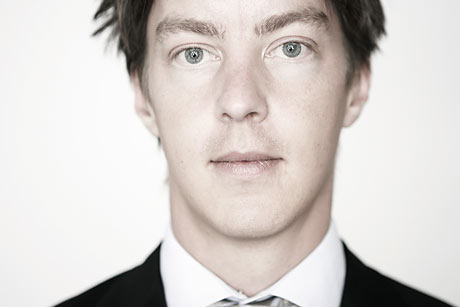
Remo Burkhard.
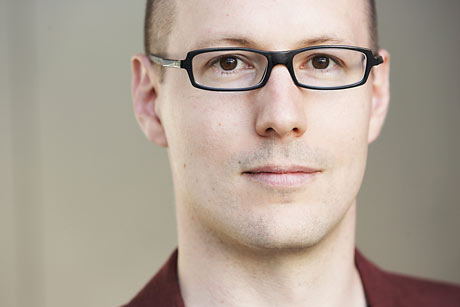
Michael Meier.
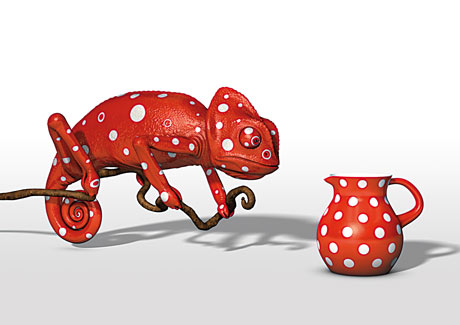
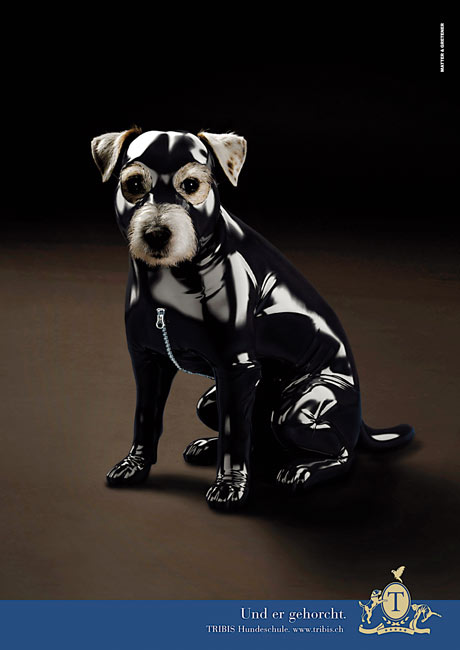
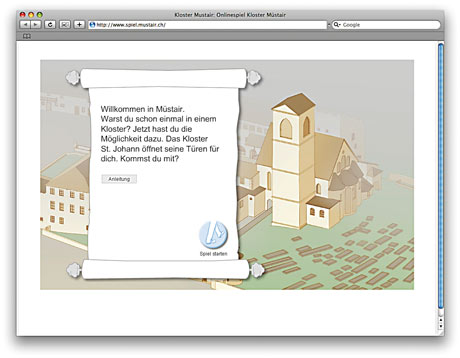
Vasp's work samples show: Virtual photography is predestined to make fantasies and fictions visible. Suddenly, ideas, objects, and content that were impossible to represent, or could only be represented with elaborate composings, model construction, and retouching, become realizable thanks to the computer.
Before prototypes of new products are produced, photorealistic images can already be used for marketing and advertising purposes.
The technology is also successfully used in architecture.