
Analysis of data as a continuous content optimization process


CONTENT MARKETING Martina Garcia* explains how "smart data" can be used to continuously optimize and disseminate content marketing activities.

How can data be used intelligently to optimize content marketing activities?"Big data is a hot topic at the moment. Many companies are focusing on it and hiring analysts who deal exclusively with data, collecting, interpreting and professionalizing it. No wonder that Data scientist one of the sexiest jobs of the 21st century is. New tools are constantly being developed to collect and structure data. Among other things, this data offers huge potential for getting to know your own target group precisely and optimizing and distributing content accordingly and in line with customer needs. A process that I have developed, especially for B2B content marketing, summarizes all the steps that are necessary for the implementation of successful content marketing in B2B. This process requires a clear and differentiating positioning, which is made evident by a clearly recognizable and consistent tonality. This is followed by an in-depth examination of the information behavior and needs of the customer base. This starting point is the foundation for the next steps in the continuous content optimization process, which can build and strengthen customer relationships. "Smart data" is used to continuously optimize and disseminate your own content marketing activities.
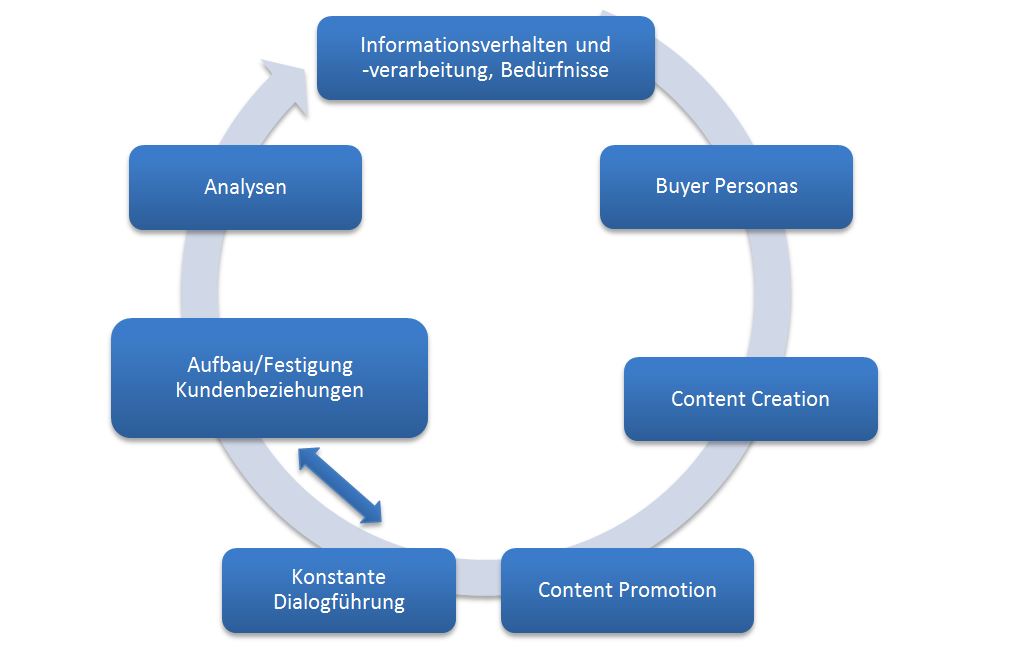
Summarizing the success process in B2B content marketing.People are at the centerThe first step in successfully addressing consumers with content is to examine their information behavior and needs. Looking at the world through the eyes of the customer means knowing what they want, how they think and how they will react to content. In In my last post, I explained the Elaboration Likelihood Model. The model is an approach that serves as a basis for interpretations in relation to the information processing of the relevant target group. In a further step, any know-how and data about the target group should be collected and mapped. If no precise know-how exists, assumptions must be made. Don't worry! Not all buyer persona characteristics have to be exactly right at the beginning, but these assumptions can or should be built on. The buyer personas can be specified during the repeated process.Clear positioning and target definition as a prerequisite for successA clearly recognizable and consistent tonality spans the company's content and all touchpoints with the brand. This unique language is derived from the corporate identity, positioning and brand essence. The resulting recognizable voice helps to differentiate your own content. I highly recommend this article and instructions by Gilles Bachmann, Notice Kommunikation for the development of the brand essence and the resulting clear positioning, followed by the definition of objectives. Content marketers often fail to align these with the company's objectives. It is essential to harmonize the marketing and PR goals with the company's goals. It must be clear what the content is intended to achieve. The clearly formulated objectives and sub-objectives are the basis for concrete implementation measures or instructions for action and contribute to generating sales. It therefore makes sense to break down the goals into sub-goals so that they can be measured. Such sub-goals could be, for example, generating new leads in the B2B sector via LinkedIn, increasing the number of comments on Facebook in order to obtain information about the target group, etc.A brand lives from its customers

Buyer personas help to understand the decision-making processes of target groups.One of the most exciting tasks in content work is immersing yourself in the brains of your target group. Beautiful content is useless if it misses the user and fails to strike the right note. In the digital world, the profiles created for the target group are called personas. These serve to establish a direct connection to real users. Personas are created precisely as fictitious personalities in order to achieve a complete understanding of the target group's needs and requirements. A buyer persona is a personal description of the members of the target group. These are usually several profiles of buyer personas that are to be addressed. They contain a photo, a list of key personality facts, information about everyday activities and backgrounds as well as the topics that these people deal with. And very importantly, how they find out about these topics. Such profiles make it possible to put oneself in the shoes of the target customers and to recognize the circumstances that control the decision-making process. In a further step, the buyer's journey can be created from the buyer personas, which provides valuable information on the touchpoints. One Instructions is clearly illustrated by HubSpot.A clear development of the content marketing strategy helps to ensure a structured, process-oriented and efficient approachFor smaller companies with limited resources in particular, it is advisable to plan them properly and integrate them into the process. When developing the strategy, it is also important to take a look into the future and at the emerging trends in content and inbound marketing in order to incorporate these into the considerations. the web expert Heinz Wittenbrink. However, it is important to reconcile the two. Content marketing serves to convey corporate values that build reputation and trust. A content marketing study by Namics found that 32% of the companies surveyed in Switzerland and Germany have a content strategy, while 45% have a content strategy in place or are planning one. The main reason for the introduction of content marketing is the increasing relevance of search engine optimization. What is interesting about the study is that 84 percent of the companies surveyed focus on the interests of their target group with their content marketing activities, but only 37 percent really address the target groups and their interests.The demands on the quality of content are highThe content must be convincing, unique, convey useful information and know-how and also entertain. The tone of voice must be rational but appropriate to the channel and format, fit the target group and also reflect the positioning of the company. The content must be variable in order to comply with the different rules of the channels. Search engines must also be taken into account. However, this high-quality content, distributed with pinpoint accuracy, can give the company a clear competitive advantage. This is why they need to be given particular attention. The clear rule here is: quality before quantity.You can't have one without the other. The content must also be seen and readThe art of distributing content is to adapt it to the right formats and distribute it at the right time on the buyer's journey. This requires a great deal of sensitivity, analysis and interpretation. I won't go into distribution methods any further in this article because that is a big topic and article in itself.Dialogue as an essential part of the entire process

Constant dialog can strengthen customer relationships.Relationships can be built through interaction between the supplier and the customer, i.e. dialog. Dialog communication has a significant influence on the trustworthiness of service providers. In the case of consulting services, interaction is mainly important because of the individuality of the service. In contrast to earlier transaction marketing, interaction has therefore become a central component of the service together with the product offered, and constant dialog management can strengthen customer relationships and enable further insights and knowledge about the target group to be generated. This continuous generation of information about customers through dialog is an important aspect. After all, if a company engages in dialog with its customers, it will know them by evaluating the customer database and know how they react to certain means of communication.The importance of analysisIn addition to the large amount of data generated via social networks and platforms, it is particularly important to carefully analyze the insights generated from conversations with the target groups on an ongoing basis. These insights are used to continuously adapt and revise the buyer personas and the content marketing strategy, as represented by the summarized success process in B2B content marketing.



