
"Working With Cancer aims to destigmatize the issue of cancer in the workplace."
Publicis Groupe presented "Working with Cancer" at the WEF in Davos in January. With the campaign, the agency wants to better support its employees with serious illnesses and has meanwhile been able to win several partner companies for this. In an interview with Werbewoche.ch, Dr. Alexander Haldemann, CEO Publicis Groupe Switzerland, explains what the initiative is about and what this means for the companies and their employees.


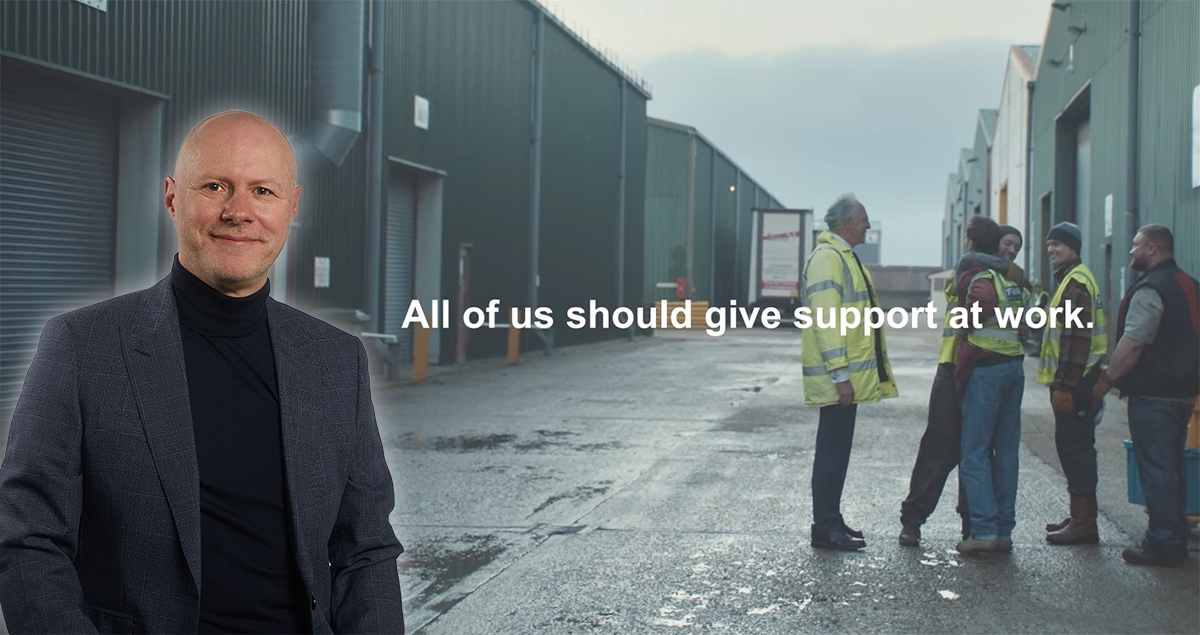
Advertisingweek.chAlexander Haldemann, a month and a half ago, Publicis Groupe presented the "Working With Cancer" initiative at the World Economic Forum in Davos - and announced its immediate implementation. What exactly is the initiative about?
Dr. Alexander Haldemann: Fifty percent of all people will receive a cancer diagnosis at some point in their lives. And again, fifty percent of those with cancer are afraid to share their diagnosis with their employer. These are frightening numbers. The "Working With Cancer" initiative aims to destigmatize the issue of cancer in the workplace and at the same time provide concrete support for those affected in their everyday lives. In Davos, we launched a cross-sector coalition in which companies from all over the world pledge to create the most open, supportive and health-promoting work culture possible for their employees.
The global CEO of Publicis Groupe, Arthur Sadoun, has a very personal connection to Working With Cancer. Last year, he made his own cancer illness public. How did you experience that as the head of Publicis Switzerland?
Arthur Sadoun was enormously open not only with our leadership team, but with all employees and also with the public. We were informed very early and very transparently by him, and in a really personal way. I have a lot of respect for that. For a global, listed company, that is extraordinary. But it is clear that while it may have been challenging for Arthur to talk about his illness, it is probably much more difficult for employees in other positions. How do superiors and colleagues react? What does this mean for my development prospects? And what are the financial consequences for me and my family? And this is exactly where the protection concept of "Working With Cancer" comes in.
In concrete terms, this means that Publicis Groupe guarantees one year's salary continuation in the event of a serious illness.
Correct. Because in Switzerland, daily allowance insurance usually takes effect in the event of prolonged illness, this may not sound all that spectacular at first. But take a look at the USA, for example. Millions of employees there are not entitled to a single day of sick leave! These are people who simply don't get paid if they can't show up for work. It's not surprising that they then often feel compelled to conceal illnesses. This has to stop.
Although the initiative is called "Working With Cancer," it explicitly includes other diseases.
Yes. Within Publicis Groupe, we will open up the program to employees with comparably serious illnesses.
Which companies have already joined?
We were able to attract major global companies such as Adobe, Disney, Google, LVMH, McDonald's, Meta and Nestlé to the initiative at the start. But there are still many more in the process. They decide individually which concrete measures they will take to protect their employees, but by joining the initiative, they show their willingness to send a strong signal for change. "Working With Cancer" thus reaches not only the 80,000 employees of Publicis Groupe, but many millions of people in almost every country in the world. And you said it yourself at the beginning: the whole thing was only introduced in mid-January. A really nice success!
The initiative is supported by a campaign. What goal are you pursuing with this?
Our goal is to destigmatize cancer in the workplace. The campaign "Work/Life" is designed to wake people up and show what cancer patients go through when they hide their illness in their working environment. To do this, with the generous support of our partners, we have a media budget of $100 million - and we created a wide range of advertising assets that were even played at the US Super Bowl. I find the main film, the centerpiece of the campaign, which you can watch on YouTube, particularly touching. Of course, in addition to the broad communication, there is also the personal, concrete dimension. And this is crucial.
What exactly do you mean by that?
If we want to permanently destigmatize serious illnesses in the professional environment, the motto "walk the talk" ultimately applies. Let's assume that someone comes to me one day before a big pitch and says: "Alex, I can't be there tomorrow, something has happened in my family," or "I have to go to the doctor, I'm not feeling well" ... then it ultimately becomes clear whether "Working With Cancer" is more than just lip service. If I in my role - and this is equally true for all other responsible people in our agency group - cannot credibly convey that this is really okay, then even the most well-meaning initiative will fail. Our colleagues are people, not machines. No matter how great the economic pressure may be - how supposedly urgent a deadline. Individual health and that of the family are more important. Categorically.
Even if it's not always easy for managers to block out the business side of things?
Probably no one who is honest would deny that. In a case like the example described above, emotions are always involved: "So now person X is missing tomorrow; what if we don't win the pitch then?" I certainly also get a queasy feeling when I know that a team is already severely challenged - and then someone else drops out. But I have to have the ability to step out of the situation mentally for a moment and abstract from my emotions. I have to ask myself: "What is this all about? actually?" And then we come back to "walk the talk." Actually A person is telling me that he or his loved ones are in a bad way. And I have to find a solution to support this person. If such a culture prevails - at the risk of sounding very idealistic - then companies can become a "safe space. A place where everyone feels comfortable; everyone gives their best. Precisely because they know: People don't just want me here when I'm doing well - they also support me when that's not the case.
The commitment of Publicis Groupe
- We will secure the job, salary level and benefits of all Publicis Groupe employees diagnosed with cancer* for at least one year so they can focus on their health treatment as a priority.
- All Publicis Groupe employees suffering from cancer* receive individualized career support when they return to work.
- All affected Publicis Groupe employees have access to an internal community of volunteers (peers) through the Marcel platform, who are properly trained to provide support.
- All Publicis Groupe employees who care for a sick person in their immediate family receive individualized personal and professional support to manage the flexibility and time management they need to maintain their energy at work and as a caregiver.
*Cancer: Publicis Groupe's commitment applies to employees suffering from all forms of cancer and other chronic diseases and serious illnesses requiring specialized medical care as defined by the country in which they live.


