SEO Trends 2020: What is important and remains important
When it comes to SEO and new trends, people often warn of the upheavals the coming year will bring and discuss unprecedented trends and guidelines that need to be taken into account. From the current perspective, no revolutionary changes are foreseeable for the new year. Rather, existing developments from recent years will continue to be significant in the coming year. But does that mean we can just sit back and relax?


Central to 2020 remains the search engines' effort to understand the intent and interest behind search queries in order to display the best possible result to the user. Google, for example, has been honing this ability for years with regular major updates to its algorithm. In 2013, the Hummingbird update laid the foundation. Building on this, the BERT update is currently being rolled out step by step. BERT stands for "Bidirectional Encoder Representations from Transformers". Simply put, the basis of BERT is an artificial intelligence that is supposed to better understand natural human language. For this purpose, terms of a search query are not only analyzed individually, but also placed in relation to each other. The aim is to better understand the user's intentions and thus display more suitable results. Google shows how this can look in practice in several published examples.
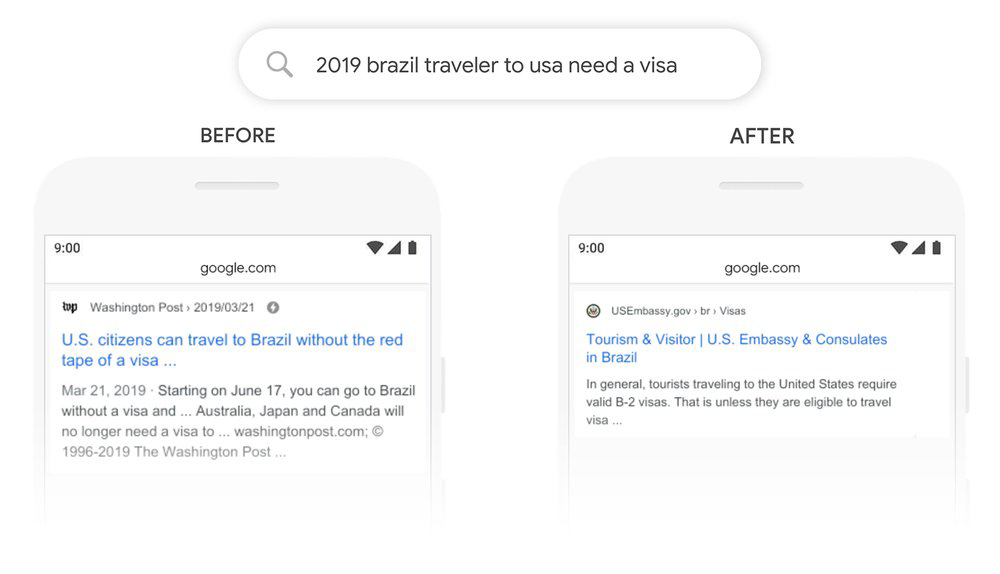
Source: Google Blog
The question you have to ask yourself as a site operator after the announcement of such an update is always the same: Do I have to take action and change something?
Those who already started in 2013 with the Hummingbird update (or even earlier) not to limit their SEO to clumsy keyword optimization, but to put their own target group at the center of their considerations, probably also have little to fear in 2020. The example shown above is a good illustration: The Washington Post will hardly have drawn any relevant traffic from the search query shown here, because it is already apparent in the snippet that the question is not answered here. The consequence would therefore be poor click rates or high bounce rates among those who did click.
If traffic is lost due to BERT, it was usually not of high quality even before. Of course, this can still hit one or the other content-weak site hard and here it is important to catch up quickly and thoroughly. However, those who already offer high-quality and useful content are more likely to profit than lose in 2020. In any case, the central task this year is to view SEO not only as pure keyword optimization or pure backlink building, but as a tool to create holistic digital experiences for the user.
But with speech, please! Keyword Voice Search
On the one hand, changes such as BERT are naturally driven by the demand to be able to deliver ever better results. On the other hand, technical changes and changes in our behavior also play a major role. It can be assumed with a high degree of certainty that one of the reasons why BERT is classified as so relevant (it is assumed that the result is influenced by approximately one in ten search queries) is because users no longer string together just a few meaningful words. On the contrary, in times of growing popularity of voice search, users are getting used to searching in natural language again. The artificial language that search engines have taught us over the years, for example "Pizza Berlin günstig", is becoming a more natural "Ok Google: Where can I find a cheap pizzeria here?
Overall, voice search will remain an important topic this year. Unfortunately, there is still a great deal of uncertainty here even after years, also because many forms of voice search are often lumped together. Optimization for voice depends to a large extent on various factors. One of these factors is whether a search is performed from a desktop or a mobile device. Another is whether the results are output graphically or whether a device such as Google Home or Alexa is used, which usually only generates an audio output. In this case in particular, the provider of the information often has little benefit from his position, despite his ranking at number one: his information is played out, but he generates no traffic, no users and thus no direct earnings.
That is why it is also necessary to check individually in 2020 whether and when voice search can be monetarily exploited at all despite its increasing importance and which optimization measures are therefore target-oriented. Although BERT helps the search engine to better interpret and understand a query, it only has a limited effect on the work of an SEO.
It is undisputed that an important help for Voice Search is the correct implementation of structured data on the website. These small pieces of information, which are not visible to the user, help all major search engines to better understand the information on a website. This is not new information either, but in our daily agency work we still encounter many sites, some of them large, that do not yet use this optimization at all, or at best only in a rudimentary way. Those who are not yet up to speed should kill two birds with one stone in 2020 and make their site fit for both classic search and voice search.
Content (marketing) remains king
The quality of the content is still of paramount relevance. It has long since ceased to be enough simply to present one's products in a good light: It is better to offer helpful content around products and service. Good content helps your own offer to be better perceived, to be ranked with other broader keywords and to position the provider as an expert. As a result, users stay longer on the homepage, build a relationship with the brand, potentially buy more, and return more often. In 2020, content no longer has to mean just text. As in previous years, the trend is clearly toward video and interactive content. The expectations of users continue to rise here and thus change the desired quality of the content: Today, it should offer entertainment, be consumable on the side to serve the surfing behavior of younger users, but at the same time be informative.
To cover all these needs, it makes sense to use the new year to more closely link SEO efforts and social media to better leverage the respective strengths of the channels - but also of the people employed there - to create great content that picks up and engages users. So again, SEO is evolving toward creating a digital experience in which the type of information, its format, entertainment factor, information content, and its design all play a role.
Well functioning and aesthetic infrastructure
From these considerations, it only takes a tiny step to understand that SEO 2020 is increasingly merging with what we commonly refer to as user experience (or, by extension, conversion optimization). It's no longer just the content that has to match the user intent; the implementation of the website and the user experience must also be right. The website must be functionally and structurally well built and optimized for mobile devices, the content must inform and entertain, the design must be pleasing, and the whole thing must have a short loading time: SEO becomes UX becomes SEO, and the various experts should work together more closely in the new year than ever before. Here it may also be necessary to overcome old and long-outdated prejudices in which SEOs ("lots of text, please") and conversion optimizers ("reduction to the call-to-action") are irreconcilably opposed to each other.
If SEO is to develop into a "holistic digital experience," however, it is no longer enough to limit one's efforts to one's own website and to measure its success in Google's organic index. In 2020, therefore, the view must also always reach further outside the box - this also means that the focus is not always only on one's own web presence.
In the meantime, mobile search queries exceed desktop traffic. These increasing mobile searches lead to more search queries with a local reference and thus to an increasing relevance of Google MyBusiness (formerly Google+ local). In addition, the service is also being expanded in small steps so that local service providers, craftsmen, restaurants, etc. can place themselves better and better in the search results here and also integrate time-limited offers, for example. Users often have the option of contacting the restaurant directly, for example, without having to visit the website first. Depending on what the goal of one's own website is, the SEO measures should therefore not be aimed purely at more traffic.
Even supra-regionally, Google MyBusiness is playing an increasingly important role, for example through the integrated ratings. "Being found" can mean in this case that one's own website only plays a secondary role.
The same applies to product-focused searches. Many product-related search queries no longer follow the classic "from Google/Bing/Yahoo/Yandex to website visit" pattern, but start directly on Amazon. So anyone who also offers products via this channel should try to optimize their presence there as well and perform search engine optimization specifically for internal Amazon searches.
The example of Google MyBusiness shows that often not only the traffic is decisive and there are many so-called zero-click searches. More and more frequently, answers are given directly in the search engine and the user no longer even visits the possible target pages. According to a study in the USA at the beginning of 2019, half of all search queries will no longer result in a click.
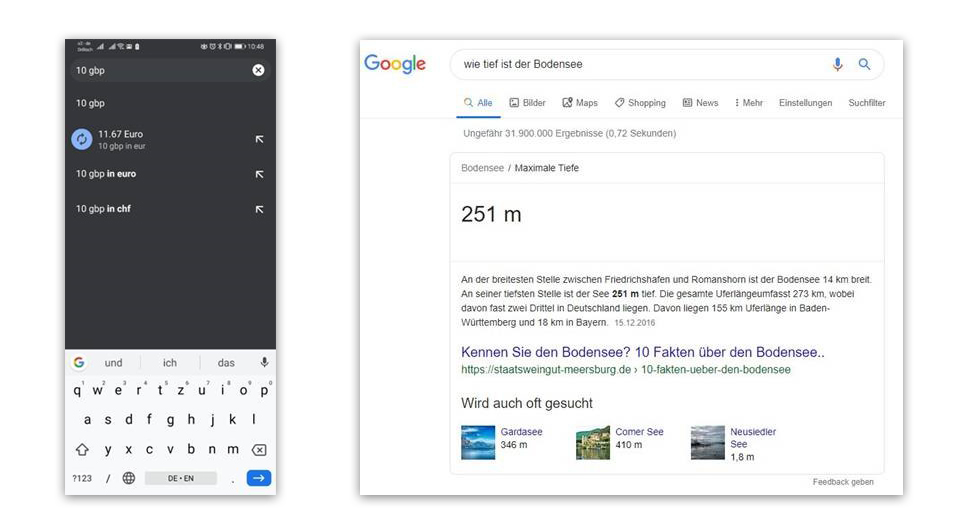
Screenshot on the left: If you want to convert a currency, the result is displayed directly. Screenshot right: The desired information is played out directly by Google. Although the Meersburg State Winery provides the information, it still does not receive a click.
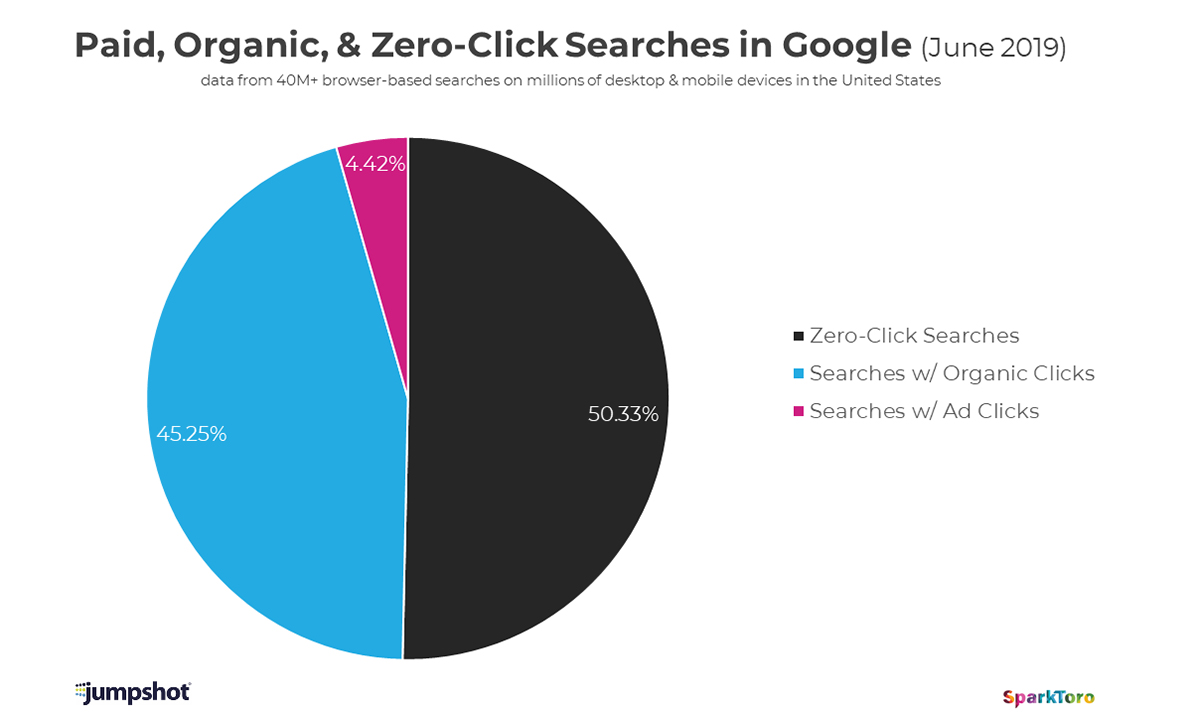
Already half of browser-based searches result in zero-click searches (source: Sparktoro)
Even if such evaluations are always to be taken with a grain of salt, this means for all those who want to bring traffic to their own site that they must no longer align their own keyword and content strategy purely according to search volume, but also according to click probability. Thus, one should specifically search for terms that require explanation and are potentially not directly answered in the search queries, and create more detailed content that offers the user real added value.
Conclusion
Anyone who actually still stuffs texts with keywords, does not have their own page load time under control or whose site still does not look decent on mobile, should urgently use 2020 to bring their efforts in SEO up to a modern standard. In addition, it should be noted that in some cases local SEO is useful to reach the target audience.
Those who were already well positioned in 2019 and have kept their optimizations up to date can start the new year with peace of mind. Nevertheless, the market is not standing still and this year it is also worth investing in the quality of your own content, in technical optimization and ultimately in the quality of the user experience. And of course, you never know what aces Google, Bing and the like have up their sleeves in 2020. The next update is bound to come.
* Swantje Fokken is a PR Consultant at Wordfinder.