Trade and industry media remain the most important source of information for digital decision-makers
Where do decision-makers in the digital sector obtain information and which information sources provide the decisive impetus for making a business decision? To find out, the PR agency Frau Wenk once again surveyed 46 C-level decision-makers about their media usage behavior and compared the results with those from 2017.


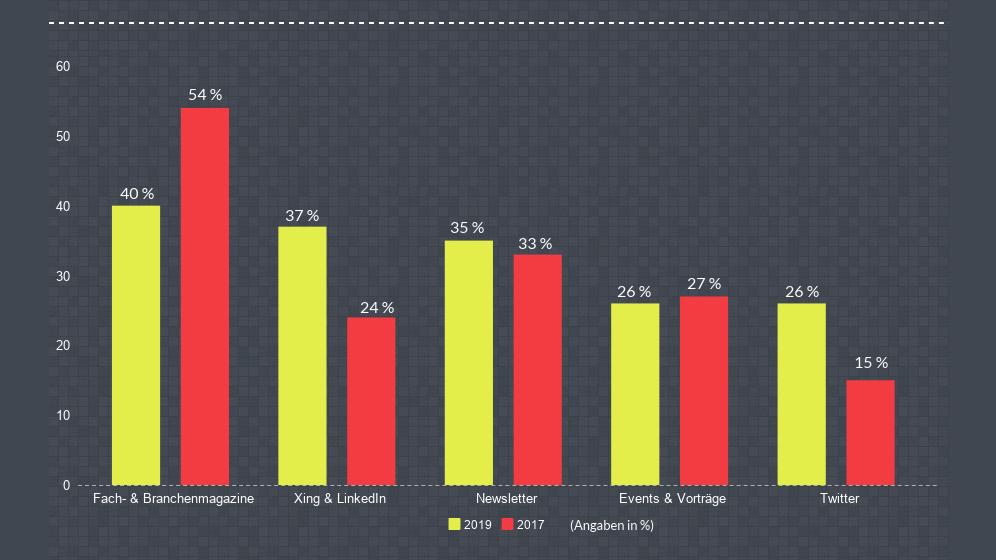
As in the previous survey, it is clear that trade and industry magazines are very important. For around 40 percent, they are the most important source of information. The news feeds of the business networks Xing and LinkedIn (37%) follow in second place among the most important channels for preparing decisions. A further 35% also read newsletters or attend events and presentations (26%).
Leading media and business magazines are also becoming increasingly important for digital managers: one in four respondents regularly read the business press. In 2017, it was only 18 percent. "Digital technologies are finding their way into almost all industries and have become an important success factor for companies. Business magazines are adapting their content accordingly and reporting more and more frequently on the digital economy," analyzes Andrea Buzzi, owner and CEO of Frau Wenk.
A trend from last year is continuing: personal conversations and recommendations provided the decisive impetus for their last business decision, say 45 percent. Xing and LinkedIn are also gaining in importance. "Both networks are ideal tools, especially in the B2B sector, for generating more visibility, building up experts and giving technical products a face. It is therefore becoming mandatory for companies to maintain and professionalize their business profiles on Xing and LinkedIn," explains Andrea Buzzi.
Twitter is also becoming more important for digital decision-makers: a quarter (26%) currently use the microblogging service to stay up to date. By comparison, this figure was only 15% in 2017. Facebook, on the other hand, has lost around seven percentage points and is barely noticed (2%).
The increasing use of Twitter as an information channel coincides with the time component - probably the most valuable commodity for most decision-makers. When asked how and when they find out about business topics, one in two (52%) said they do this every now and then. In addition, mornings and evenings are popular times to scroll through magazines and news feeds. "Especially on Twitter, content is scattered in small portions. This allows you to absorb a lot of information in a short space of time. Companies should make targeted use of these time slots to disseminate their news," advises Andrea Buzzi.
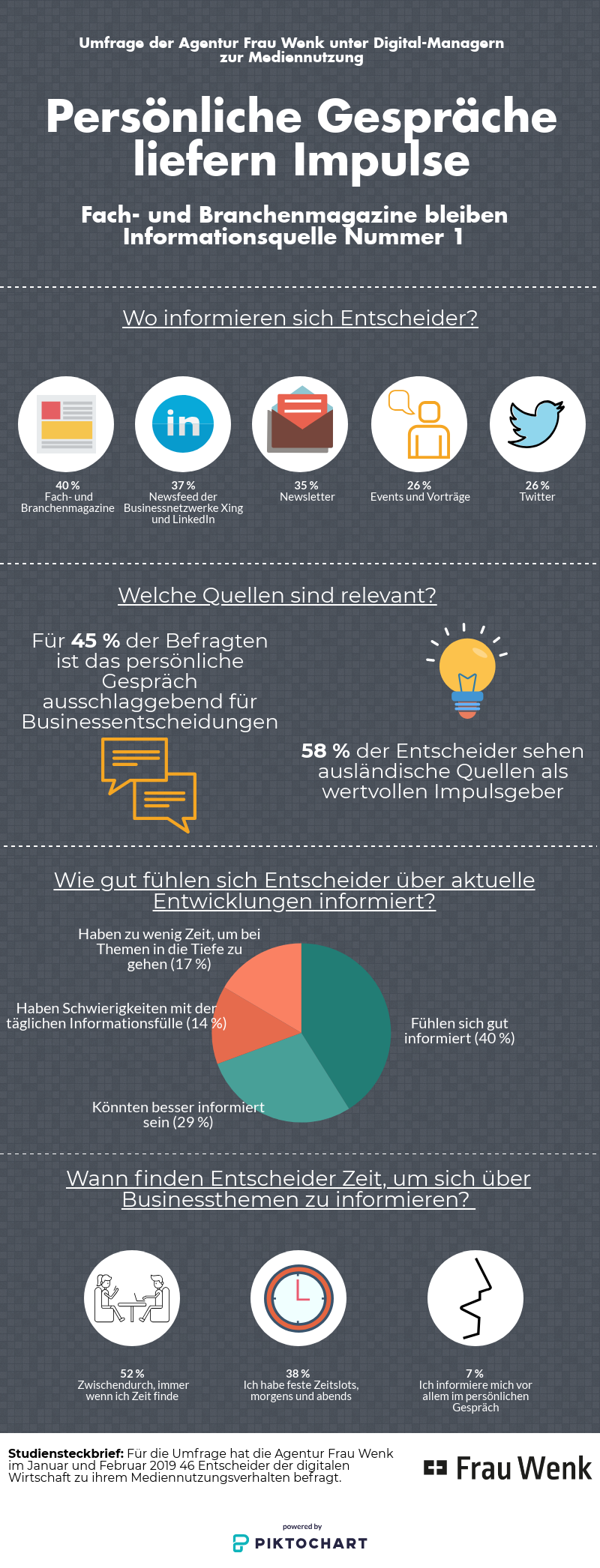
For the survey, PR agency Frau Wenk asked 46 decision-makers in the digital economy about their media usage behavior via an online questionnaire in January and February 2019. Companies from the entire DACH region were surveyed, with the majority of respondents being German decision-makers. Ms. Wenk conducted the decision-maker survey for the first time in September 2017.