The digital transformation: a mammoth task for HR development
In the process of digital transformation, human resources development must support the change process within the company while also transforming itself. This guest article by Machwürth Team International (MTI) highlights that this can often lead to problems in practice.


The digital transformation of the economy and society is in full swing. Personnel development plays a key role in this process in companies. It faces two challenges in parallel:
- On the one hand, it must accompany this cross-divisional and cross-functional change or transformation process in the companies with appropriate qualification and development offers, and
- on the other hand, redesign their own range of services and portfolio by means of modern information and communications technology in such a way that this meets the requirements of the digital age and the desired learning and corporate culture.
Meeting this Janus-faced challenge is not easy - in part because ...
- the process of digital transformation is an ongoing one in which a great many influencing factors, including external ones, have to be taken into account, which is why an agile, iterative approach is necessary,
- as an internal service provider, HR Development is dependent on the cooperation and support of the other divisions in order to meet this challenge, and
- The accomplishment of the above-mentioned tasks also requires a different self-image and a different form of personnel development work.
HR development must also undergo the digital transformation process itself, so to speak, and put its previous thinking and actions to the test and readjust them as necessary in dialog with the other corporate divisions.
Against this background, MTI decided to conduct the study "Digital Transformation as a Challenge in HR Development" in summer 2019. 145 HR managers were asked about the current stage of development of HR development in their respective companies with regard to the challenge,
- actively shaping the digital transformation process in the organization and
- to transform themselves at the same time?
In many companies, the journey has only just begun
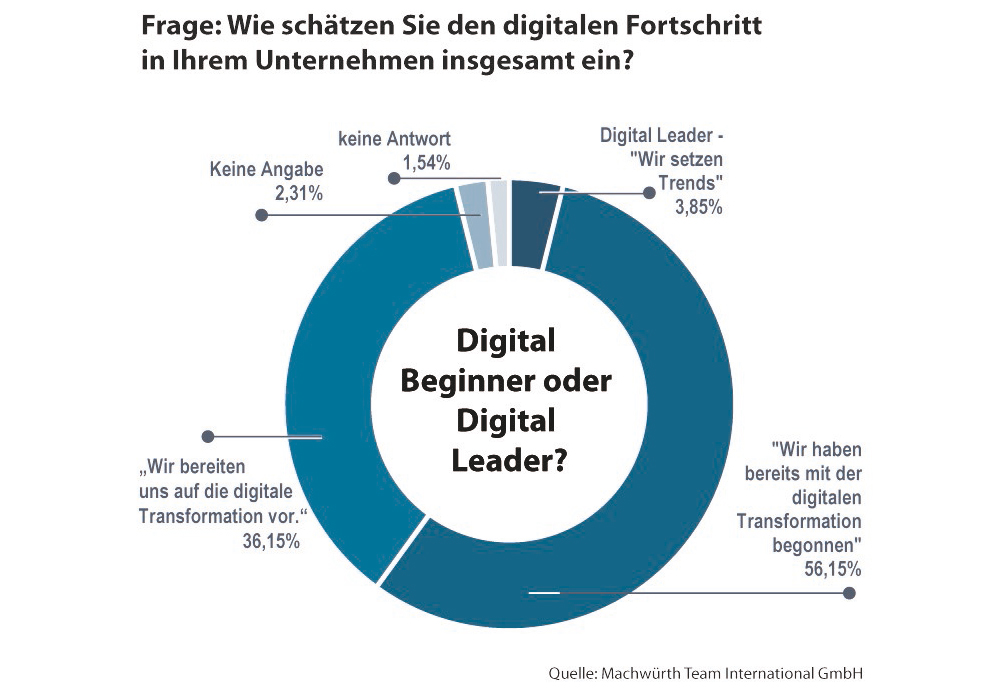
In terms of their status in the digital transformation process, 36 percent of the companies surveyed classify themselves as still at the very beginning. This means that they are already using modern information and communications technology to some extent - like virtually all companies - to solve certain tasks. However, these are largely isolated solutions.
This means that both the business models and processes of companies have not yet been examined to determine the extent to which they meet the requirements of the digital age, nor - if necessary - have they been redesigned accordingly. In addition, it has not yet become firmly established in people's minds across divisions and functions that a paradigm shift is currently taking place in the economy that will require a different form of (collaborative) work in companies, at least in the medium and long term.
Fifty-six percent of respondents emphasized that this process was already underway in their organization - including a strikingly large number of companies from the mechanical engineering, automotive and financial sectors. However, only 4 percent of the companies classified themselves as "digital leaders" who set trends in their industry, for example.
Gap between need for change and doing
Irrespective of this, however, the respondents across all industries generally consider the topic of digital transformation to be important or very important. However, there is a correlation with the size of the company: While many SMEs still classify the topic as a "future topic", the vast majority of representatives of larger companies with more than 500 employees emphasize that the topic is very important.
This is true even if the HR managers surveyed assess their company as not yet having begun the process of digital transformation. In other words, in the eyes of many HR managers, there is a large gap between the need for change that exists in their company, at least in the medium and long term, and the activities they are developing in this area.
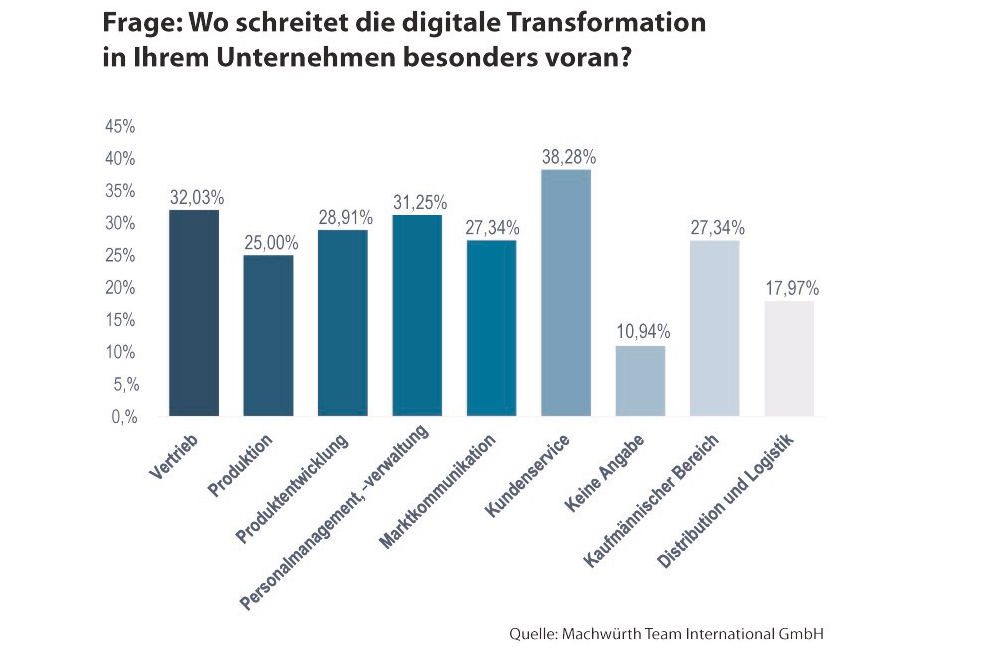
The respondents consider customer service (38 percent) and sales (32 percent) to be the most advanced in this process in their organization. However, human resources management and administration immediately follows in third place with 31 percent.
Human resources departments often drivers of change
This suggests that the HR departments in the companies, and thus also their HR development departments, are definitely among the drivers of change - at least in terms of mindset. However, they come up against organizational obstacles that probably also have their roots in the qualification and competence profile of HR developers.
This assumption is reinforced by the fact that only 13 percent of the survey participants stated that specialists already existed in their company's HR development for digital transformation. 19 percent emphasized that they were in the process of implementing such specialists in their organization.
In other words, HR developers are well aware that their area needs new competencies in the digital field, among other things, if it wants to continue to fulfill its function in the organization professionally in the future and, for example, implement cross-divisional learning architectures that enable employees to learn independently and responsibly as needed.
HR managers see benefits of digital learning
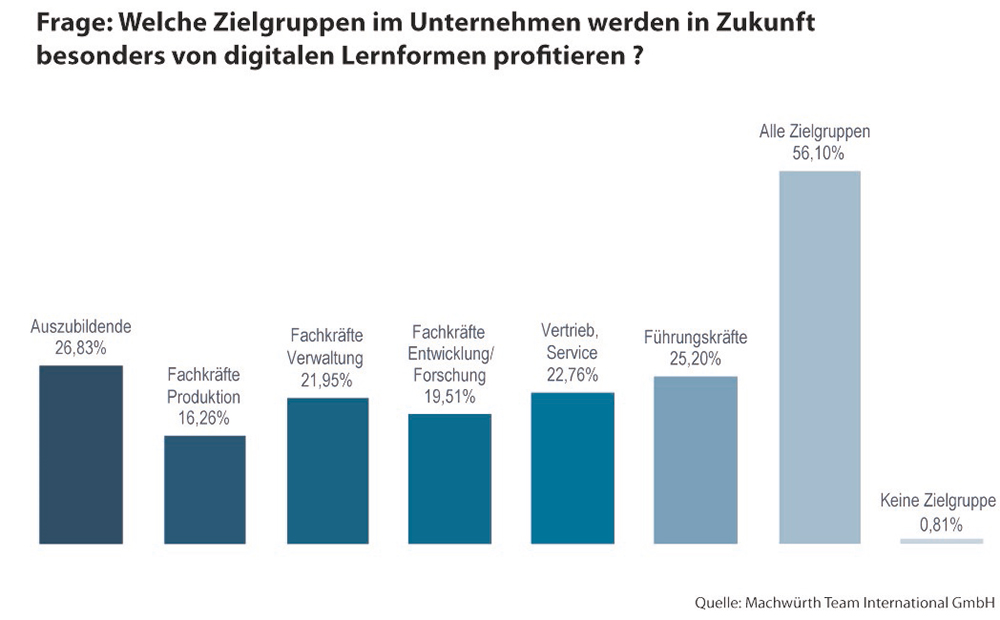
This finding is corroborated by the fact that the majority of HR managers surveyed are convinced that all target groups in the company could benefit from digital learning (56 percent). However, many respondents consider the benefit of digital learning landscapes to be particularly great for trainees (27 percent), managers (25 percent) and employees in service and sales with direct customer contact (23 percent).
In general, HR managers are convinced that all digital learning forms and methods will gain in importance in the future. However, they see the future less in the introduction of individual learning tools and more in networked systems. For example, 66 percent of respondents predict that digital learning worlds (i.e., portals with learning nuggets such as videos, podcasts, and apps for self-directed learning on demand) will become very important, as will 64 percent of e-learning programs that evaluate knowledge acquisition and learning success, for example, with tests.
However, most HR managers - with the exception of those in the automotive and mechanical engineering industries as well as in the financial sector - are still rather wait-and-see skeptical about virtual and augmented reality processes: due to the current state of technological development and because corresponding problem solutions are still very expensive. However, this is likely to change in the near future.
Currently, most HR development departments are primarily concerned with learning tools such as online training and webinars (72 percent) and knowledge tests (68 percent) - primarily for conveying technical and factual content. However, 50 percent of companies, especially the larger ones, already use a learning platform or a learning management system (LMS) to provide learning content and organize learning processes.
HR managers often prefer blended learning concepts
In general, it can be stated: HR experts in companies see the opportunities offered by the digital transformation of HR development. They are also prepared to use modern communications and information technology to further develop their HR development concepts and qualification measures. However, they do not consider online learning to be the solution to all problems.
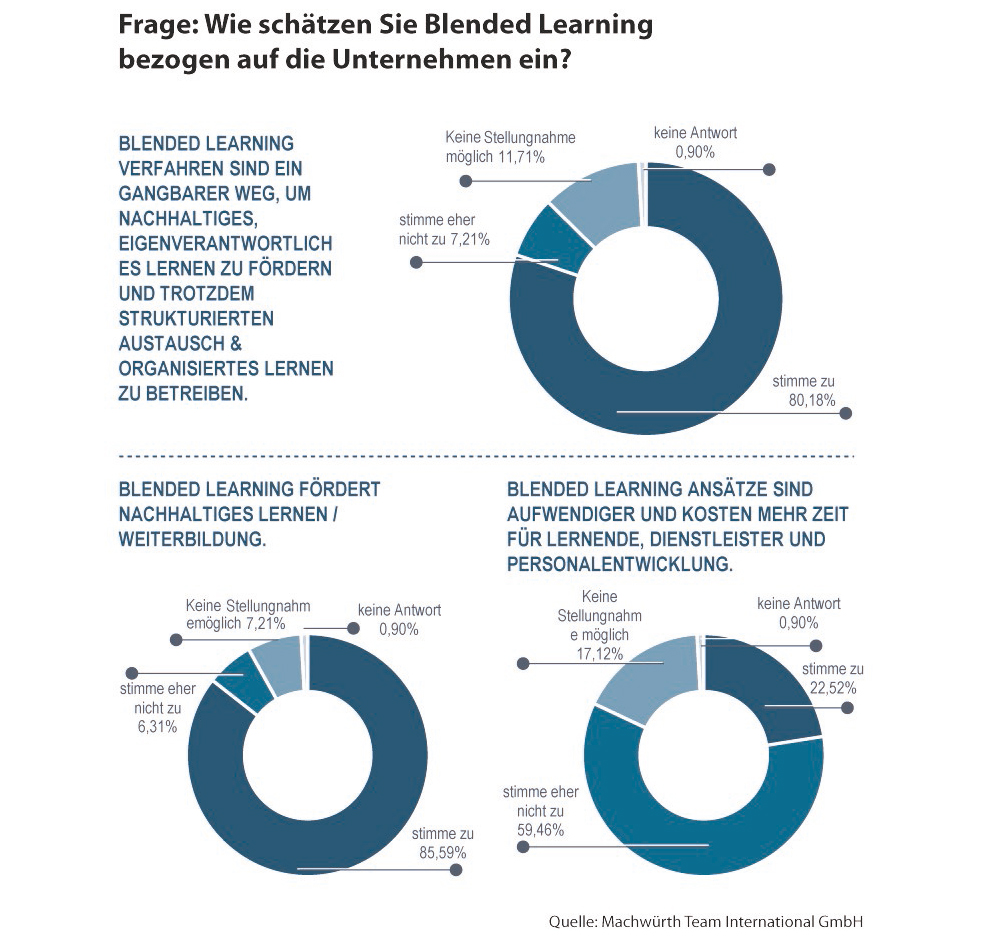
For example, it is striking that HR developers now almost without exception rate blended learning approaches, which combine online learning with learning in face-to-face events, very positively. For example, almost 80 percent of respondents agree with the statement "blended learning approaches promote independent learning" and 85 percent consider them to be a promising way to enable "sustainable personal and organizational learning". In addition, almost 60 percent consider them to be cost-effective.
This broad consensus is certainly also due to the fact that there are now simple tools for combining digital and analog forms of learning. In addition, however, many key positions in companies today are already held by so-called "digital natives" who are very open to modern information and communications technology and use it as a matter of course in their everyday work, for example in the context of projects.
Personnel development is increasingly being confronted by them with the expectation that this technology, which they see as proven, should also be used within the framework of company qualification measures. There, this expectation is also increasingly meeting with a positive response because a generational change has already largely taken place in the personnel development areas as well: Digital natives are increasingly calling the shots there, too.
HR departments need support with implementation
Nevertheless, in the view of the respondents, a key hurdle in the process of digital transformation of HR development in companies remains the internal development of skills. For example, there is often still a lack of the necessary digital consulting skills for the target groups (46 percent). This is probably due in part to the fact that there are still very few people working in HR development in companies who have in-depth IT or general technology expertise as a result of their initial training. In addition to problems with implementation, this can also lead to acceptance problems in dialog with the IT, production and R&D departments, for example, when it comes to topics such as computer- and network-based learning.
At the very least, HR development departments often lack the necessary human resources to shape the transformation process - partly because developing and implementing digital learning offerings is time-consuming (45 percent). In addition, HR managers note deficits in collaboration with IT when it comes to creating the conditions for implementing and effectively using digital learning opportunities in the company (51 percent). If they want the process of digital transformation to progress, company management must also make the appropriate fundamental and investment decisions.
Creating the necessary freedom for digital learning
However, it is important not to harbor the illusion that creating the necessary technical infrastructure will solve another serious problem that HR developers have identified: The addressees in the company often still have difficulties integrating digital learning into their everyday work - because there are usually (seemingly) more important and urgent things to do in it (52 percent).
This shows: If HR development in companies is to change in such a way that it adequately accompanies the change and learning processes associated with the digital transformation of companies, not only is close collaboration between the HR and IT departments necessary. It is also necessary to reflect on the organization of (collaborative) work and to structure it in such a way that employees are not only provided with the necessary infrastructure for online learning, but that learning also takes place in real terms, in the sense of the desired new learning culture.
* Sabine Machwürth and Frank Ninnemann are two of the four managing partners of Machwürth Team International (MTI Consultancy). Björn Ramminger is responsible for market research and the execution of studies at MTI.
As part of the study "Digital transformation as a challenge in HR development", 145 HR managers and experts from manufacturing and service companies were surveyed online. They answered a questionnaire consisting of 14 questions, some of which allowed multiple answers. Two-thirds of the companies surveyed employ more than 500 people. Otherwise, they were SMEs with 50 to 500 employees.