The trade media judges for Epica

3,397 entries were judged at the Epica Awards in Paris. Switzerland won three gold, two silver, and four bronze Epicas. The jury includes trade media outlets from around the world, such as *Werbewoche*.

"It's crazy. It never stops," Peter Brönnimann was delighted when Werbewoche was able to inform the creative director of Leo Burnett Switzerland about the new gold for his Swiss Life phrases. The new edition of the witty wisdom also made it into the discussion for a Grand Prix in Paris. However, after the agency - then still SFLB - had already been awarded this top prize in 2011 for the identical campaign, the jury wanted to be a little more creative in 2013, although it was clear to everyone that "the most sustainable ideas are actually the ones that can be continued endlessly".

Switzerland also won gold in the Film Communication Services category. Swisscom won with the online video "Action Hero". The clip was produced by Swissfilmmakers GmbH, directed by Tobias Straka and filmed by Pascal Walder. Another gold was awarded for a film about the campaign for the new Galaxy S4 at Zurich main station. Who's McQueen Pictures used 13 cameras to create an entertaining documentary about how passers-by were able to win the new smartphone if they could keep "all eyes on the Galaxy S4" despite numerous distractions.

Patriotism with an eye on Germany

The work, produced by Philipp Petersson and Rainer Spix, was also awarded a Gold Edi. At the Epica Awards, however, the entry ran under the German flag because it was submitted by its Berlin home. A film series for Volvo triggered a very emotional discussion within the jury. Forsman & Bodenfors in Sweden have shown a series of - quite literally - sensational films about Volvo trucks. All four films received the highest number of points in the anonymous voting. Nevertheless, the jury ultimately decided against the Film Grand Prix because the films were also a continuation of an existing campaign. This was an argument that some could not understand, as it is a crucial insight in advertising (as with the turnaround sentences) that the best concepts work in the long term and can therefore be revived again and again over the years. In the end, the Film Grand Prix went to Denmark and the small fashion label "Made from cool" for a series of commercials in which Hollywood star Christopher Walken plays a really "cool" role.

The film "Hands" is absolutely worth seeing. The image production for Honda from England deservedly won gold in the animation category. Finally, Swiss silver went to Ruf Lanz with the film "The Kiss" for Delizio Kaffee and Wirz Werbung with Marionnaud "Fragrance Pairs". Bronze went to Leo Burnett Switzerland with the film "Program Guide" for Tele, Wirz for Christoffel Blindenmission and once again Wirz for Tibits "Natural Skylines". Bronze also went to Y&R with the "Merkel" film for SonntagsZeitung. In contrast to most creative competitions, the jury for the Epica Awards is not made up of advertisers and creatives judging their own work, but representatives of the international trade press. The journalists from 19 magazines awarded scores between 0 and 10. In addition to delegates from Lürzer's Archiv (Germany), Brand News (Italy), Kampanje (Norway), New Moment (Serbia), Sostav (Russia), Exchange4media (India) and Press (Poland), Werbewoche also actively participated in the jury in Paris.

Andreas Panzeri

PDF of the article (with pictures)
 

The impact check of Werbewoche November 2013

We show how current campaigns are performing with consumers.

In terms of awareness, the VW ad from the advertising agency KSP Krieg Schlupp Partner came out on top, followed by the ad for Ikea from the advertising agency Wirz and the Valais ad from the advertising agency Contexta. The Tier-im-Recht ad by the Ruf Lanz advertising agency won the Uniqueness criterion ahead of the ad for Pro Juventute by the KSP Krieg Schlupp Partner advertising agency and the ad for the VBZ-Züri line by Ruf Lanz. In the Brand Fit criterion, the Ikea ad won ahead of the Tier-im-Recht ad and the Valais ad. The Tier-im-Recht ad came out on top in terms of likeability, ahead of Pro Juventute and the Züri-Linie.

The Impact Check of Werbewoche November 2013 (PDF)

Detailed results (PDF)

The creativity trainer

How do you find the good ideas? With a lot of training and a little humor, says Chris Brügger. With his company Denkmotor, he gives his customers the creativity kick they need.

Unbenannt-12_14
Photo: Isabel Imper

"Creativity at the touch of a button" is the name of Chris Brügger's workshop. And it starts off in this style right away. Each participant is handed a dowel. "What can you use this for - except to hang a picture?" asks Brügger to the group. "You have two minutes to write down ideas." While some are already starting to take notes, others still seem to be waiting for the brainwave. It's not so easy to be creative "at the push of a button". "Ideas are the basis for business success. Nevertheless, many companies leave the search for and finding of new ideas to chance," says Brügger. Luck, however, plays only a limited role in creativity, he is convinced. Neither does personal disposition. "Creativity can be learned to a large extent. It is a muscle that can be trained."

With his company Denkmotor, which Brügger founded eight years ago together with Jiri Scherer, his business partner, he gives companies and their employees the necessary creativity kick. In lectures, creativity trainings and innovation workshops, he teaches tools that help generate ideas and subsequently evaluate them. Be it ideas for new products and services, for marketing and sales. Whereas Denkmotor used to be booked for training courses, today it's mainly workshops. "Companies no longer want their employees to just learn the theory, but to see a result." For Migros, for example, a workshop generated ideas for a new milk-blend drink. Four variants of the milk-tea mixture were finally on the shelves a few months later. Denkmotor's services are primarily used by larger companies in the service and industrial sectors. In addition to many insurance companies and banks, the creativity trainers have, for example, already equipped a company for eye laser technology with the necessary tools to discover new surgical methods. Brügger draws a circle and a knife on the flipchart. "This pie is to be cut into eight pieces. But you may only cut three times with the knife." Scribbling ensues. After only a few seconds, the first ones put the pencil aside. "And?" asks Chris. A seminar attendee presents his approach. "Okay, good. Did everyone come up with this solution?" Hands go up. "And who came up with more than this one?" Now it's down to two.

If we are not prompted to look for several solutions, we normally settle for one. This "laziness of thought" is quite rational, since it saves resources. Once we have found the fastest way to the office, we always choose the same route from then on. "Creativity, however, means not always taking the same route." Brügger draws a river on the flipchart. "The big body of water flows down the wide stream. That's the routine, the habitual way of thinking. Thinking creatively means leaving the river and branching off into the side streams." To get his clients off the habitual flow of thinking, Brügger works with various creativity techniques. One of them is the stimulus word method. It goes like this: a random stimulus word is chosen that has nothing whatsoever to do with the actual topic. "Magician," "fireworks," or "razor blade," for example. Associations are formed with these terms. If the magic word is "razor blade", it could be "sharp", "silvery", "masculine" or "shaving" etc.. Based on these associations, consider the question again. "The stimulus word method is a powerful trigger for suddenly coming up with novel ideas. "

"What would be the advantage if there were only yellow cars? Write down as many points as possible in one minute. Only advantages, no disadvantages." The best way to find a good idea is to have as many ideas as possible. First, therefore, the focus must be opened wide, says Brügger. It is important to remember that no matter how absurd or unrealistic the suggestions may seem, criticism is forbidden in this first phase. "Doomsayers and skeptics who tell you why something shouldn't work are still plentiful afterwards." However, this very rule is often ignored when creativity techniques are tried out. With consequences. Without organization, the techniques are often unsuccessful. The fact that some people are at war with brainstorming, which is probably the best known, is therefore not surprising to Brügger. Brainstorming is often too unstructured. One person says something, the other criticizes: "That doesn't work anyway, we already tried that last year. "The brainstorming ends in an aimless discussion. In the end, nothing is implemented, everyone is frustrated. "Anyone can look up creativity tools for free on Google. However, that's only half the battle."

If Denkmotor conducts workshops for customers, the goals are agreed with the customer in advance and the procedure is derived from this. It is important to bring the right people and skills to the table. "Creative solutions require both expertise and creativity. Ten experts do not guarantee a brilliant idea. Neither do ten lateral thinkers reinvent the world. It's the right combination that makes it."

What factors work against creativity in a company?

CB: Steep hierarchies and long decision-making paths make it difficult to be creative. It is also not very conducive if there are never any personnel changes in a company. Every now and then, fresh blood is needed. And then there's something else: zero tolerance for mistakes is an absolute creativity killer. Mistakes should not be condemned or swept under the rug. Employees should be motivated to try something out and not just do "business as usual".

What fosters creativity?

CB: Humor is a big concern for me in this regard. A good working atmosphere is a prerequisite for creativity. It has to be possible to crack a joke at work every now and then. In addition, humor gives you easier access to creativity. Creativity and humor have the same systematic approach. In both cases, it's about leaving the usual flow of thoughts and coming up with something unpredictable, something surprising.

Humor has an important place in Brügger's life. "I love his sensitive, intellectual humor more than anything else," says a good friend. At the same time, he describes him as extremely loyal and serious. Brügger's seminars are a mix of both. Well-structured and planned, he nevertheless manages to respond to the participants and react spontaneously to situations. The necessary pinch of humor is not left out.

"Chris Brügger has retained his freshness and liveliness of appearance over many years. He always brings up unfamiliar ways of thinking in a credible way and then also has the ability to develop a solution approach from them," says Jürg Kuster, managing director of BWI Management Weiterbildung at ETH Zurich, where Brügger lectures. "Pick someone from the round and portray that person. Thirty seconds, let's go." Participants begin to draw. "Stop," the time runs out. "Are you happy with the result? ", Brügger asks. The seminar attendees seem less than happy. "Would the picture have been noticeably better if you had had more time?" Shake of the head. "Not everything gets better when you have more time," he explains. "Time frames are very important. You have to know when it makes sense to invest time and when it doesn't." Does Bruegger see himself as creative? "I think I have a flexible way of thinking and finding creative approaches to solutions. In everyday life, I don't get stressed out right away, but quickly find ways to respond to things. Creative in the sense of I am not," he says. The fact that he is sometimes met with skepticism as a "trainer" and "coach" and that he first has to prove himself is not a tragedy for Brügger. "The problem is: many coaches don't limit themselves enough. One makes project management, if the customer Shiatsu inquires, puts one however still another Massage session. There the alarm bells should ring with customers. At Denkmotor, we've clearly staked out our theme and made a good name for ourselves in this manageable pool."

Brügger has no illusions about the long-term effect of his seminars and workshops. "If the techniques learned are not applied in everyday life, the effect fizzles out relatively quickly." Ideally, therefore, a company should implement the techniques in some form or repeat workshops. The creativity trainer is convinced that there is enough potential. After all, creativity is not only in demand when it comes to inventing new products and services, but above all to improving existing ones. "The world is becoming more and more complex and complicated," says Brügger. Technical devices are constantly gaining more functions, and products and services are becoming more extensive and more confusing. But more and more is not always better. "Often, more and more means above all: more time spent, longer employee training periods, more customer inquiries... ". Simplicity is increasingly becoming a competitive advantage.

That's why Denkmotor's newest child is called "Simplicity. Currently, the creativity trainers are assisting a large corporation that wants to undergo a "simplification cure". Denkmotor equips it with the tools to find and walk the path to simplicity. Brügger: "Being complicated is pretty simple. Being simple, on the other hand, is not so easy."

Isabel Imper

Unbenannt-13_9
In a nutshell
Chris Brügger (picture left) is a hotelier and certified quality manager. His professional career has taken him around the world as an international tour guide and consultant to hotel chains in the luxury sector. Eight years ago, he founded his own company Denkmotor with Jiri Scherer, which is dedicated to the topics of creativity, innovation and simplicity. Its client base includes companies such as Credit Suisse, Coop, Daimler, Generali, Helsana, IBM, Migros, SBB, Die Post, Axa Winterthur, Allianz, ABB and Alstom. Chris Brügger is a guest lecturer at two Swiss universities of applied sciences and a lecturer at BWI Management Weiterbildung at ETH Zurich. He is co-author of the books "Simplicity - Principles of Simplicity", "Innovation Management" and "Creativity Techniques". He is also a member of the German Speakers Association (GSA).

torte

Resolution:

The "simple" solution:

1. First vertical cut, cut in half
2. Second vertical cut, quarter
3. Horizontal cut, eighth

kuchen1

Problem: not all pieces are the same (lower pieces with cake base/without icing, upper without base).

Further solution:

1.+2. see above
3. Pile the quarters on top of each other and cut vertically again.

kuchen2
Problem: piling on top of each other could damage the cake pieces

Further solution:

1.+2. see above
3. Arrange all quarters one after the other on a straight line and cut them in half one after the other with the knife.

kuchen3
Problem: None?


Kraftkom: Corporate design for Kibesuisse

Kraftkom has designed a uniform image for the new Swiss Childcare Association Kibesuisse.

The Swiss Childcare Association Kibesuisse, a merger of the associations Kindertagesstätten der Schweiz Kitas and Tagesfamilien Schweiz SVT, promotes the various forms of family and school-supplementary childcare. Kraftkom created a new corporate design for the successful launch of the young association, which is used on promotional and merchandising articles, stationery and the new website.

Responsible at Kibesuisse: Nadine Hoch (Co-Managing Director), Talin Stoffel (Co-Managing Director). Responsible at Kraftkom: Pascale Hoch (Head of Consulting), Natalie De Cataldo (Project & Production Management) Mario Siano (Creative Director), Anja Brönnimann (Graphic Design).

1.kibesuisse.1
1.kibesuisse.2
1.kibesuisse.3

TBS: Campaign platform for Hawa product innovations

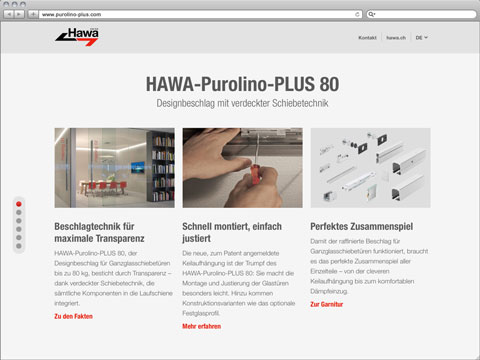
TBS & Partner has developed a campaign concept designed to enable Hawa, an internationally active manufacturer of sliding hardware, to communicate its products in a consistent and modern way through a new platform.

The Platform is used for global communication, both for the launch of new Hawas products and for the relaunch of existing ones. The current campaign is promoting the HAWA-Purolino-Plus 80 all-glass fitting - further product launches will follow soon, the press release announced on Thursday.

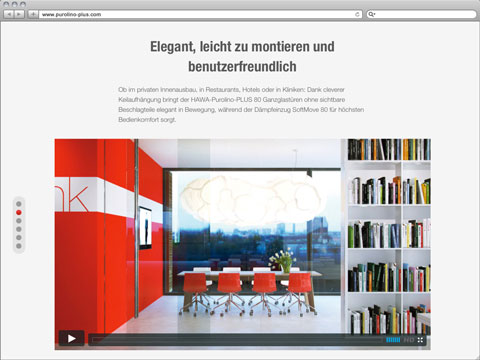
The TBS campaign concept uses classic and online communication channels simultaneously: the advertisement and direct mailing direct interest directly to the product itself. From there, users are directed to the microsite via a QR code. To ensure a high recognition value across all channels, the microsite incorporates the visual elements of the mailing and advertisement.

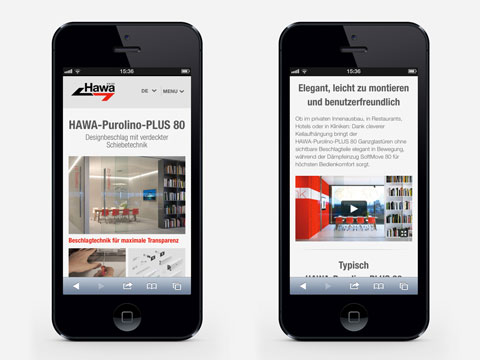
The structure of the campaign also takes future uses into account. For new launches or a relaunch, communication can be orchestrated according to the same pattern - with a uniform look & feel and consistent content structure. The microsite is also equipped with responsive design technology, which means that the layout of the website automatically adapts to the respective output device.

Responsible at Hawa: Rolf Arnold (overall responsibility), Viola Hofmann (project management). Responsible at TBS & Partner: Beat Aeschlimann (overall responsibility), Michael Schädelin (concept), Thomas Geissberger (AD), Franziska Binz (AD), Federico Mazza (graphics), Nadia Ermert (polygraphy), Gregor Herzig (text), Amir Ferhatbegovic, Marlen Gassler (consulting/project management), Tom Bütikofer (highfive, programming).

1.hawa_.1
1.hawa_.2
1.hawa_.3
1.hawa_.4
 

Class instead of mass

Patrick Zanello, the longtime head of advertising and marketing at Ringier Romandie, has founded a new marketing company for television and digital media. His representative in Zurich is Goce Nikoloski.

Unbenannt-11_14

WW: What distinguishes News and Sport Factory SA from other marketers?
Patrick Zanello: We have a special positioning because we work for niche channels and niche media. For us, it's not about the size of the channels, but about specific and high-quality content. That is our priority. When I left Ringier, I wanted to work for a smaller company. I want to be close to the customers, but also close to the broadcasters. Quality content is very important to me. There is a place for the qualitative marketing of different target groups, e.g. for cosmetic products, the automotive industry, banks and insurance companies. In print, there are ideal titles for these target groups. It's not so easy on television.

WW: Television is primarily a mass medium ...
PZ: That's only partly true, there are countless niche channels that cover interesting target groups and also allow for storytelling. It's also about credibility. Today, you can find enough cases where a Chanel product or an Audi is advertised in the same commercial break as a discount store or a cheap fashion line. That makes no sense. It's not about reach or meaningful placement, but about reach and meaningful placement. I think advertisers prefer the second option.

WW: Do the small transmitters provide enough power?
PZ: It depends on how you market them. A single small channel can't deliver the performance, but several small channels with an aggregated offering can deliver interesting performance for customers and agencies. Today, ROI is very important. So we have to deliver good performance. But this is only possible with aggregated offerings.

WW: What do you offer specifically?
PZ: We have two types of offer. One is the aggregated offering with good services. The second type of offer is then topic-related. Topics can be, for example, the next Olympic Games or the WEF. For the WEF, for example, we can make a good offer with different channels. There are customers, for example the watch industry, who are looking for just such a qualitative environment - the quantitative performance is then secondary.

WW: What kind of channels do you market?
Goce Nikoloski: When observing the market, we quickly realized that practically all entertainment channels have already been developed. But we also realized that there are very attractive channels in the news, sports and culture sectors that had not been marketed before. Hence the name of our company: News and Sport Factory. Patrik Zanello: We market the Swiss advertising windows of BFMTV, a French news channel, Escales TV, travel documentaries, Eurosport (German-speaking Switzerland) and Golf Channel France. It was important for us to also have a Swiss channel on offer, it is the Swiss television channel CHTV. We also market the Swiss traffic of the online and mobile offerings of the corresponding channels and Euronews. We do this in collaboration with Romandie Network. There is also SPORTAL HD, a sports web TV channel that will be launched next year.

WW: Despite all the qualitative aspects, media agencies and clients also want performance data. What is the situation there?
GN: We work together with Mediapulse. As far as the advertising market is concerned, we aggregate the usage data within a time slot in a pool, but each channel can be booked individually at the advertising block level. We currently have our own planning tool. However, we are planning to work with Publiplan in the second half of 2014. PZ: The collaboration with Mediapulse is important for us. We can't work without these figures.

WW: You are now starting with these five channels, what's next?
PZ: We think that we will be marketing seven to eight channels by the end of 2014. However, the channels' online and mobile offerings are also important to us. So we also offer video ads on the broadcasters' corresponding sites. The future will be digital; we cannot limit ourselves to television alone. We can put together attractive offers with TV and digital.
 
Interview: Pierre C. Meier


Schneiter Meier starts with SBB Real Estate

Schneiter Meier is repositioning the retail offerings at the Bern, Basel, Zurich, Lucerne, and Geneva train stations for SBB Real Estate and replacing Railcity. First stop: Bern.

Bern was the first train station in Switzerland to relaunch its shopping offer. Next to the existing blue passenger world, the new red shopping world is being built. Schneiter Meier developed the brand system and the brand design and, together with specialized partners, implemented all signaling and marketing communication measures for the launch at Bern station. In November, the Basel and Lucerne stations were also converted. In 2014, the stations in Zurich and Geneva and others will follow. In a second step, parts of the brand system will be transferred to a further 27 stations such as Winterthur or Lausanne, according to the statement.

SBB_Grossbahnhof_Bern_1
SBB_Grossbahnhof_Bern_2
SBB_Grossbahnhof_Bern_3
SBB_Grossbahnhof_Bern_4
SBB_Grossbahnhof_Bern_5


Lamunière sells Tamedia stake

Pierre Lamunière, a publisher from French-speaking Switzerland, has sold nearly his entire stake in the media company Tamedia. Lamunière will, however, remain on Tamedia's board of directors.

Michel Preiswerk, Managing Director of Edipresse Group, confirmed a corresponding report by Handelszeitung to the SDA news agency on Wednesday. Almost all of the 250,000 registered shares that Lamunière received from Tamedia have been sold, Preiswerk said. These registered shares represented less than three percent of Tamedia's total share capital. On October 30, the SIX Swiss Exchange published a sale of 246,730 registered shares for a total value of CHF 25.98 million. As Lamunière was a member of the Board of Directors, the sale had to be published.

The only thing Edipresse managing director Preiswerk said about the buyers was that they were "several private individuals". The reason for the sale was that the investment was no longer of a strategic nature in the medium term. There are no changes at Edipresse. Although Edipresse publisher Pierre Lamunière sold the Swiss newspapers such as 24 heures to Tamedia, he retained the international magazine business. With the takeover of 12 paid daily newspapers from Edipresse announced in 2009, Tamedia became one of the largest Swiss media houses. (SDA)

Picture: Tamedia

Good prospects for the medium of radio

A Publicom survey of experts shows that, despite new digital threats, private radio will maintain its place in the Swiss media landscape. However, broadcasters must focus even more on regional content and invest in editorial quality.

Since the early days of local radio, the media landscape in Switzerland has changed radically, and in the face of personalizable streaming services and other digital offerings, radio faces further challenges. Radio, however, will maintain its place in the media landscape in the coming years. This is primarily because of its diversity and its functions as an ideal accompanying medium. At least, this is how the vast majority of the Delphinarium expert panel sees it. However, there are also a few words of warning mixed in with the positive basic mood. Concerns include the declining interest in the medium among young people and the general fragmentation of media offerings and use. The Delphinarium also takes a positive view of the role of private radio stations in the Swiss media landscape: almost three quarters of those surveyed believe that they contribute to the identity and independence of the regions. The experts see the greatest opportunities for equipping themselves for a successful future in continuing to focus on the regional and in improving editorial quality.

Fee splitting would have to take performance into account

The fee-splitting system, which was highly controversial at the time, met with overwhelming approval in the expert panel, but the fee shares should be allocated according to performance criteria instead of regional structural characteristics. In addition, the 19 million francs in license fee money currently allocated to private radio stations is considered sufficient. There are only isolated calls for an increase.

Teaser image: Keystone

JWT/Fabrikant: Swiss stars against violence

A social media campaign by JWT/Fabrikant and other agencies is mobilizing Swiss celebrities on behalf of UNICEF to combat violence against girls.

Big Zis, Emel, Heidi Happy, Francine Jordi, Anna Känzig, Eliane Müller, Sina, Lyn M. and Angie Ott are committed to Unicef - by doing what they do best: singing. In many parts of the world, girls have no chance. They are neglected, killed, aborted. Just because they are girls. According to Unicef estimates, around 100 million girls and women are "missing" worldwide. JWT/Fabrikant Zurich is sending a clear signal against this on behalf of Unicef. "We were looking for alternatives to get younger target groups interested in Unicef's work. With this social media campaign, we can do both: activate and inform about an issue that is close to our hearts," says Elsbeth Müller, Managing Director of Unicef Switzerland, summing up the benefits.

The product developed by the agency to encourage users to donate is also the centerpiece of the multichannel social media campaign: a touching, stirring song in which nine Swiss singers raise their voices - against the senseless death of girls. Produced by the successful composer Roman Camenzind, "Echo" describes the anxious moment of birth, when a mother learns that she is going to have a girl. It describes the absence of a family member and how the family represses this. And he asks what could have become of the missing girls if they had lived.

Via a teaser video seeded on all well-known blogs and social media platforms, users are taken to the campaign website Echo-of-the-girls.chwhere they can watch the music video and download the song for a donation starting at five francs. There is also a making of, interviews with all nine stars and detailed background information about Unicef's local education programs, which aim to break the spiral of poverty and discrimination.

JWT/Fabrikant manages the overall implementation and all agencies involved. The Zurich PR and communications agency Open Up is responsible for the conception and implementation of media relations in online and offline media as well as radio and TV. The promotion of the singers and the song on the radio is handled by the agency Das Office. The microsite was realized by Netzbarkeit and Kampaweb.

Making Of music video:

//www.youtube.com/watch?v=y08lmanEsXY

Teaser video of the campaign song "Sorry I am a girl":

//www.youtube.com/watch?v=uAOct2u-QsE

Teaser for the current Unicef campaign:

//www.youtube.com/watch?v=J6q2Dt4PXbc

Responsible at Unicef: Elsbeth Müller, Managing Director / Elisabeth Karagiannis, Head of Communications. Responsible at JWT/Fabrikant: Remy Fabrikant (CEO) / Michele Salati (Creative Direction) / Heinz Helle, Lars Haensell, Urs Zwyssig (Text) / Martin Bettler, Cagdas Cakmaktas (Art Direction) / Jochen Hennecke, Ute Schäfer (Consulting) / Daniela Berther (Art Buying) / Adrian Huwyler (Digital Direction) / David Guntern (Production). Responsible at Open Up: Patrick Preuss, Rahel Perrot (Consulting). Responsible at Das Office: Claudia Boggio. Responsible at Hitmill: Roman Camenzind (producer), Pele Loriano (songwriter/producer). Responsible at Playground Media Productions: Rudolf Isler (Production Manager). Responsible at Canada, Barcelona: Laura Estorch (Production), Roger Guàrdia Torrents (Director), Robert Batholot (Photographer). Responsible in case of networkability: Bruno Elmer (wireman). Responsible at Kampaweb: Miro Dietiker (CTO).
 

Eurobest: The first shortlist places are here

The first shortlists have been announced for the Eurobest creative festival in Lisbon. Seven Swiss agencies are in the running. 

eur

The "Eurobest European Festival of Creativity" recorded over 4,700 submissions this year - 237 of them from Switzerland. The first shortlists were announced at the start of the three-day festival. Seven agencies from Switzerland have secured places. The Garnier campaign by Publicis for L'Oréal and the Swiss Life subjects by Leo Burnett are particularly well represented. Havas Worldwide, Jung von Matt/Limmat, Draftfcb/Lowe, Advico Y&R and Wirz are also in the running. 

Two shortlists are still outstanding: "Craft - Film" and "Integrated". 
All lists and further information can be found at Eurobest.com.

Swiss shortlist places


Category Agency Title Customer
Print Publicis  Blonde L'Oréal
  Publicis  Black L'Oréal 
  Publicis  Red L'Oréal
  Havas Worldwide La Mer Zurich Chamber Orchestra
  Havas Worldwide Midsummer Nights Zurich Chamber Orchestra
  Leo Burnett Everything we need Swiss Life
  Leo Burnett Most important thing Swiss Life
  Leo Burnett Once Swiss Life
  Leo Burnett The End Swiss Life
Outdoor Publicis Blonde L'Oréal
  Publicis Black L'Oréal
  Publicis Red L'Oréal
  Leo Burnett Billboard Memory Sihlcity
  Leo Burnett Everything we need Swiss Life
  Leo Burnett Most important Swiss Life
  Leo Burnett Single Swiss Life
  Leo Burnett The Baby Swiss Life
  Leo Burnett Once Swiss Life
  Leo Burnett The End Swiss Life
Interactive JvM/Limmat Digital Newspaper Holder NZZ
Direct Draftfcb/Lowe The Fastest Christmas Song BMW (Switzerland)
Media Draftfcb/Lowe The Fastest Christmas Song BMW (Switzerland)
Design Advico Y&R ADC Yearbook 2013 ADC Switzerland
  Wirz Shadow Faces Christoffel Mission for the Blind
  Wirz Picnic bag Tibits
  Leo Burnett The Swiss Wrestling Emmentaler Emmentaler Switzerland
Craft: Print & Poster Leo Burnett Everything we need Swiss Life
  Leo Burnett Most important thing Swiss Life
  Leo Burnett Once Swiss Life
  Leo Burnett The End Swiss Life
  Havas Worldwide La Mer Zurich Chamber Orchestra
  Havas Worldwide Midsummer Nights Zurich Chamber Orchestra
  Publicis Blonde L'Oréal
  Publicis Black L'Oréal
  Publicis Red  L'Oréal
Film Advico Y&R Nurse Merkel Sunday newspaper
Radio Publicis Opel Renault Suisse
  Publicis Ford  Renault Suisse
  Publicis Peugeot Renault Suisse
  Publicis VW Renault Suisse
  Draftfcb/Lowe Theater Rigiblick plays the traffic news (2x) Theater Rigiblick
  Draftfcb/Lowe Theater Rigiblick plays the weather forecast (2x) Theater Rigiblick

RSI with new director

The Ticino Radio and Television RSI gets a new director. The regional council of the Corsi appointed a successor for Dino Balestra on Tuesday evening. However, the name is not to be announced until December 13.

The final decision rests with the Board of Directors of SSR SRG, the regional board Corsi said in a communiqué. The board will not meet until December 13 in Bern. Any speculation about names in the media would be neither confirmed nor denied until then. According to Ticino daily newspapers and online media citing unofficial sources, the regional council is said to have appointed the current RSI head of information Maurizio Canetta as his successor.

Dino Balestra, who celebrated his 65th birthday last year, is retiring. He will remain director of RSI until May. He has been at the helm of Ticino Radio and Television since 2006. The regional council's meeting in Lugano on Tuesday was also attended by SRG SSR Director General Roger de Weck, Corsi added. (SDA)

get_footer();