There is only one topic in the media at the moment: the acceptance of the mass immigration initiative. The discussion revolves mainly around the reasons, consequences and possible next steps. But did it really turn out the way it had to? Here you can read an analysis of the online presence of both committees during the referendum campaign - and how the tables could perhaps have been turned.
Supporters and opponents of the mass immigration initiative crossed swords for months on various portals and media. Among other things, both camps were represented by a website on the Internet. We investigate: Whose online marketing was more efficient and successful?
Website presentation: 1:0 for the supporters
The supporters rose with the side Massimmigration.ch in the race, the opponents of the initiative opted for Bilaterals.ch. The aesthetics of both pages cannot be faulted and the most important content is also shown.
We also find the most important information and some nice extras on both websites:
The opponents are waiting with
- Well presented testimonials
- A constantly updated news section
- Extensive information material
- Factsheets, FAQs and events
- The opportunity to register with the committee
Nothing spectacular, but definitely appealing. The supporters cover these areas in a similar way, but are a little stronger in engaging their visitors, which increases the viral effect of such a campaign page. They achieve this through
- A much more prominent social media integration
- Integration of videos, which unfortunately have not been optimized for search engines
- Direct invitations to participate (promotions, joining a committee, financial support, possibility to submit letters to the editor) - all with clear call-to-actions
Overall, the Masseneinwanderung.ch site is somewhat more interactive, which probably helped it to attract more attention via viral effects.
This advantage alone is not enough to win and can be compensated for... or could be...
SEO: and it's already 4:0
In the search engine area, however, Bilaterale.ch falls more clearly Although the website is not indexed worse than Masseneinwanderung.ch, according to the SEO tool Search Metrics the site is found via the following search terms: "bilaterale", "power point presentation", "arguments", "brief", "presentation", "simonetta sommaruga" and "bilaterale 1"
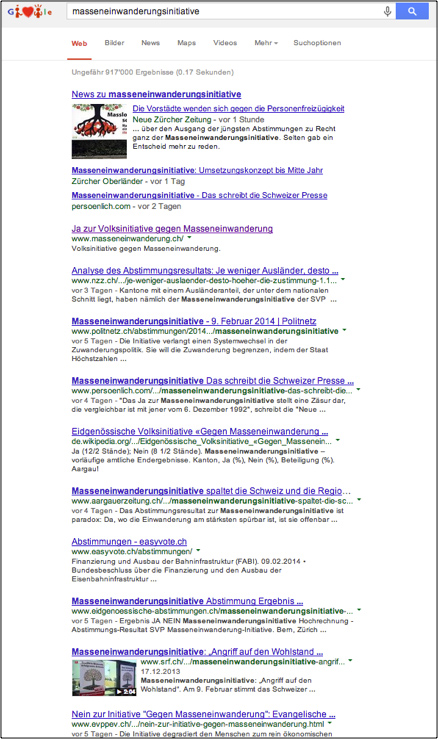
The proponent side, on the other hand, is present for search terms such as "mass immigration", "mass immigration initiative" (each in 1st place), "immigration switzerland", "foreigner percentage switzerland", "immigration to switzerland", "immigration switzerland" and "against" (2nd place, hihi)
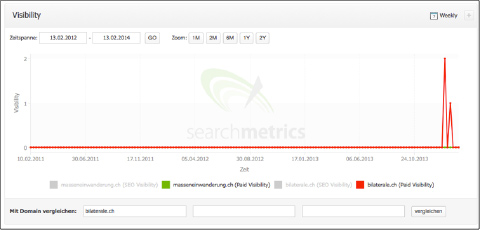
Bilaterale.ch cannot be reached via these current and concise keywords, as can be seen from the following screenshot (with the exception of "mass immigration no" - where the opponents are present and in first place).
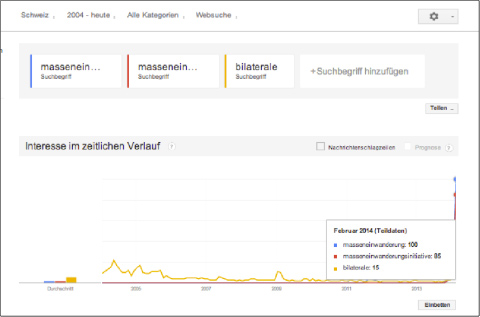
For both camps, it is of course essential that their sites appear in the search terms that undecided voters are looking for in the period before the vote. But which search terms had a strong increase in search queries before the vote? Let's take a look at the search query ratios:
We see: The search terms "mass immigration" and "mass immigration initiative" each have five to six times more search queries than "bilateral". The majority of people who actively searched for information on the vote found the supporters' website.
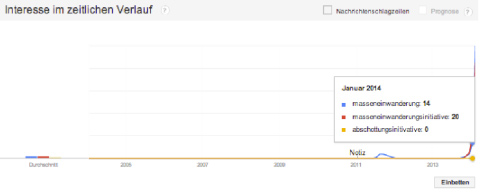
The paradox is that the opponents of the initiative have laid their own eggs in the nest, because on their website (following the campaign jargon) they always referred to it as the "foreclosure initiative" - a term that never caught on with the electorate, as the following graphic shows.
Using Google Trends and the Google AdWords Keyword Planner, you can roughly estimate the number of search queries in recent months for "mass immigration" and "mass immigration initiative": These were estimated at around 300,000 to 400,000 - and were optimally intercepted by Masseneinwanderung.ch. This does not even include foreign-language search queries.
Conclusion: Online marketing could perhaps have turned it around
The following opportunities were missed by the opponents of the initiative:
- Viral effect on the website
- Lack of presence among several hundred thousand voters who were searching for information on the web due to a lack of keyword analysis before the website was launched
I cannot evaluate the presence of "purchased" traffic via Adwords and other channels such as banners or social media in detail, which of course also had an impact on the result. According to Searchmetrics, the proponents placed at least a small number of paid search engine ads.
Nevertheless, the initiative's opponents missed a great opportunity with their suboptimal online presence and, above all, their lack of consideration for SEO - a negligent and perhaps momentous omission in view of the close outcome of the vote.
Linus Oertli, SEO/SEM manager at Zip Media, Zurich