
Gulf boom bypasses mountain regions
Swiss tourism has high hopes for guests from the Gulf States. While many Europeans are switching to less expensive vacation destinations, Saudis and Qataris are coming in large numbers - and still spending a lot of money. But mountain regions such as the Valais or Graubünden are struggling to profit from this development.


929,799 overnight stays in Swiss hotels in 2015 were attributable to guests from Bahrain, Qatar, Kuwait, Oman, Saudi Arabia and the United Arab Emirates. This is around a fifth more than last year and more than three times as many as ten years ago. The trend is continuing this year as well: from January to July 2016, the number of overnight stays by guests from the Gulf States rose by 9 percent. According to Switzerland Tourism, the results for August should also be awaited, as July and August are the peak season for this clientele.
Strategic growth market
At the same time, travelers from the Gulf States also spend a lot of money in Switzerland: They leave an average of 500 francs per day, as calculated by Tourismus Monitor Schweiz in 2011. By comparison, the figure for Germans is 150 francs. The tourism marketing organization Switzerland Tourism has therefore long since defined the Gulf States as a strategic growth market. The gross marketing budget excluding personnel costs for the Gulf States amounts to 1.8 million francs for the current year. That's 5 percent of Switzerland Tourism's marketing budget, the organization said in response to a question. But so far, not all of Switzerland's tourist regions have been able to benefit to any great extent from the lucrative clientele. Visitors are drawn primarily to three tourist regions: Geneva, Zurich and the Bernese Oberland. More than two-thirds of the overnight stays by guests from the Gulf States take place in these regions.
Halal barbecue and signpost to Mecca
Geneva can look back on a long tradition with Arab guests. Arab guests have been coming to Geneva for decades, Kristelle Gentina of Geneva Tourism told the sda news agency. The city attracts Arab guests with its international orientation and direct flight connections. To date, of all Swiss destinations, the most tourists from Gulf countries stay there. It takes time to build up an appropriate service, Gentina says. High on the list of Arab guests are luxury hotels, shopping opportunities and good food. Hotels have adapted to the needs of Muslim customers: For example, with breakfast buffets that are halal, i.e., meet Muslim specifications for consumption, or markings in the rooms that point the direction to Mecca, where Muslims turn for their prayers. Interlaken also made an early effort to attract this group of guests. For example, Interlaken Tourism runs cruises with a "Halal Barbecue" or Arabic evening tours. Hoteliers are trained in workshops where the behavior of other cultures is explained and participants are sensitized.
Disillusionment in Basel
Not all regions, however, have the potential to attract guests from the Gulf States. In 2013, the Basel region announced its intention to attract Arab guests. But the hoped-for success failed to materialize. Around 14,000 overnight stays were generated by Arab guests in 2015, which is only slightly more than the 13,600 overnight stays in 2012. There are too few tourist offers in Basel that correspond to the Arab market, according to a request from Basel Tourism. Therefore, Basel Tourism has decided to no longer actively work the market. Mountain regions are also having trouble attracting this lucrative clientele. At the same time, these regions are currently suffering from a loss of visitors and would have to rely on alternative target groups. The Valais and the Grisons have seen a slight increase in the number of visitors from the Gulf States. But that is not nearly enough to compensate for the loss of European visitors.
Critical size important
In Graubünden, travelers from the Gulf States were responsible for just 16,324 of a total of 4.7 million overnight stays last year, while in Valais they accounted for 26,619 of 3.7 million overnight stays. 90 percent of the overnight stays by Gulf state guests in Valais are accounted for by the three destinations of Zermatt, Crans-Montana and Verbier, according to Valais Promotion. With more and more Arab individual guests traveling to Europe, this market holds particular potential for the larger destinations such as Davos Klosters or Engadin St. Moritz, according to Graubünden Ferien. In both Graubünden and Valais, the larger destinations work directly with Switzerland Tourism to advertise in the Arab market. This is not expected to change in the foreseeable future. After all, smaller destinations have little chance of attracting guests from the Gulf states on a large scale. The decisive factors are a critical size that also allows a certain density of luxury hotels, as well as international recognition, says Jürg Stettler, head of the Institute for Tourism Management at the Lucerne University of Applied Sciences and Arts.
For longer stays, Arab guests prefer the cities, according to Stettler: On the one hand, these offer the appropriate infrastructure. On the other hand, the natural landscapes and mountains valued by tourists are easy to reach from there. Nevertheless, there are also rays of hope for the regions that have so far benefited less from the growth market of the Gulf States: According to Stettler, tourist visits via round trips such as the Grand Tour of Switzerland are likely to be more spread out in the long term. (Tina Tuor/SDA)
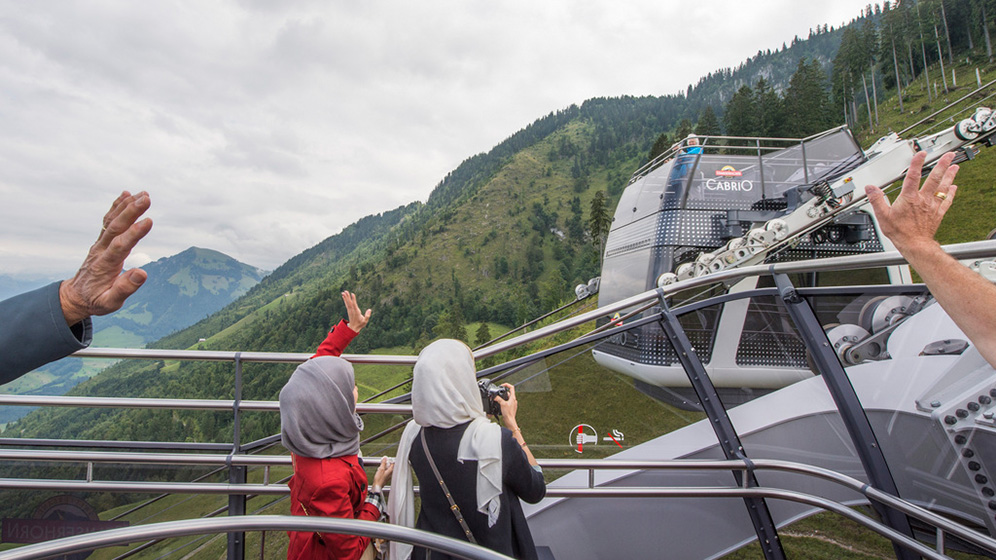
Image: Keystone/Sigi Tischler; Stanserhorn cabrio gondola


