It is not enough to love the customer
Many companies use cross-media advertising as if the customer were prey: they startle them, shove the product into their pocket, and vanish without a trace.


But in times of saturated markets, this no longer works, Peter Marti is convinced, "because the usual marketing tools have worn out". Consequently, the CEO of Marti.Seiler Communications uses the latest online technologies and strategies in his work and combines them with a clever offline presence "to focus on the individualized approach to the consumer".
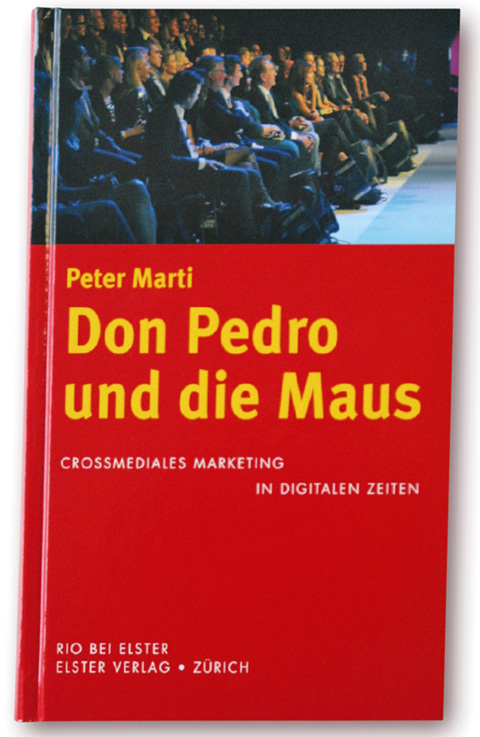
Peter Marti has now also written a new non-fiction book about this. "Don Pedro and the Mouse" follows on from his first book "Lizard Marketing". It was about the "Absolute Return". In the sequel, the method developed by Marti is now taken further into the online world. "Cross-media marketing in digital times" is the subtitle. The title "Don Pedro" goes back to Marti's wife. "She gave me this name two years ago. And the mouse is my work tool. The Apple mouse, of course." Don Pedro and the mouse have written numerous well-known advertising campaigns for well-known Swiss and international companies - advertising campaigns with bare bottoms, with girls, golden rabbits and Hollywood stars such as Penélope Cruz. The poses have earned Don Pedro the nickname "Füdli-Marti". Provocations of this kind are no longer Don Pedro's style. However, the aim of Pedro's advertising remains the same: an absolute return for the brand and, of course, for the client. In his current essay, Marti also uses this "absolute return" as a control instrument again. "It's not just about loving the customer, it's about having the goal of every advertisement in mind: to sell successfully!"
The 200-page book analyzes the role of the Internet in the present and future. Even Marti "cannot see" into the future. But he dares to go out on a limb with a few predictions. However, he does not want to "fall into the trap of most futurologists who extrapolate the future linearly from the present". Marti sees "intelligent cross-media marketing" as the appropriate response to the changes of the last ten years since "Eidechsen Marketing" was published. Some of these changes have also been incorporated into the new book. Attention has become an important commodity in our over-information society. Advertisers are increasingly asking what happens to the money they invest. Marti's answers: The "Absolute Return" method uses state-of-the-art database technology to handle every customer contact effectively and in a customer-friendly way. It uses cross-media marketing in all available media. The method uses a media focus around which all activities can be grouped. And the "Absolute Return" method compares income with expenditure in a fundamental and differentiated way. After chapters such as "Cross-media marketing in digital times" or "The change in customer satisfaction", Marti also writes about Facebook, Twitter and YouTube. The dangers and opportunities on the net. Or "How the design can promote the return of the website." The "New Diversity" section looks for new directions, for example the "end of television in the living room". The chapter "From mass communication to communication on demand" also provides valuable insights. Attached to the multi-layered considerations are "75 tips from Peter Marti" as well as various practical aids and checklists - from the briefing and presentation to the choice of channels and, of course, the advertising agency. pan