Seth Priebatsch describes himself as a "proud dropout" from the renowned Princeton University and has a clear visionary claim: "The last decade was characterized by social networks, the next decade will be the decade of games." He is getting his message across and has found several backers for his start-up, including Google. Online games promise advantages in the increasingly difficult battle for attention. Thanks to smartphones and social networks, they are becoming increasingly ubiquitous and merging with the real world.
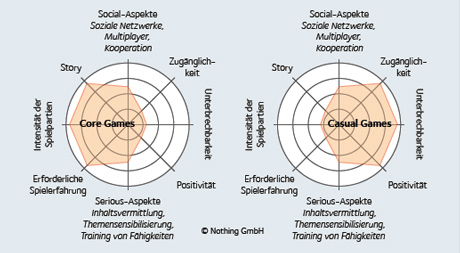
When it comes to the use of games in the advertising and communications environment, a distinction must first be made between two types: On the one hand, video games (so-called core games), which are mainly played on game consoles and computers, and on the other hand, so-called casual games, which also include the category of advertising games (advergames, ad games). These two genres differ in important criteria (cf. chart). Core games are usually huge productions that require special hardware and often take players into other worlds for hours at a time. In-game advertising can be used to book logos and messages (such as perimeter advertising in soccer games), which are displayed to players in suitable scenes.
Casual games (occasional games) are different. They are easy to play and correspondingly cheaper to produce. They offer a quick sense of achievement, are entertaining, and can be played in between games and quickly abandoned. A legendary advertising game is the grouse hunt, with which the Scottish whisky brand Johnnie Walker attracted attention a good decade ago. Advertising games are primarily credited with these advantages: If the brand world is successfully staged with the right target group, such advertising games can be used to positively charge one's own brand. Because popular advertising games are readily recommended to others, the brand messages spread virally. In this way, a company can set itself apart from competitors and win and retain customers. The success of the game can be tracked continuously and usage and contact data can be obtained.
In our country, Migros in particular has repeatedly made an appearance with Advergames in recent years. Since 2008, the collection campaigns (Manias) have been accompanied online by additional information, stories, games or a quiz. "We have noticed that the number of visits to the games on the websites created especially for the Manias increases every time," media spokeswoman Monika Weibel reports when asked. Currently, she says, the number of visits to the current Nanomania website is about the same as to the main Migros.ch site. Not only because of these high visitor numbers, but also because of the feedback on the games that arrives by mail or on Facebook, Migros is clear "that the users are having fun and appreciate the games.
Since advertising games are a new advertising phenomenon, there are hardly any key figures available. The fact that companies like Migros or SBB (see interview) repeatedly use them at least allows the conclusion that they are satisfied with the advertising impact compared to the effort. For example, Weibel reveals that last fall's Oceanmania campaign achieved a total of 1,002,897 visits, with between 35,000 and 40,000 visitors on peak days. The currently running Nanomania has already recorded half a million visits after just 14 days since its launch on January 30, with over 50,000 visits already on the 4th day. 25 659 registered users have saved 53 115 high scores. Remarkable is the average visit time, which is 7:04 minutes.
According to a survey by the market research company Nielsen, American surfers spend ten percent of their time online playing games. The main reasons why games will continue to grow in popularity and attract new segments of the population are as follows:
- The mobile market with smartphones is growing rapidly. With their touch-sensitive user interfaces and motion sensors, these devices are also ideally suited for games. Migros, for example, created an iPhone app for Nanomania for the first time, which has already been downloaded 47,224 times, earning it a place among the top 10 apps in Switzerland.
- Increasingly fast, powerful, and affordable bandwidths make it easy to download games, often on the fly, both on fixed and especially mobile networks.
- Games are increasingly offered via social networks, primarily Facebook, and are linked to them. The best-known example of this is Foursquare, where players use the GPS system in their smartphones to communicate their location and thus collect awards and discounts.
Such location-based services are considered the next big thing in social media. And that brings us back to Seth Priebatsch, who is working with his company SCVNGR to take the Foursquare concept one step further. His vision is clear: Building on the framework concepts now established for social networks, the goal now, he says, is to cover everyday reality with virtual game layers in order to influence behavior. He makes it clear that it is "really important" what basic concepts are created for this.
Christoph J. Walther
Casual games, which include promotional games, differ from video games in key ways, which is why they can be used to good effect in communications. Source: Nothing GmbH; classification into stereotypes based on literature and experience.