Social media today
Everyone’s talking about Xing, Facebook, and Twitter—and since being part of the action is everything, almost everyone is jumping on board. *Werbewoche* wanted to know why and how. That’s why we conducted a social media survey among 15 media companies, businesses, and advertising agencies. Although the results aren’t representative, they reveal some interesting insights into the potential and weaknesses of social media networks.


Those who conduct surveys are sometimes surprised by answers that aren’t really all that surprising. This is due to expectations. In our survey, it was surprising that most managers first had to figure out what was actually going on with social media at their companies. Our questions were often forwarded directly to the people in charge of online operations. This shows that the integration between the virtual and real worlds is still far from working as well as it could. It’s a finding that’s both well-known and surprising.
Another trend that emerged in our survey is the widespread use of «trial and error»: People have jumped on the social media bandwagon and are now just seeing where it takes them. Studies show that in Switzerland, about 90 percent of full-time communications professionals use Facebook, Twitter, Flickr, or YouTube in their personal lives. Typically, they gained their first experience with social networks through a personal account before setting up an account for their employer as «social media experts» for companies, newspapers, or agencies. But this “learning by doing” approach clearly works very well: Respondents take social media seriously and use it very professionally for marketing campaigns and the distribution of editorial content.
It also became clear that currently neither companies nor media outlets nor agencies expect to make money from their involvement in social networks. If anything, they expect a positive effect for the brand. For brand-oriented companies, therefore, social media still holds untapped opportunities. Another interesting trend emerged: While companies and media outlets are actively engaged on Twitter, Facebook, YouTube, Netlog, and similar platforms, most of the advertising agencies surveyed are reluctant to create their own accounts—even though they all handle social media marketing for their clients. Markus Ruf, Creative Director and co-owner of Ruf Lanz, offers an explanation: «The agency itself deliberately does not have any accounts. Take Xing, for example: it’s mainly people looking for work. But we’re already getting far too many inquiries from production companies, printers, or freelancers who want to work for us. This would multiply even further if we had an account—to the dissatisfaction of everyone involved.» If the only «risk» of a social media presence is receiving too many inquiries, it might become important for up-and-coming agencies to set up a Xing, Twitter, or Facebook account. Jung von Matt/Limmat, for example, plans to open a Twitter or Facebook account in the near future, and Erdmannpeisker is evaluating whether a Facebook account might be worthwhile for the agency. Gabriel Peisker is weighing the pros and cons carefully: «It’s quite possible that we’ll set up an account. However, we’ll first conduct a cost-benefit analysis, because maintaining these platforms is time-consuming. We’d rather not have a presence at all than have a poor one that offers no added value.»
In fact, just being there isn’t everything. That said, it’s not a good idea to wait too long to get started on social media. But if you just tweet a little here and there or set up a Facebook account without a strategy, clear goals, or the manpower to manage it—and without regularly engaging with your friends—you’re not doing yourself or what you stand for any favors. The biggest mistake people make with social media is underestimating the effort it takes to maintain accounts and to be—and remain—authentic and creative.
How: Type of Activities
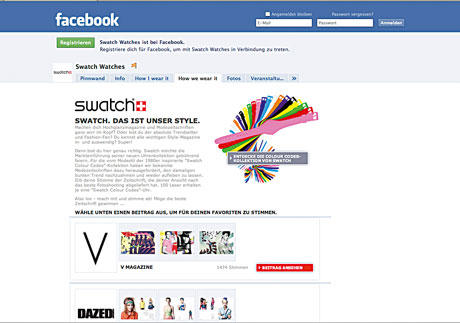
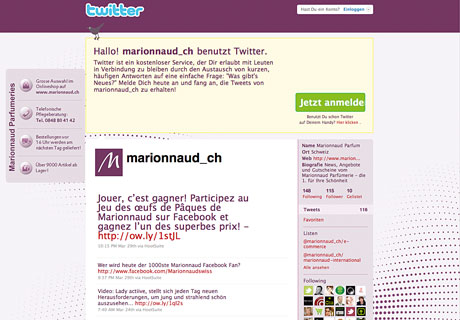
Companies primarily use Twitter, YouTube, and Facebook to post marketing and topical content, highlight promotions, or take orders. Marionnaud, Philips, and Swiss also have their own social media platforms: Marionnaud and Philips run blogs, while Swiss operates a social media newsroom. However, the companies surveyed use Facebook and Twitter not only to post announcements and offers, but also to interact with their friends and followers. «For Swiss, Facebook is the »hub,«» says Swiss spokesperson Sonja Ptassek. «All of our multimedia content is linked or uploaded to Facebook; we provide our fans with news, insights from the company, services, contests, and last-minute offers. We also actively communicate with our fans there, take in criticism, input, and ideas, and answer questions.» Swiss Post also values its customers’ opinions and gathers them through Facebook, among other channels: Swiss Post’s Facebook group serves “to gather customer feedback,” says Swiss Post spokesperson Mariano Masserini.
Another key driver for engagement on social media is brand management and brand protection: Sevenone Media believes that «distributing our news in a modern, straightforward, and trendy way will enhance the image of our brands among feed readers.» Marionnaud online specialist Yago Veith is also concerned with protecting his brand: «We’re also active on social media to ensure that the Marionnaud brand isn’t misused by others.» Misuse? Indeed, this risk is high: «The existing Tages-Anzeiger Twitter pages are not ours,» confirms Tagi Editor-in-Chief Markus Eisenhut. «For us, Facebook is the top priority. We use Twitter selectively when it comes to reporting directly and quickly on an event from the scene, such as the WEF in Davos.»
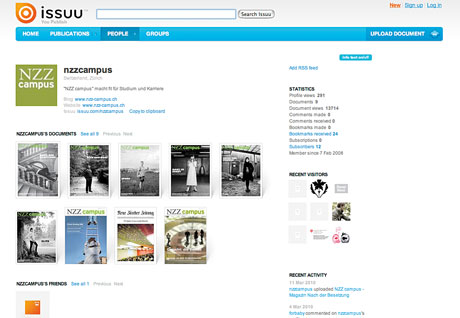
The media primarily use social networks to share news tweets and distribute editorial content. Their goal is to retain readers, attract new ones, and increase their reach. On Twitter, they link both to articles that have just been posted on the newspaper’s or broadcaster’s website and to video podcasts available on YouTube. In addition, NZZ campus makes all of its magazines available as e-papers on Issuu.com. SF runs fan pages on Facebook for individual programs and offers live chats during live broadcasts on the Internet.
None of the advertising agencies surveyed maintains an agency account on social media. However, it would be a fallacy to conclude from this that they lack social media expertise. After all, these advertisers are very active and creative on social media on behalf of their clients. Jung von Matt/Limmat carries out «all kinds of marketing activities» on social media for its clients; Erdmannpeisker is active on Facebook and Twitter for Rivella and Mammut; and Rod has developed a promotion for Saturn Germany that runs exclusively on Facebook. «This campaign leverages an insight into the medium,» explains co-owner David Schärer. «The app lets users play a game by setting their relationship status to »single.« So anyone who »cheats’ on their partner with Saturn gets rewarded.” Thanks to Facebook, the “Slow down. Take it easy.” campaign managed by Rod has also caused a sensation. The angel Franky Slow-Down has around 100,000 fans on Facebook—twice as many as Switzerland’s biggest pop stars.
Time-consuming: Account maintenance
For companies and media organizations, updating social media accounts is usually an additional task: corporate spokespeople tweet and post on Facebook between press releases and press conferences; online managers do so alongside their development work; and TV and print editors do so between news stories and features. Swiss is a notable exception: The airline employs a full-time staff member dedicated to managing its social media accounts. At Swiss Post, plans are underway to establish a dedicated “Social Media” team. None of the agencies surveyed maintain their own agency accounts. When they post on Twitter, Facebook, and YouTube, they do so on behalf of clients—which means that managing social media is a genuine part of advertisers’ work.
Why: Significance for the balance sheet
For Swiss and Philips, engagement on social media is clearly part of their future strategy. David Schärer of Rod sings the praises of social media: «For the agency’s own branding, social media is still secondary—or even tertiary. But from our clients» perspective, it offers an opportunity for genuine dialogue on equal footing. Only those who are relevant can establish meaningful contact with their audience. From an advertiser’s perspective, the challenge lies in utilizing new formats. I see this development as a major creative liberation.”
Outlook: What the Future Holds
For many respondents, the outlook for the future remains vague. They often vaguely mention that they are planning «a few things» by the end of the year. Whether that means «we’re not providing any information on that» or «we don’t have any plans» is left open to interpretation. Swatch does not disclose any information about its future plans «for strategic reasons.».
However, specific plans are also being announced: Swiss is launching activities on the frequent flyer forum Flyertalk.com; Rohner Socks will update its posts regularly and feature promotions in its online store as well as live streams; Marionnaud is compiling behind-the-scenes information for its fans; SF plans to make its video-on-demand offerings available on the major social media platforms; the Tagi will expand its existing Facebook presence and increase interactivity on its mom blog; NZZexecutive.ch plans to expand its job boards on social media, and NZZ campus plans to further refine its «use of these channels» and focus on social media sites with wide reach.
According to David Schärer, Rod is also busy planning new projects: «A major campaign is in the works and will be unveiled in May. But the biggest thing for us this year is likely to be mobile internet.» Ruf Lanz is currently working on new campaigns for VBZ, Suva, and Hiltl, in which social media also plays a role due to the target audience. Markus Ruf: «But here, too, the key is a surprising idea: The benchmark is the Facebook campaign by Crispin Porter + Bogusky for Burger King, where you could trade ten Facebook friends for a Whopper.»
It seems we can also expect surprises from Swiss Post: «Swiss Post has recognized the importance of these new channels for the exchange of information and opinions and is currently developing its social media strategy,» reveals spokesperson Masserini. «By the end of the year, these interactive media will be integrated in various ways into our communication, marketing, and sales activities.»
Anne-Friederike Wilhelm