AI Content Labeling: 83 Percent Call for Mandatory Labeling
A representative study by Marketagent Switzerland shows that while the public actively uses AI, it remains skeptical of AI-generated content. Four out of five people call for mandatory labeling—and the phenomenon known as «AI slop» is on the rise.


AI Content Labeling: What the Swiss Public Really Wants
Artificial intelligence has long been part of everyday life in Switzerland—but calls for clear labeling of AI-generated content are growing. A representative study by the digital research institute Marketagent Switzerland, conducted among 1,000 respondents from German- and French-speaking Switzerland, reveals a clear tension: While AI as a technology is widely accepted, skepticism toward the content it produces is growing at the same time. The survey took place between July 29 and August 7, 2026.

Widespread use, ambivalent attitude
The majority of respondents say they actively use AI (89 percent), with 63 percent of them doing so at least once a week. Younger generations, in particular, are driving this trend: More than three-quarters of Generation Z (77 percent) and Millennials (75 percent) regularly use AI applications. Across Switzerland, ChatGPT and similar tools are primarily used for quick research and information gathering (56 percent).
Attitudes toward the technology, however, remain divided: While 41 percent of the population has a generally positive view of AI—a figure that rises to 50 percent among Generation Z and 53 percent among millennials—one in five people express clear opposition (22 percent).

Quantity Over Quality: AI-Generated Content Falls Short in Terms of Quality
As usage increases, so does the prevalence of AI-generated content: Six out of ten Swiss people say they encounter such content regularly (62 percent). But growing visibility does not automatically lead to acceptance. Four in ten respondents view the growing volume of AI-generated images and text negatively (43 percent), and just as many are somewhat reluctant to consume such content (43 percent). The perceived quality also falls short of expectations and is rated as only average on average (mean: 3.3).

Uncertainty in recognition—and a strong desire for AI-labeled content
The lack of confidence in identifying AI-generated content has emerged as a key issue: Only about one-third of the population feels capable of reliably identifying AI-generated content (34 percent). Even among young people, who engage particularly intensively with digital technologies, this confidence remains limited (49 percent among Generation Z).
To identify AI-generated content, users primarily look for elements that seem unnatural (47 percent), explicit labeling (40 percent), or inconsistencies in the content (39 percent). Thirty percent become suspicious when the content seems too polished or perfect. Against this backdrop, an overwhelming majority of 83 percent supports mandatory labeling of AI-generated content.
«AI Slop»: When Content Becomes Low-Quality Mass-Produced Goods
Seven out of ten Swiss people already perceive an increase in trivial or interchangeable content (73 percent), and six out of ten fear that high-quality, human-created content will be displaced as a result. «A growing phenomenon is the so-called »content flood’ caused by AI,” says Andrea Berger, Research & Communications Manager at Marketagent.
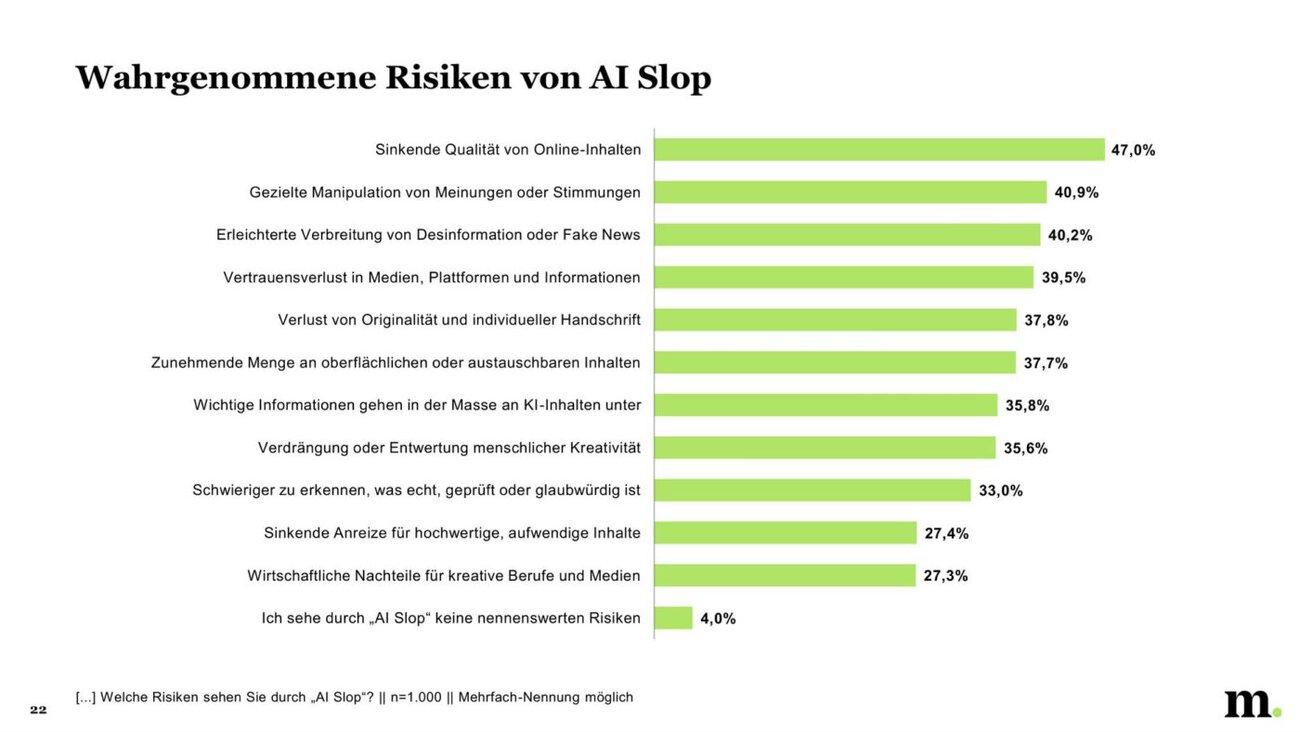
The term «AI slop»—mass-produced, often superficial AI-generated content—is not yet widely known in this country (33 percent are familiar with it; among Gen Z, the figure is 54 percent). However, 73 percent are already actively aware of the phenomenon behind it. The greatest risks are considered to be a decline in the quality of online content (47 percent), targeted manipulation (41 percent), and the spread of disinformation (40 percent). Three-quarters of respondents expect this trend to continue to grow in the future (74 percent).

The study was conducted as an online survey (CAWI) via the Marketagent reSEARCH platform. A total of 1,000 people between the ages of 14 and 75 were surveyed; the sample was representative of the Swiss population in German-speaking and French-speaking Switzerland.
More information about the study and Marketagent Switzerland's services is available at https://www.marketagent-schweiz.ch.