«AI makes content production easy—but good content marketing isn't»
In an interview, Bodo Nuber, Head of Marketing at Redact and guest lecturer at HSLU, explains why the roles of content creators are undergoing a fundamental shift in the age of generative AI—moving away from production and toward more strategic work, quality control, and distribution management.


 Today, m&k GKI produces blog posts, social media posts, and images in a matter of seconds. Do companies still need content creators and distributors?
Bodo Nuber More than ever. GKI makes content production incredibly easy. But that’s exactly the challenge. When anyone can publish as much content as they want in a very short time, the flood of information increases dramatically. We’re currently experiencing «Content Shock 2.0.» As a result, the sheer volume of content is becoming less and less of a competitive advantage. What really matters is whether the content is truly relevant to the target audience.
Many companies are already using GKI. How far along are they, really?
Most people are experimenting with it or already using GKI in their daily lives. ChatGPT has become a staple in many marketing teams’ toolkits and is being promoted by companies. Whether it’s drafting social media posts, summarizing texts, or developing ideas—it works well.
However, many are still a long way from having a fully GKI-supported content production process. Often, clear processes or the necessary expertise are lacking. Most companies are currently gaining practical experience and learning where GKI creates real added value—and where it does not.
Where are the limits?
GKI is no substitute for marketing expertise. Many expect ChatGPT, Claude, and the like to deliver perfect results. But a language model works with probabilities, not with domain knowledge. Without good prompts or a clear briefing, the result is often generic text—and in the worst case, text that’s factually incorrect. And if you don’t actively specify corporate language or brand values, you’ll get generic results instead of differentiation. What’s more, not all AI is created equal. There are specialized applications that excel at their tasks. Others aren’t yet precise enough for complex marketing tasks.
Nevertheless, the temptation to produce as much content as possible automatically seems strong.
That will happen, too. The bar is really low these days. But quantity alone isn't enough. If everyone publishes more, it will become harder to get any attention at all. Visibility doesn't come from volume alone, but also from relevance. That's why high-quality content will become even more important in the future than it is today.
What makes for good content?
It answers the target audience’s questions and is tailored to them. Many companies focus primarily on talking about themselves. But hardly anyone is interested in a brand for its own sake. People are looking for solutions, guidance, or inspiration. Those who understand these needs and address them credibly will have a good chance of success, even in an AI-dominated world. Storytelling remains central to this, and it thrives on the experiences of real people. Authentic emotions and experiences cannot be generated artificially.
Is there any content where AI is already making a strong impression?
Yes, absolutely. AI-generated content is ideal for summaries, SEO copy, or standardized technical information—provided the content is fact-checked by an expert. It also saves a tremendous amount of time when it comes to first drafts or text variations. However, as soon as personality, perspective, or journalistic quality are required, human craftsmanship is still needed. Especially with feature stories or emotional narratives, you can quickly tell whether a text is merely correct or truly well-written.
Do you think content creators will become obsolete?
No—but their job description is changing. In the past, a lot of time was spent on the actual production process. Today, AI tools can support this work or take over parts of it. This frees up time for content creators to focus on what truly adds value: understanding target audiences, evaluating content, developing ideas, and strategic planning. AI makes experts more productive, but it does not replace their expertise.
And how is distribution changing? Can GKI decide who sees which content?
Yes, this is actually already happening on a large scale. Especially in social and performance marketing, AI systems help curate feeds and optimize campaigns. They test different variations and can often reliably identify which post performs better and when it should be published. People remain essential for selecting the right channels for the content and because they have a knack for identifying suitable content. Every platform works differently. A good LinkedIn post is by no means a good TikTok clip, and content creators are still better at judging that at the moment.
Is organic reach still a realistic distribution goal?
Not really when it comes to social media. Many companies overestimate their organic reach. The major social media platforms no longer automatically show content to their own followers, and company profiles are even worse off. The algorithms decide who sees what based on interests and usage behavior. That’s why anyone looking to build reach today can’t do without paid media more and more often. Good content remains a prerequisite—but it must be distributed strategically. The situation is a bit different with search engines. Organic reach is still possible on Google and other platforms with the right content. However, SGE—that is, AI-powered search—has also changed a lot here. Being cited by AI is no longer the same as a click on the landing page.
What is your take on the future of content marketing?
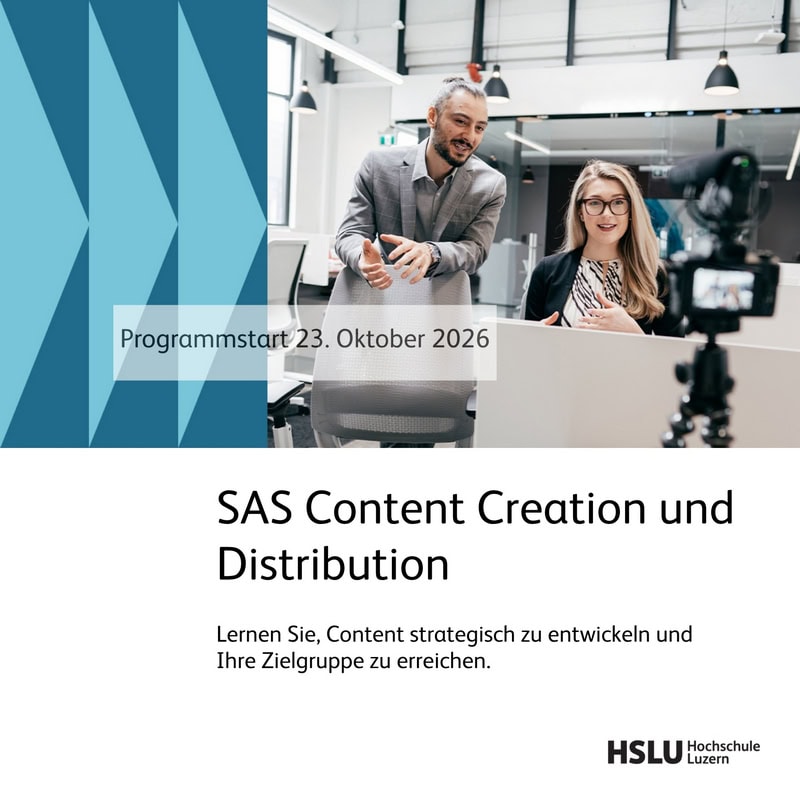
GKI takes the drudgery out of our work and makes teams more efficient. Marketing professionals need the skills that machines cannot fully take over: strategic thinking, an understanding of target audiences, creativity, and sound judgment—and, last but not least, the ability to use GKI applications professionally. The basic rules remain the same: Good content marketing relies on marketers who reach the right people at the right time with relevant and engaging stories. That’s exactly what we teach in the SAS Content Creation and Distribution course. In this compact training program, participants deepen their skills to strategically develop content, tailor it to specific target audiences, and effectively distribute it through the right channels—with AI always there as a sparring partner.