Reha Rheinfelden Content Ecosystem: Content Instead of Pages
Instead of a website relaunch, blueheart partnered with Heartbeat to build a content ecosystem for Reha Rheinfelden. Content is treated as structured data modules and distributed across all channels based on a central logic.


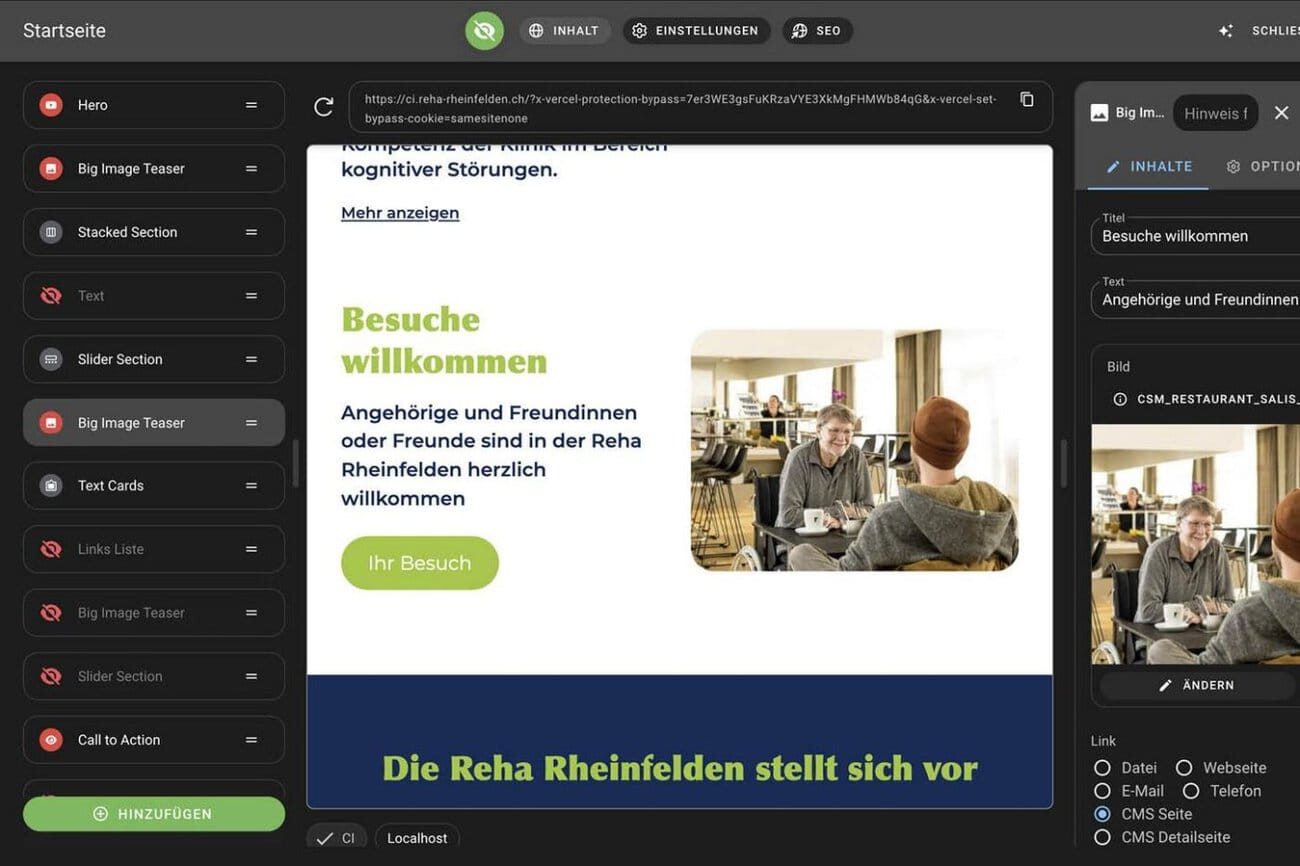
Together with its technology partner Heartbeat, the communications agency blueheart has built a content ecosystem for Reha Rheinfelden. It no longer ties content to individual channels but treats it as structured data modules. According to those involved, the website, newsletter, social media, digital signage, and patient terminals are now all powered by a single, centrally managed content framework.
The Current State of the Reha Rheinfelden Content Ecosystem
Reha Rheinfelden wanted to make its digital communications more efficient and effective. A small marketing team was faced with the challenge of managing an ever-increasing number of channels. Under the previous approach, each new channel meant additional work: content had to be created, copied, adapted, and reformatted for each platform. The key question, therefore, was not what to communicate, but how to maximize the impact of each individual piece of content. blueheart and Heartbeat worked with the clinic team to structurally redesign their communication strategy.
Content as structured data rather than as pages
At the heart of the project is a conceptual model that views content not as text on web pages, but as structured units of information. People, therapies, courses, events, departments, locations, job postings, and menus are no longer individual web pages, but data records with meaning, relationships, and attributes. This channel-independent architecture allows content to be combined and delivered according to the target audience and channel. blueheart was responsible for this content logic: from analyzing the evolving communications landscape to defining content types and translating them into a modular design system.
Headless, but pragmatic
Heartbeat provided the technological foundation with Flyo Content Hub, a headless platform developed in Switzerland. According to the press release, traditional headless architectures prioritize maximum technical flexibility, thereby creating a high degree of dependence on development teams. Flyo, on the other hand, is designed as an end-user-friendly application. Content is managed via an editorial interface, with structure, relationships, and multichannel logic built in. External systems, such as ERP or HR tools, are integrated via defined interfaces. Structured data also enables AI-powered features in content management.
One piece of content, many channels
In the new architecture, the website is just one of many channels. Newsletters, social media, screens, print materials, and patient terminals all access the same database. As a result, a new newsletter is no longer a time-consuming project, but rather another way to distribute existing content. The ecosystem was implemented in stages: from the data architecture through a pilot in live operation to the rollout from a central platform.
Less friction, more consistency
For Reha Rheinfelden, the ecosystem is intended to mean less effort with greater impact. Content is managed centrally rather than entered multiple times, and, according to the press release, new channels can be integrated more quickly. Building on this foundation, additional components such as digital signage and a digital annual report have already been developed. The project demonstrates that a well-designed content ecosystem is not a matter of corporate size or a large budget. What matters most is a clear vision for the content and the willingness to rethink structures.
More information: www.blueheart.ch/cases/reha-rheinfelden, www.reha-rheinfelden.ch/ and www.flyo.ch/blog/reha-rheinfelden-eine-neue-art-digitale-kommunikation-zu-denken
Responsible at Reha Rheinfelden: Patrik Forster, Deputy Head of Marketing & Communications and Executive Secretary. Contact at blueheart: Daniel Bachmann, CDO; Kristin Enzler, Digital Project Manager; Paula di Battista, UX Designer; Marianne Kieser, UX Designer. Contact at Heartbeat: Stefan Märke, Project Lead; Basil Suter, Software Development.