LUKB and Jung von Matt: «We create space is a concrete mandate for action»
Lucerne Cantonal Bank is undergoing a fundamental paradigm shift: moving away from the brand as a communicative sender toward a strategic growth driver. In collaboration with Jung von Matt BRAND IDENTITY, a new positioning was developed that combines regional roots with national aspirations. In this interview, Dr. Lena Martschenko, Julius Jäger, and Dr. Thomas Deigendesch explain how the brand is becoming a trusted advisor, what role AI plays in this—and why „We Create Space“ is far more than just a campaign slogan.



Luzerner Kantonalbank ventures a paradigm shiftLUKB is repositioning itself beyond the canton's borders with a holistic brand transformation. Jung von Matt has guided LUKB through the twelve-month transformation and is also realizing the launch campaign under the new brand promise «We create space». We spoke to the people responsible.
What was the specific trigger for the fundamental paradigm shift - and why exactly now?
Dr. Lena Martschenko: The trigger was our LUKB30 strategy. In recent years, LUKB has consistently developed into a supra-regional universal bank. The wider market often does not yet perceive us in this way. As we want to be one of the five leading universal banks in Switzerland by 2030, we need to convey our sovereignty and professional strength beyond the canton's borders with our image - and above all emotionally. This is where the brand comes into play.
What overarching business objectives is LUKB pursuing with the new brand strategy, including outside the canton of Lucerne?
Dr. Lena Martschenko: We want to exploit LUKB's full potential. This means securing long-term market leadership in Lucerne and at the same time establishing ourselves throughout Switzerland as a specialist for sophisticated advice in the investment and pension business. For our brand, this means a significant change of role: from product provider to «trusted advisor». In this way, we create space in which clients can realize their plans and the brand becomes a strategic lever for gaining a credible foothold in our growth areas outside Lucerne.
Which KPIs are decisive when it comes to brand positioning?
Dr. Lena Martschenko: Three KPIs are decisive for us: top-of-mind awareness, our perceived innovative strength, which differentiates us and makes us fit for the future, and brand trust, which is closely linked to our perceived quality. Together, they show in the integrated KPI framework whether our positioning is effective in the long term.
What was the biggest challenge in using the brand less as a communicative and more as a strategic tool?
Dr. Lena Martschenko: The biggest challenge was to free the brand from its traditional marketing silo and uncover its potential as a strategic management tool. It was not about a new look, but about a new self-image: away from the brand as a visual sender, towards the brand as a factor that actively supports our growth targets and a brand promise that anchors us in the market and to which we align our actions and our decisions.
Julius Jäger: We deliberately did not solve this challenge in a small brand circle, but with over 100 employees from Corporate Development, HR and Customer Advisory. After all, a brand-led bank is not created through its appearance, but through shared decision-making logics. We have created a common language for this with formats such as the value proposition frameworks. This is an essential prerequisite for making the new promise a consistent experience across all target groups, both internally and externally.
Transforming a bank with a long history is not usually an easy process. How do you manage the balancing act between heritage and new values?
Dr. Thomas Deigendesch: Strong brands do not leave their origins behind, they develop them further. At LUKB, regional roots and proximity remain central. This is complemented by what the bank has consistently strengthened in recent years: Performance and expertise. This makes the brand clearer and more distinctive. And without losing credibility and grounding.
Which findings from the interviews and workshops had the greatest impact on the strategic direction?
Dr. Thomas Deigendesch: The realization that LUKB does not have a performance problem, but a perception problem. Its actual range and quality of services are underestimated, and its geographical origin often dominates. This realization gave rise to the central theme for the entire project: to make LUKB's strengths clearer, more distinctive and more visible in its value proposition, brand design and communication. And then to make this tangible for all target groups: from private to business to private banking customers. The result is a value proposition that credibly combines proximity and expertise.
How is it possible to be perceived both as a locally anchored cantonal bank and as a serious player in private banking?
Dr. Lena Martschenko: The answer is not an either-or, but a precise double-coding: strategically, Luzerner Kantonalbank remains firmly rooted in Central Switzerland, that is our DNA. At the same time, we interpret our three experience principles - approachable, confident and inspiring - in a segment-specific way. In Private Banking, for example, the brand is more sophisticated in terms of visuals and content in order to do justice to excellence and discretion without losing its familiar grounding.
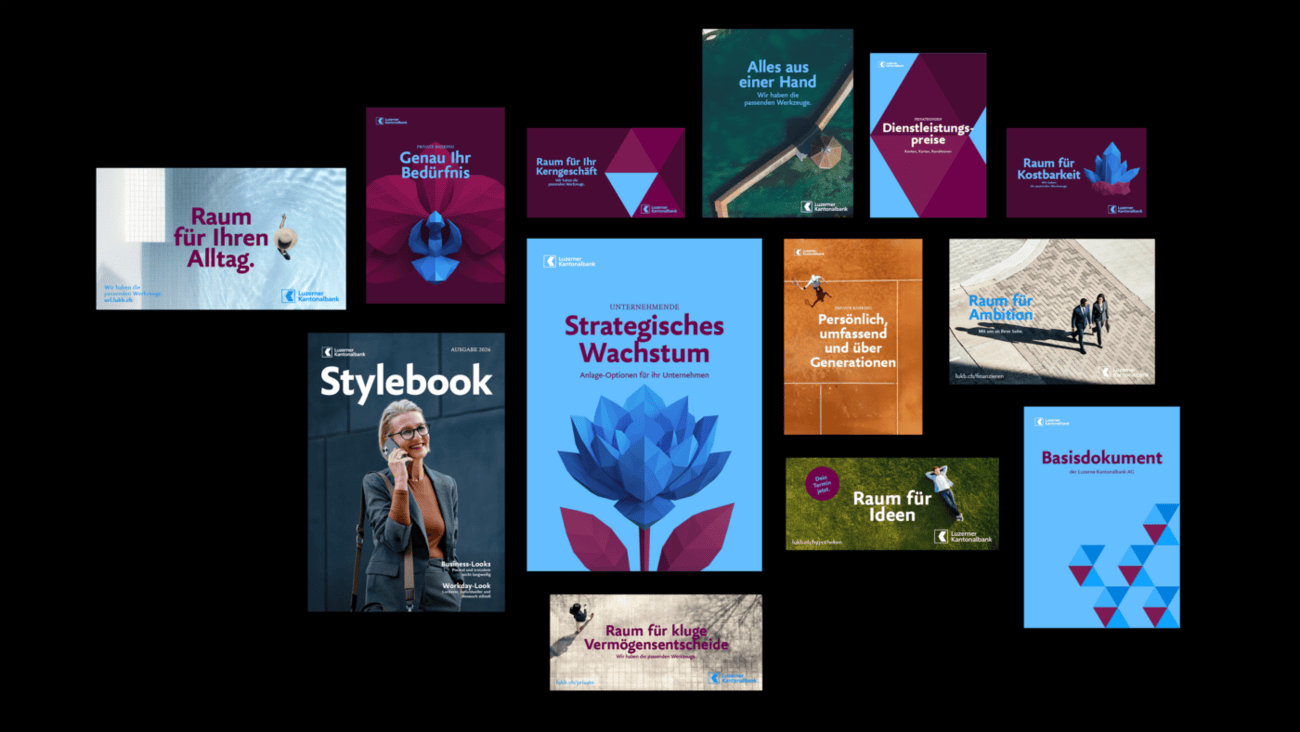
Julius Jäger: This is particularly visible in the design system. In retail, the familiar blue remains dominant. In Private Banking, the brand works more strongly with the new color Berry and a calmer, reduced design. In this way, the same brand is interpreted differently depending on the context, without losing its origins.
What specifically distinguishes the new brand positioning from other banks?
Julius Jäger: The difference begins where many rebrandings end. For LUKB, it was not about modernizing the design. The goal was a clearer identity: regionally anchored, but with new ambition. That's why the positioning was thought through more deeply and built as a system: with a precise promise, a differentiating design, a language logic and principles that make the brand consistent in everyday life. This is precisely what distinguishes LUKB from those who primarily modernize their appearance without really sharpening their inner profile.
The AI-supported brand approach is key - where are the greatest opportunities?
Julius Jäger: The biggest opportunity lies in understanding AI not as a mere efficiency shortcut, but as an amplifier of a clearly defined identity. If a brand knows how it wants to act, speak and look, it can use AI to scale this logic consistently. For LUKB, this was key: an image system with clear rules, precise prompts and a set of language rules suitable for everyday use. So that the brand is not only rethought, but also operationally connectable. Used correctly, AI does not simply deliver more content, but more precision and consistency.
What does the brand promise „We create space“ mean in concrete terms in everyday life at LUKB - for customers, but also for decisions within the bank?
Dr. Lena Martschenko: «We create space» is not just a communicative bracket for us, but a concrete mandate for action. It shapes how we advise, prioritize and make decisions. For our customers, this means more orientation, greater relevance and solutions that fit their life situation so that they can turn their financial opportunities into realities.
Internally, this claim serves as a filter: does a new service really create the promised added value? Only if we consistently deliver on this in everyday life will the brand prove its strategic impact and not simply remain an aesthetic shell.
The campaign clearly declines the brand promise to customers and their needs. What was the approach?
Dr. Lena Martschenko: Brands convince through relevance, not through self-description. As a universal bank, our promise arises from the genuine needs of our customers - customer focus is the foundation of our credibility.
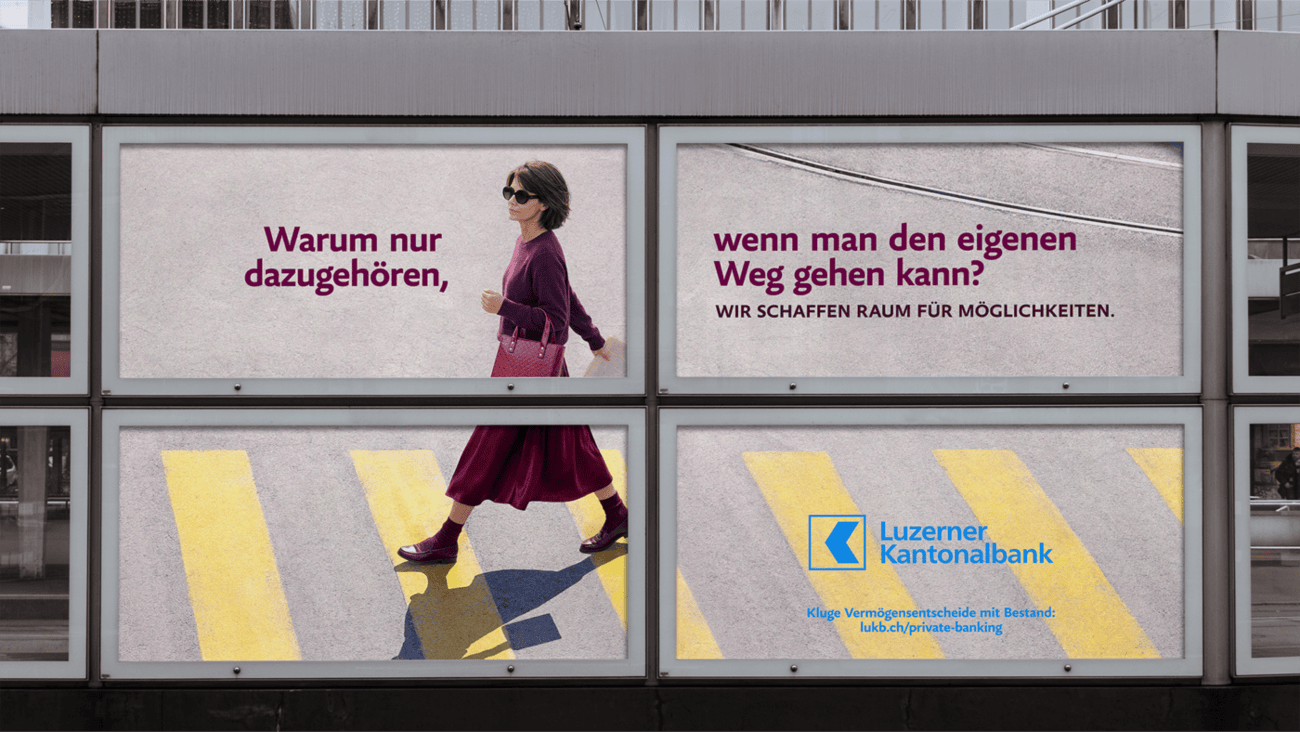
With the 'We create space for possibilities' campaign, we are focusing on precisely this idea. The reduced, graphic imagery makes this visually tangible: we step back to give our customers' visions space. It is crucial that our positioning is not only seen, but also experienced as a real relief. Then space is created.