
The air is getting thinner and thinner in the US ether
Revenues for American radio stations fell sharply in 2008. There is no sign that the situation will improve.


The radio business in the USA is in a bad way, even worse than the ailing newspaper business, according to many industry observers. When the industry association Radio Advertising Bureau (RAB) in New York recently published its sales figures for the month of November last year, it was met with a hail of bad headlines. No wonder: sales fell by an average of 20 percent compared to the previous year, with national advertising down by as much as 24 percent. "You have to go back to 1954 to find a similarly bad situation," says James Boyle from market research company C. L. King & Associates.
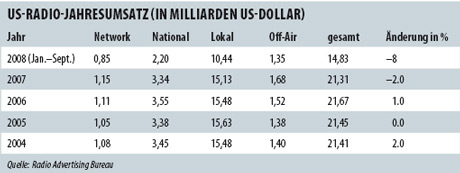
The producers are racking their brains as to how they can become less dependent on their only source of revenue, radio commercials. In the current market, their prices are being mercilessly negotiated down by advertising companies. One idea is to enter into partnerships with sponsors who sponsor entire broadcasting areas over a longer period of time. There is also a focus on so-called off-air advertising, i.e. mobile or online advertising, as well as concerts, events and merchandising - the only category that is showing slight growth. "We have experimented a lot with new advertising platforms such as sponsoring entire program blocks and the option of downloading individual programs to an iPhone," says RAB Head of Communications Renee Cassis. "The more platforms we have where radio is available, the more time people will spend listening to it."
In addition, the RAB has partnered with the National Association of Broadcasters to launch a nationwide marketing campaign called "Radio Heard Here" to "remind both listeners and advertisers of the important role radio plays in the everyday lives of Americans," says Cassis. After all, 92 percent of all Americans say they listen to the radio. The two associations want to raise awareness of the fact that radio has jumped on the bandwagon in the development of new technologies. However, the measure is attracting critics. "A marketing campaign for a medium is ridiculous," says David Rogers, marketing professor at Columbia University in New York. "Maybe it makes sense if you want to appeal to advertisers, but in terms of media consumers, such a project is useless."
Business turns its back on radio
One of the biggest challenges is to extend radio into other media areas, as print and television do. "Radio stations don't have the content that fits well with Internet technology, they don't have video, they don't have sophisticated news, they don't have ads," says Gordon Borrell, founder of newspaper consulting firm Borrell Associates. So radio's traditional key advertising sectors, such as retail, automotive, communications and financial services, are looking to other platforms.
Not even the industry's great beacon of hope, satellite radio, is providing confidence. The two broadcasters, Sirius and XM, launched their service around seven years ago and merged last summer. They did so in the hope of containing the horrendous costs. Sirius XM, as the fee-based service is now called, offers its subscribers over 100 ad-free music channels as well as dozens of other stations with news, talk, entertainment and sports. However, the company's total debts amount to around one billion dollars, a sum that was mainly caused by the expensive transponder technology and the high salaries of some of its stars. "Shock-Jock" Howard Stern alone, who entertains his fans with porn monzettes and fecal humor, collected 500 million dollars for his five-year contract. And although subscriber numbers look relatively good at 20 million and continue to rise due to many new cars being equipped with the service, the company has not yet been able to make a profit because the debt burden is too great and cannot be reduced in the foreseeable future. It is uncertain whether the company can survive in the face of this challenge.
Gerti Schön
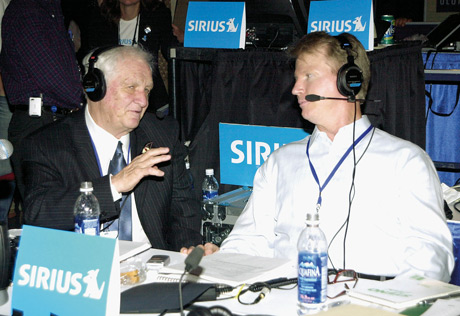
Sirius XM (here a sports talk) now has around one billion dollars in debt.
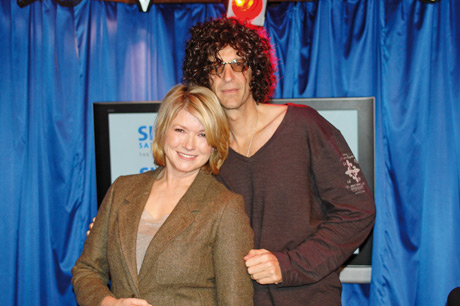
Stars like "Shock-Jock" (here with media diva Martha Stewart) are still raking in millions.


