Problematic use of social media among four percent of children
A national study of schoolchildren conducted by Addiction Switzerland provides insights into schoolchildren’s screen use. Only 4 percent of Swiss schoolchildren exhibit problematic use of social media. However, one-quarter of adolescents aged 11 to 15 turn to social media to escape negative feelings.


This is more often the case with girls (33.3 percent) than with boys (22.7 percent), Sucht Schweiz announced on Tuesday. The school study conducted by the non-profit foundation on the subject of screen behavior also shows that every tenth school child is affected by bullying in the virtual space - here too, girls (11.5 percent) are more often affected than boys (6.4 percent).
Difficulties with social media use
The 11- to 15-year-olds report difficulties with using social networks such as Snapchat, Instagram or Twitter in the past 12 months. These include unsuccessful attempts to spend less time on social networks (girls: 37.5%, Y: 23.7%) as well as frequent use of social networks to escape from negative feelings (girls: 33.3%, boys: 22.7%). Almost every fifth child surveyed has even had serious conflicts with parents or siblings because of their use of social networks (girls: 18.2%, boys: 14.6%). Compared to boys, girls seem to have more difficulties with the factors mentioned.
Gender-specific usage patterns
There are certain differences between the genders in terms of usage: Video games are significantly more popular with boys and they watch slightly more videos, while girls invest more time in other screen activities, including those related to schoolwork, surfing the Internet or social networks.
Online most frequent contact with close peers
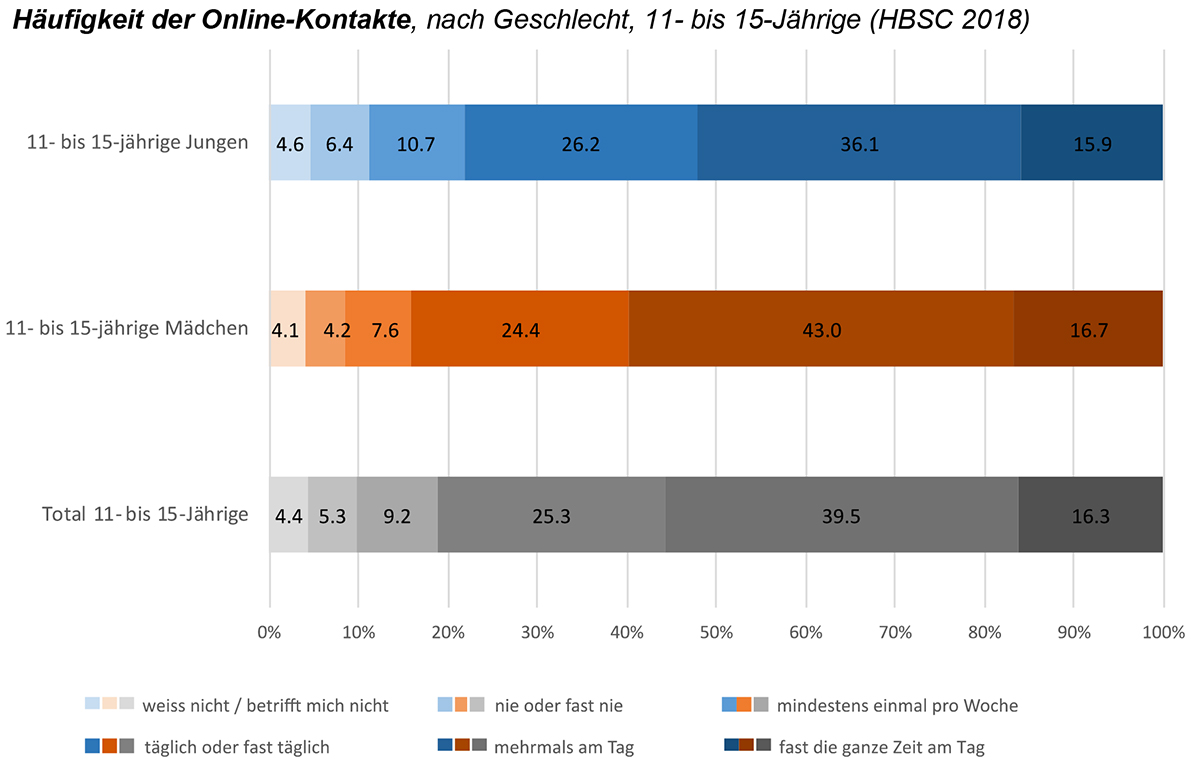
More than half of 11- to 15-year-olds say they interact online several times a day or almost constantly, i.e., receive and send messages, or receive and send emoticons, photos, videos, or voice messages (girls: 59.7%, boys: 52.1%). According to the young people, they are most likely to do this with best friends and girlfriends. People such as parents, siblings, classmates or teachers are mentioned much less often. Online acquaintances play a subordinate role.
Personal concerns prefer direct exchange
Young people also share secrets, worries and feelings on social media. However, the vast majority of students prefer to talk about this directly. Only a minority clearly prefers screen media for this purpose: 7.7 percent of girls and 6.7 percent of boys. Switzerland is thus one of the countries where this preference is least widespread.
Who else has problems is more online
As Sucht Schweiz writes, screen time and social network use increase among young people when they have more problems in general, including drug use, physical ailments or difficulties in the family.
The Health Behavior in School-aged Children (HBSC) study, conducted every four years, is under the auspices of the World Health Organization Europe and examines various health-related behaviors of 11- to 15-year-olds, including alcohol and drug use, the results of which were published earlier.
Addiction Switzerland conducted the study for the ninth time in 2018. Participation in the survey was voluntary and anonymous. The final national sample comprises 11,121 girls and boys. (SDA/swi)