
More impact for communication
Communications professionals need to be more courageous, according to the Swiss Conference on Communications Controlling.


The pioneering days of communication controlling and the battle over methods and models are over. In the meantime, scientists have agreed among themselves and together with practitioners on a common model. Anyone who wants to learn more can do so at www.communicationcontrolling.de. Even the international controller association could be committed to the four-step model (input, output, outcome, outflow). Now, the implementation of controlling instruments is only hindered by debates about how exactly one can prove the impact chains of communicative measures to monetary behavior. "Here, those responsible for communications should show a little more courage and not allow themselves to be constantly questioned," pleaded Prof. Lothar Rolke of the University of Applied Sciences Mainz in his presentation at the third Swiss Communications Controlling Conference on June 17 at the HWZ Hochschule für Wirtschaft, Zurich.
Communications Controlling brings better communication
Rolke explained that companies which use controlling instruments in some form can demonstrate better communication performance. This is mainly due to the fact that controlling forces communication managers to define communication goals. His comments on his recent studies on the relationship between public relations and classic advertising were also interesting. He found that both disciplines contribute equally to brand management, but with a clear advantage for PR. It costs companies significantly less.
Alex Aiken, who has won several awards for his communications work for Westminster City Council - for us Swiss, simply put, the London administration - did not start his plea for communications controlling with the obvious argument that taxpayers have the right to know how their money spent on public sector communications is being used. He compared communications directors to successful coaches of a soccer team. What counts above all is leadership. Only those who know where they want to go know what they want to control. And with clear goals, controlling also brings added value by improving processes. And he also gave an example to show that controlling should not be confused with monitoring. The measurement of communication measures has shown that indirect communication by means of ambassadors who speak positively about the public administration is much more effective than old-style propaganda. He demonstrated this with a girl who reported on her stay in a home for children with behavioral problems run by the City of London. But for those responsible for communications, this also means having the courage to let go at times and to trust in the quality of one's own organization.
Afterwards, the participants of the symposium were able to inform themselves and exchange ideas in five breakout sessions about concrete approaches to communications controlling. The final presentation was given by Patrik Zwahlen, BildKom. He presented an approach on how image messages can also be checked for their effectiveness.
Andreas Jäggi
Notes at the symposium
"Public relations can do as much for brand recall as advertising, only at one-eighth the cost." Prof. Dr. Lothar Rolke, FH Mainz.
"Press spokespeople are available off the shelf. Good researchers who can make statements about the impact of communications are rare."
"What do you want to be famous for?" is a question not only every company should be asking, but its communications people should be asking as well." Alex Aiken, Director of Communications & Strategy, Westminster City Council.
"You can't measure everything, but you can measure very, very much. And you should definitely do that to increase the probability of success." Harald Burgener, owner of Dreizweieins GmbH, Bern.
"Only transparency in the process of all communication activities about products, services or the company creates the prerequisite to check, evaluate and control strategy conformity and adherence to values and to ensure integrated communication." Rudolf Blankschön, Head of Brand Management SBB.
"Communications controlling must also include the impact of image messages." Patrik Zwahlen, BildKomGmbH.
Put your controlling work up for discussion!
The next Swiss Communications Controlling Conference is planned for June 2011 and will again be held at the HWZ. The organizers would again like to show participants insights into current examples of controlling in organizational communications. If you would like to take advantage of the opportunity to present your experiences at the conference, please contact [email protected].
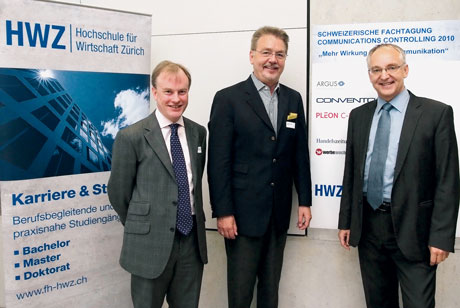
Prof. Lothar Rolke, Alex Aiken and Cyril Meier, HWZ.


