
Do we need new models for media management?


MEDIA AGENCIES Media agencies have been quiet for a long time in recent years. For some months now, there have been headlines that media managers would rather not have seen. Some international media agencies are the focus of criticism.
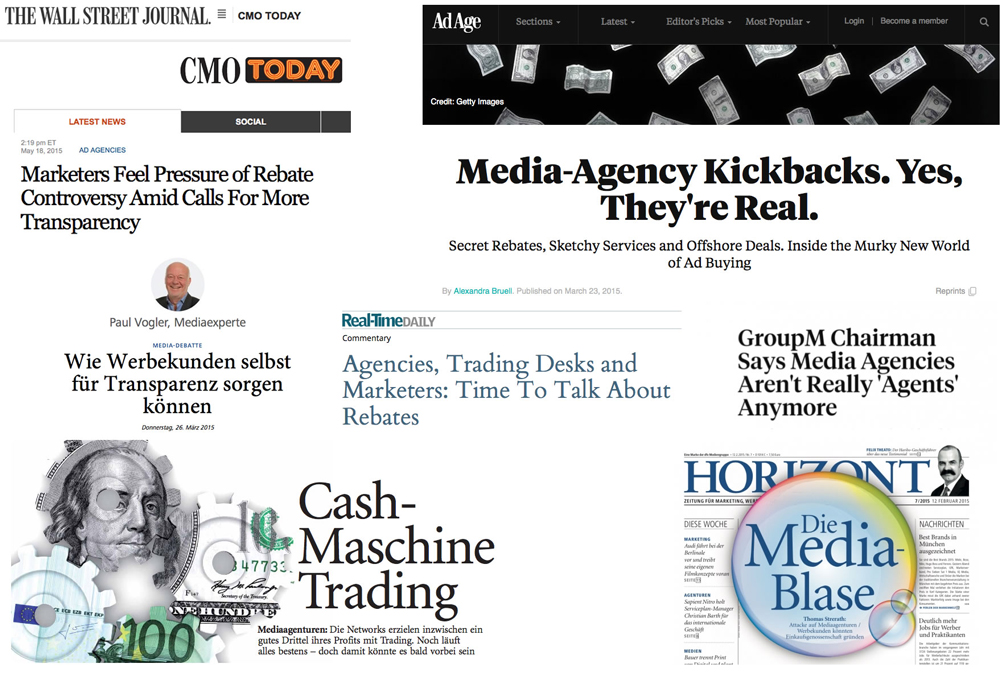
Media agencies make negative headlines in the Wall Street Journal.The criticism centers on the lack of transparency regarding the role of media agencies, buying power and the handling of discounts, freespace and kickbacks. In his presentation on March 5, 2015 at the ANA Media Leadership Conference (ANA is the US equivalent of the Swiss SWA), former US Mediacom CEO Jon Mandel triggered a flood of emails from media and marketers with anecdotes about hidden kickbacks of between 10 % and 20 % with "Have you ever wondered why fees to agencies have gone down and yet the declared profits to these agencies are up?". In Germany, Haribo has been litigating since 2009 for the right to inspect the business documents of Magna Gobal, the purchasing organization used by Mediaplus - based on the assumption that not all discounts in kind (freespace) granted were disclosed or passed on to the customer. The German Mister Media, Thomas Koch, stated in W&V on 9.3.2015 on the general situation in the market: "Skewed media plans were rigged in favor of the agencies. So cleverly that clients without their own media management were unable to recognize it."Complexity in the purchasing processThe problem is the complexity of the buying process between advertising client, media agency, buying company, marketers and the media. In addition to the simple triangle of client-media agency-medium, there are specialized independent agency units with agency agreements, which are intended to bring bundling advantages at holding company level or as joint venture partners, but also prevent transparency. Some agencies are even quite clear in this respect thanks to stock exchange regulations (including SOX) and have their clients sign corresponding contract addenda. These explicitly exclude the right to media audits. Of course, during the "sales pitch", the focus is placed on the expected benefits (additional discounts, additional free space or lower contact prices) and the loss of the audit is not even mentioned. However, forgoing your right to audit can cost you dearly. But auditing alone creates neither transparency nor trust. In addition, the need for auditing is a clear sign of a loss of trust."Skewed" media plans?It doesn't always have to be the withholding of freespace or kickbacks that can permanently disrupt trust. It often starts with "skewed" media plans. The media plans are weighted in favor of the agency's interests. Own products or those of partner and network agencies are planned in, or media with bonus/business supply agreements are given disproportionate consideration in the budget allocation. Thomas Koch is crystal clear about this: "This is then openly cheating the customer in favor of your own returns."Everything different in Switzerland?In contrast to Germany, media agencies in this country book in the name and on behalf of their clients and the invoices usually also bear the client's address. However, the situation has changed fundamentally in some cases. Some larger media agencies in particular have transformed their role as neutral consultants into a new hybrid of consultant, marketer and product provider. In such cases, it is often no longer clear to the client whether they are dealing with the media agency in the role of a trustworthy consultant or a salesperson with vested interests.What to do?Advertising clients need to be clear about the role and dependencies of their agencies by discussing this openly with the agencies and regularly evaluating their services. The review of media agency contracts and conditions belongs in the hands of specialists. Advertising clients can seek support from the SWA or third parties. Another approach is to build up more media expertise within your own organization. After all, a lot of advertising money and the return on media investment are at stake. Specialized workshops on media management, for example, are suitable for bringing the communications department up to the same level as media agencies. This enables advertising clients to increase the quantity and quality of their media plans. However, this is not about a general suspicion of media agencies! If you have nothing to hide, you should be able to provide open information about everything and thus promote transparency and trust.Separation of strategy/planning and purchasing?Media strategy and media planning must be neutral and independent in the interests of communication objectives. Ideally, buying should be separated from the strategy and planning process in order to prevent incentive-oriented booking. For media strategy and planning, specialized and, above all, neutral advice from media experts is needed, who are sensibly compensated for their work on a time and material basis. We see this field of work as an opportunity for the future. In exceptional cases, and probably only for larger clients, purchasing can be handled by the company itself or transferred to an independent purchasing organization. media management is becoming increasingly complex and therefore more demanding for everyone! This makes it all the more important to set the course in the right direction in good time. The SWA advises its members on all these issues and provides various tools on its website, www.swa-asa.chAuthors: Sandro Prezzi, media expert (sandroprezzi.ch) and Roland Ehrler, Director SWA


