
"We want more appreciation for journalism".
The ten-person Zurich-based startup Project R aims to revolutionize the Swiss media landscape—or at least offer an alternative to it with its digital magazine Republik. In an interview, Managing Director Susanne Sugimoto, Community Manager Richard Höchner, and Campaign Manager Andrea Arezina reveal how they finance the project without advertising, how much say investors have, and what role the community plays.


Advertising Week: The crowdfunding for Project R broke records in the first hours and days. After two weeks, you now count over 11,000 members and have raised over 2.8 million francs. Did you expect such success?
Susanne Sugimoto: No, we last. When I wrote a media release shortly after the crowdfunding launch, I had to constantly adjust the numbers. Our adrenaline level rose when we saw the numbers climb up at breakneck speed.
Richard Höchner: On the first day, we had over 300 refreshes on the status counter on our website - per second! We were flabbergasted and had to process this first. Hand on heart: none of us expected this start. The success creates space for us in many ways, has taken a bit of pressure off everything, but puts it back on in a different way. This encouragement is both a mission and a responsibility, a mandate that we want to fulfill.
Aren't you afraid that this was a one-off initial hype that could die down again?
Sugimoto: Of course, one also thinks about such things. We can't know how everything will develop. There are also people who wait and see. There is still potential there for the future. Through the crowdfunding success, we have a little security for the time being. Further security comes from our organization.
This consists of a cooperative and a joint stock company. What should the cooperation look like?
Sugimoto: The AG produces and distributes the magazine, which has to prove itself on the free market. The cooperative is a non-profit organization. It is responsible for the further development of journalism and general debates around media. The cooperative owns a maximum of 49 percent of Republik AG shares. Thus, those who now become members of the cooperative are, to a certain extent, co-owners of the AG. The remaining shares are owned by founders and employees, and a maximum of 20 percent belongs to investors.
How much influence do investors have?
Sugimoto: Practically none. They make their investments without the intention of making a profit and provide us with their money. As soon as Republic is self-sustaining, we start repaying the investments.
And how much say do the subscribers, each of whom is a co-publisher, have?
Sugimoto: The editorial team is fundamentally independent. However, we will take input from readers seriously. Our community management, which takes place in the cooperative, is broader than in other media.
What does this other community approach look like?
Höchner: We see readers not just as users, but as people with whom we want eye-to-eye encounters. Ahead of us lies a playing field where we can test out interaction formats, both digital and offline. Our ideas go far beyond classic comment columns. We want a lively exchange on the web, but also on site with the community. Over the next few weeks, we'll be going out to talk to people about our project and get an impression of what moves people, what they want, what questions they have.
Community building seems to be working well so far. Is that another surprise?
Höchner: We are incredibly pleased that the community is already so strong. With crowdfunding, everyone had the opportunity to publish a statement and upload their photo. Over 3000 have made use of this opportunity. 3000 questions, wishes, inputs, comments - a strong signal and valuable working material for us.
What do you plan to do with the data you collect?
Sugimoto: The demographic and geographic data and the statements are for internal use only. We will evaluate them systematically over the next few weeks. They provide us with important input.
Without this evaluation, can you already tell who the people are who support Project R and Republic?
Höchner: We have a heterogeneous community with different opinions. We are very happy about this diversity. After all, we see ourselves as initiators of debates.
Do you have an example of outside input?
Sugimoto: Certain input is not pleasant, but it is valuable. For example, we have already been accused of adopting an elitist attitude, of wanting to reinvent journalism. We criticize the system - and not the numerous good journalists who move within it.
How should the prevailing media system change in your eyes?
Höchner: For us, it's about creating more appreciation for journalism again. As in the music and film industries, digitization has led to an erosion of the market in the media industry as a first step. We now want to bring more value back into the entire production process, and the precarious production conditions in particular are an issue that needs to be put on the table. The response to crowdfunding shows that people are willing to pay money for good journalism.
So you're not going to hire low-paid interns?
Sugimoto: We do not offer the classic internships, but apprenticeships. The trainees receive half of the standard salary that all employees currently receive. Quality should have its price, and that starts with the trainees.
Other media also offer quality journalism, and yet they suffer massive financial losses. Why won't that happen to the Republic?
Höchner: We have a business model that does not yet exist in Switzerland. We will be a digital magazine with low distribution costs and do not have to comply with any advertising logic. This means that the majority of revenues can flow directly into journalism. We have a business plan, we have capital - and we finance ourselves through readers. If we do a good job, hopefully they will continue to support us.
Sugimoto: No one can say today how prices for digital media will develop. If prices develop negatively, we have a certain degree of security in the background thanks to the cooperative. Will it work? We'll know more in a year. In January, we'll be launching our product on the market, where it will have to prove itself.
Not everyone can create a new magazine with new structures. What do you think those you criticize as steering the system should do differently?
Sugimoto: Invest in journalism! And in new technologies. Readers should be queens and kings, not advertisers. Of course, some are already doing that.
Höchner: The speed would have to be throttled back, readers today are inundated with quick fodder. The compression power and reflection approaches are missing.
What would you do yourself if subscription numbers dropped sharply?
Sugimoto: We can't give an answer to that yet. We have to retain the flexibility to decide according to the situation. Growth is always asymptotic; every marketing cycle goes downhill at some point. We will certainly bring marketing expertise on board and possibly expand the offering, be it with an in-depth business section or with events. In any case, we will remain true to our principles.
What would have to happen for you to say: the project has failed?
Sugimoto: We do not have a crystal ball, so it is difficult to give a reliable answer.
You've announced that you want to gain 22,000 subscribers over the next few years. What is your marketing concept for bringing the project to the people in the long term?
Andrea Arezina: The marketing concept will be long-term with outstanding content, the overall goal and thus to strengthen journalism as the fourth estate in the state. To get to the goal, the campaign is running supportively, at the moment with a focus on crowdfunding. The focus is currently clearly on the community and its participation.
What is special about this campaign?
Arezina: Every campaign carries the risk of losing it - and the chance of winning it. What distinguishes this campaign, and other successful campaigns, is the team behind it. If they manage not to lose sight of the overall goal, a lot has already been achieved.
After all, building a brand begins long before a campaign. What was your approach?
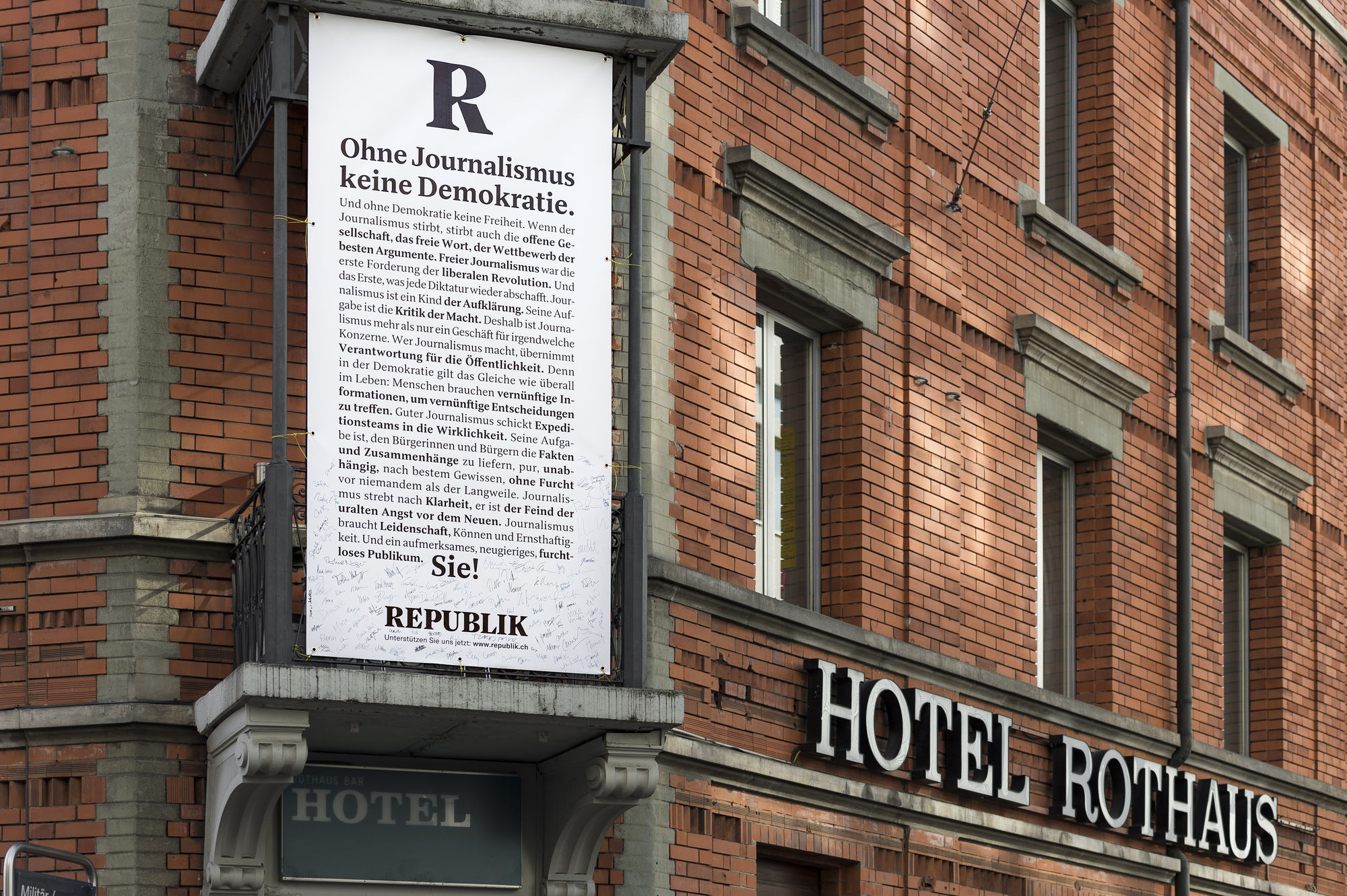
Sugimoto: Brand building was a good piece of work that we took very seriously internally and discussed with external partners. Fortunately, many have already worked on such brand processes in one form or another. We debated a lot. Now we are all in love with what we have created together. For example, our typeface called Republik.Serife ...
Höchner: We have deliberately chosen a typeface that is not streamlined.
And how did the naming process work?
Sugimoto: We discussed for a long time and condensed more and more until there were six names left to choose from. The process took several months.
Höchner: We also asked experts for feedback, because the name "Republic" is not entirely innocuous. Clarifying all that took time.
Sugimoto: It was similar with the design, with the logo creation. Tobias Peier from Bodara participated in many meetings with different campaigners. With the manifesto, the process was similar. We wrote, discussed, until we could all say, "Yes, now it's right, now it just feels right."
It's not just the brand that you've built up yourself. You are also breaking new ground in the technical area. Why is your own CMS necessary for this?
Höchner: Freedom in the presentation of journalistic content is central for us. Also, because we want to involve our community in a different way, we have to have technical possibilities that are not available off the shelf. In addition, the brand lives primarily on the web, so we have high quality standards. The user experience is also immensely important: four clicks are often three too many.
Sugimoto: It was clear from the start that IT and editorial staff should work particularly closely together. One important point is the visualization of data, which will play a major role on Republik.ch.
Still a lot of effort ...
Höchner: We are committed to the open source approach, so we don't have to start from scratch. In return, we make our developments available to others. We are also in discussion with other small media about how to make the technical possibilities available to everyone.
You have announced that you now want to expand your team. What are the next steps?
Sugimoto: We are initially hiring more IT developers. The editorial team is forming independently, and talks will begin there in the summer. The first journalists will start in October. We don't want to expand the team overnight, but step by step so that we can integrate the newcomers well.
How are you tackling the growth wave?
Sugimoto: When a company grows, growing pains are part of it. Up to now, we have been in start-up mode, but that will change.
Höchner: One should consciously distinguish between times when one opens up, gathers thoughts, discusses and those when one closes down and everyone devotes himself to specific tasks in his field of expertise.
Last but not least: How does the competition rate your success?
Sugimoto: We had a meeting with other small media the other day, and they confirm that we are not primarily a competitor, but that we give a boost to the entire media landscape.
Höchner: Exactly, if we can get people to pay money for good journalism, that benefits the media as a whole.
Interview: Nora Dämpfle / Ann-Kathrin Schäfer
This article is from the current Werbewoche 9/2017, published on May 19, 2017. Don't miss out on anything else: To the subscriptions.


