
Swiss advertising market 2025: out-of-home grows, traditional media stabilizes
The Swiss advertising market will close out 2025 with gross advertising expenditure of 3,930.8 million CHF in the traditional sector (-1.7%). After a weak start, the market gradually stabilizes in the second half of the year. Out-of-home remains the clear winner with growth of 4.4% and continues to expand its market share. TV provides a positive boost in the third quarter thanks to WEURO.


The traditional Swiss advertising market shows a robust picture in 2025 despite a slight decline. With gross advertising expenditure of CHF 3,930.8 million, it is down CHF 1.7% on the previous year. However, the course of the year shows a gradual stabilization: after a weak first quarter (-4.2%) and a likewise declining second quarter (-2.9%), the market is approaching the previous year's level again in the second half of the year. In the third quarter, the decline was only 0.2%, and in the fourth quarter the market even turned slightly positive (+0.1%).
TV delivered the only quarterly boost to growth in the third quarter (+0.8%), driven by campaigns in the sports environment surrounding the Women's European Championship 2025. Out-of-Home grew consistently throughout the year, achieving growth of 4.4%.
Digital advertising market: total advertising pressure at over CHF 6 billion
If we expand the view to include the display delivery statistics, the total value pressure is CHF 4,481.1 million, which corresponds to a decline of 1.4%. The turnaround is even more visible at quarterly level: the first quarter is -4.9%, the second -2.8%, while the third quarter shows growth again at +0.6% and the fourth quarter at +0.9%. With YouTube, the picture changes only marginally: classic plus display delivery statistics plus YouTube reach CHF 4,688.5 million, also a minus of 1.4%.
The entire digital advertising market - including search - results in a total advertising pressure of CHF 6,007.5 million (-2.4%). In the case of Search, it should be noted that there were strong fluctuations in the recording in 2025, particularly in the first half of the year, due to Google updates, which limited the comparability of the gross advertising pressure with the previous year.
Media mix: out-of-home continues to gain in importance
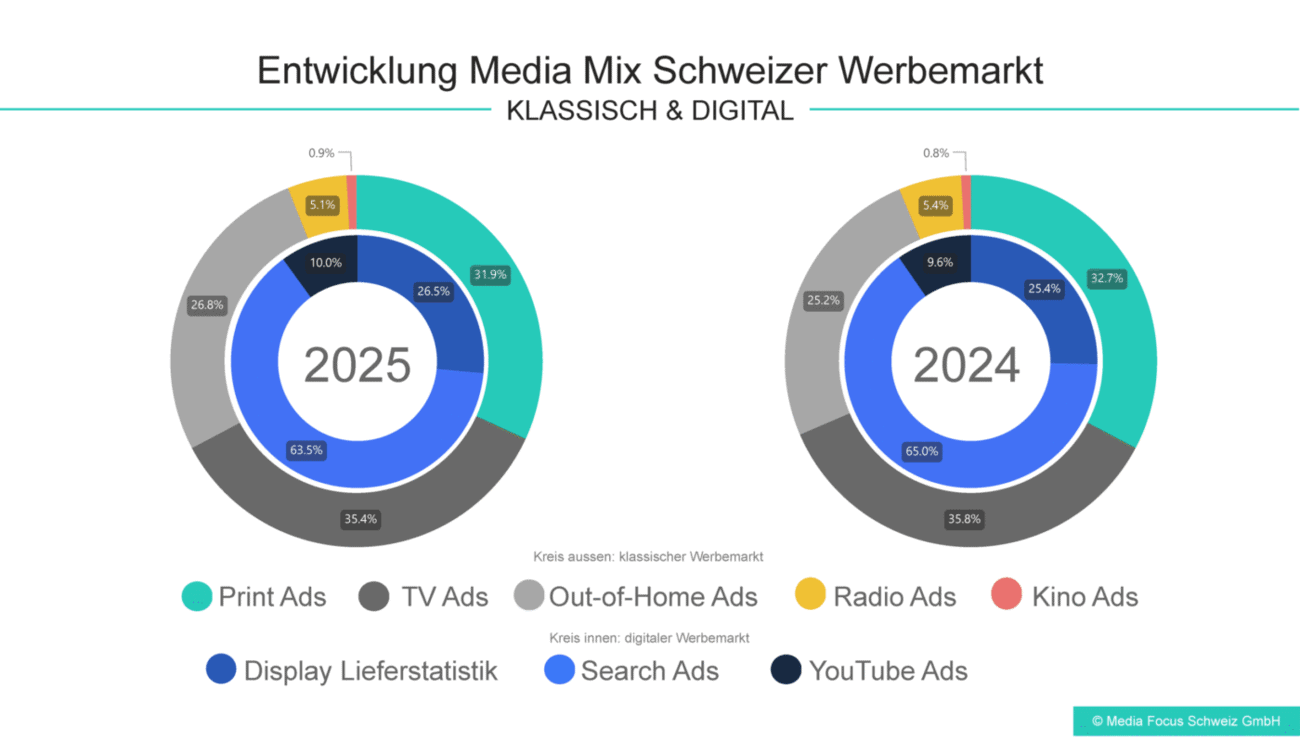
The media mix shows a further shift in favor of out-of-home in the traditional advertising market in 2025. Out-of-home advertising will increase its share from 25.2% in 2024 to 26.8% in 2025, gaining 1.6 percentage points. At the same time, print will fall from 32.7% to 31.9%, a decrease of 0.9 percentage points. TV remains largely stable as the largest media group, but is down slightly: from 35.8% to 35.4%, which corresponds to a decline of 0.4 percentage points. Radio is also down slightly, falling from 5.4% to 5.1% (-0.3 percentage points). Cinema increased slightly (from 0.8% to 0.9%), confirming its stable role as an attention-grabbing supplementary medium.
In the digital advertising market, search remains clearly dominant with 63.5%, despite volatility in the recording. Display accounts for 26.5% of advertising pressure, the channel can increase marginally (+0.6%). YouTube accounts for 10% of advertising pressure. However, the increase cannot be explained by growth within the measured values, but by the fact that less search advertising pressure could be measured.
Top advertisers: Coop and Migros remain in the lead, Swisscom and Nestlé make strong gains
At the top of the advertising client ranking, the ranking remains stable: Coop and Migros continue to occupy first and second place. Coop has a share of advertising (SoA) of 24.0% and is slightly below the previous year (-2.5%), while Migros has increased significantly with a SoA of 16.2% (+20.9%). Procter & Gamble is again in third place with an SoA of 7.7%, albeit with a decline of 19.0% compared to the previous year. The consumer goods giant has significantly reduced TV advertising pressure across several product segments.
Behind the top 3, the dynamism of individual advertisers is particularly striking: Denner grows by 20.9% and improves from 6th to 4th place, driven by a strong presence in Migros Magazin and two out-of-home campaigns at the beginning of the year and around WEURO in July. Swisscom even gains 54.5% and rises significantly from 12th place. The telecommunications provider is noticeably increasing its advertising pressure in 2025, particularly in out-of-home, but also in TV and radio. McDonald's is also growing (+7.8%).
On the opposite side, several brand players are under pressure: L'Oréal loses 25.9%, Henkel 18.2%, Beiersdorf 7.2%, Aldi 7.9% and Ikea 6.6%. The composition of the top 20 provides additional movement: Nestlé is new to the top 20 with TV Offensive and makes it straight to 11th place (previous year 23rd place), accompanied by very strong growth (+91.7%). However, Möbel Pfister, Swisslos Interkant and Verfora are no longer in the top 20.
Top products: Fast food, diapers and vacations dominate
McDonald's restaurants and Pampers diapers once again lead the ranking of the most advertised products, closely followed by trivago.ch in third place. NZZ Shop and brack.ch, two e-commerce offerings, make it into the top 10. The list is completed by other travel providers (car-tours.ch, Thurgau Travel), a credit provider (Credit Now personal loan), Poltronesofa living room furniture and Ariel All in 1 Pods.
The top new products in 2025 are dominated by technology and consumer goods: the Apple iPhone 17 Pro tops the list, followed by the Samsung Galaxy S25 Ultra. There are also strong innovations from the FMCG and beauty sectors - from Ariel with Lenor Unstoppable and Nivea Cellular Epigenetics Serum to Schwarzkopf Creme Supreme Coloration. A health product is also represented with Vicks Angimed lozenges, while Bilz Stellare 0.0, Super Bock Unfiltered and Birra Moretti Sale di Mare show that beverage innovations, especially non-alcoholic alternatives, are also being visibly pushed. Swisscom Blue Security + Service rounds off the top 10 as a service innovation.
Display, YouTube and Search: Different industry profiles per channel
The retail trade remains the clear leader in the display sector: with Coop, Migros, Aldi, Lidl and now Denner, five retailers are represented in the top 10. Behind them, the list is much broader: VW brings automotive power to the ranking, while Spusu, a price challenger from the telco environment, makes it into the top 10. With UBS and Bitpanda, both an established financial giant and a fintech are represented in the top 10. Philip Morris completes the field and illustrates that digital channels are particularly attractive for highly regulated categories.
On YouTube, a mix of entertainment and strong consumer goods brands is at the top: Nintendo leads the ranking, followed by Beiersdorf and PepsiCo. With Coop in fourth place, a retailer is once again prominently represented, while The Walt Disney Company strengthens its entertainment presence in the top 10. This shows how widely YouTube is used as a brand platform: Philip Morris enters in 6th place, Ferrero follows in 7th place and international e-commerce giant Temu has to settle for 8th place (last year 4th place). McDonald's (9th place) and L'Oréal (10th place) complete the top 10.
The comparison with TV is exciting. Only 3 of the top 10 YouTube advertisers are also represented in the top 10 on TV: Coop rank 5, Ferrero rank 3 and McDonald's rank 8. Beiersdorf (11) and L'Oréal (12) just miss out on the top 10. Others, such as frontrunner Nintendo (48th), third-placed Pepsi (60th) and fifth-placed Disney (186th), are much less visible on TV. And still others - namely Temu and Philip Morris - do not appear on TV at all.
In 2025, the topic of travel and comparison is particularly clearly reflected in Search: With booking.com at the top and other travel offers such as Skyscanner, Trivago, Opodo, eDreams as well as ab-in-den-urlaub.ch and ab-ins-blaue.ch, travel providers dominate the top ranks. As many as 7 of the top 10 advertisers are travel platforms. Comparis.ch in second place underlines the continuing high level of information and price awareness, while non-travel-related players remain visible with axa.ch (insurance) and yallo.ch (telco).
Sectors: Retail trade strengthens leading position, vehicles still under pressure
In the traditional advertising market, the vehicle sector remains under clear pressure in 2025: at -8.5%, it closed significantly below the previous year, but remains in 7th place. However, the picture behind the decline is not uniform: several brands have noticeably increased their traditional advertising pressure, including Volvo, Mercedes, BMW, Polestar and Fiat. At the same time, the decline is largely due to significant reductions by individual major players, above all VW and Cupra.
Initiatives & Campaigns (-9.8%, rank 3), Beverages (-6.6%, rank 10) and Pharma & Health (-5.7%, rank 12) are also in decline. However, there will also be winners in 2025: Retail will continue to expand its leading position and grow by 13.3%. Services also increased (+6.4%) and gained one rank (now rank 11). The growth in Personal Supplies is also striking (+10.6%), also gaining one rank (now rank 16). Telecommunications also grew significantly (+13.3%), not least due to Swisscom's advertising campaign, and is now ranked 15th.
A comparison of the industry rankings shows clear shifts between the traditional and digital advertising market in 2025. As the traditional digital frontrunner, retail remains dominant, particularly in display (rank 1), but loses significant weight in search (rank 12) and YouTube (rank 10). Food is also widely visible, but stands out above all in YouTube (rank 3), while Display (rank 10) and Search (rank 15) are clearly behind.
Conversely, other sectors have a much stronger digital impact: Telecommunications is ranked 15th in the traditional ranking, but is ranked 4th (Display) and 6th (Search) digitally. Digital & household (classic rank 14) is particularly present online - with rank 2 for YouTube and rank 4 for search. The financial sector is ranked 4th in traditional terms, but is even better positioned digitally in 2025: It retains 2nd place in Display and Search, and improves from 3rd to 1st place in YouTube, thanks in part to the YouTube campaigns of Migros Bank and Axa.
Outlook 2026: Uncertain environment and new challenges
In 2025, the Swiss advertising market shows an overall robust picture in the traditional segment: at CHF 3,930.8 million, gross advertising pressure is only slightly below the previous year (-1.7%). What is striking is the annual trend, which is gradually stabilizing on a quarterly basis. If the digital channels Display Delivery Statistics and YouTube are included, the decline in advertising pressure weakens slightly (from -1.7% to -1.4%).
One trend is clearly continuing in the traditional media mix: out-of-home continues to gain in importance and is once again increasing its share of the traditional market. Out-of-home also developed particularly consistently throughout the year, confirming its role as a stable growth driver in the Swiss advertising market. However, the ongoing discussions about a possible ban on out-of-home advertising continue to sow uncertainty. A ban could further encourage the shift of advertising budgets to international platforms - with negative effects on value creation in Switzerland.
TV remains the strongest media group despite the decline. Only in the third quarter did campaigns in the sports environment surrounding the WEURO provide a noticeable boost, while TV declined in the other quarters. Print and radio, on the other hand, remain under structural pressure, while cinema confirms its role as an attention-grabbing supplementary medium.
2026 will be particularly exciting against the backdrop of a persistently uncertain environment: geopolitical tensions, times of punitive tariffs and a global economy that is difficult to plan are increasing the pressure on budgets and making flexibility the key currency in media planning. Added to this is politics: possible advertising bans and, above all, the halving initiative are creating uncertainty. At the same time, consolidation in the media landscape is accelerating - with effects on reach, pricing logic and the availability of high-quality environments.
Last but not least, social media has become a key addition to the media mix and the migration of advertising money to the major tech platforms is continuing, albeit only partially measurable statistically to date. As in 2025, 2026 is therefore likely to be a year in which advertisers, agencies and media companies will face new challenges in equal measure. It will be all the more exciting to see how budgets continue to shift in the area of conflict between traditional reach media, digital platforms and new AI-driven opportunities.


