
Project R launches republic
Project R's planned digital magazine is to be called Republik. The makers have chosen a special date for the christening. They explain why in their newsletter.


As befits the proclamation of a republic, Project R publishes a Manifesto.
"The Manifesto captures how we at Project R understand the role of journalism in a free society. It is timeless and written for eternity. Yet the future of Republik is still uncertain. Everything, not least 3.5 million francs of investor and donor money, depends on the success of the upcoming crowdfunding. We need to convince at least 3,000 readers to collect 750,000 francs together. Like any republic, ours is not founded by a handful of people, but by many." If the crowdfunding is successful, Republic will launch in early 2018. If it fails, the project will be liquidated. The crowdfunding launch is April 26.
Why Republic was christened Republic on 12.4? The answer is given by the Project-R makers in their announcement on Wednesday:
"Today is the ideal date for the baptism of the Republic. On April 12, 1798, 219 years ago, the delegates of the cantons proclaimed the Helvetic Republic. They did so not least under pressure from Napoleon. The republic existed for only five short years. And it was anything but stable. During the five years, the French plundered the coffers of the wealthy citizens of Zurich and Bern - while the rest of the country sank into a confused civil war in which everyone fought against everyone else: radical liberals against moderate liberals, subject territories against dominions, peasants against nobles, Central Swiss against French. In the end, those who had ruled before won: the patricians. Four coups d'état were counted in the short time.

The most important man in the founding of the Republic was the liberal Basel writer, jurist and Napoleon supporter Peter Ochs. After the failure of the revolution, his sons changed their name - out of shame. And yet their father left a lasting legacy: he wrote Switzerland's first modern constitution. With separation of powers, elections, civil rights, freedom of religion and of the press, abolition of subject territories and titles of nobility.
Freedom of the press was guaranteed by the constitution of the Helvetic Republic in the simple but comprehensive principle seven: "Freedom of the press is a natural consequence of the right everyone has to be informed" - that is, to know what is going on.

It was the birth of modern Switzerland, in the midst of chaos. For the ideas of the Helvetic Republic survived their failure. And shattered the rule of the rich families. These had previously ruled with an iron fist - not least through judicial murders. Switzerland was the inventor of this practice. Unpopular persons were sentenced and killed under abuse of the law. For example, the pastor, economist and statistician Heinrich Waser was executed on May 27, 1780. In his book "Schweizer-Blut und Franz-Geld, politisch gegeneinander gewwogen" (Swiss Blood and French Money, Politically Weighed Against Each Other), he had calculated the extent to which the patricians were enriching themselves from mercenary trade. The death sentence was passed because of the paragraph "press offense".Peter Ochs' first modern constitution made journalism not only a child of the Enlightenment, but much more: its driving force.
The legacy of the Helvetic Republic was taken over by the Republicans of 1848. It was the only successful liberal revolution in Europe. And it realized in practice what had only been on paper in the Helvetic Republic. In a very short time, an entire country was reinvented: with a constitution that guaranteed the separation of powers, equality before the law and elections, with a universal school system, universities, independent courts and freedom of the press. In addition, a complete infrastructure was built from scratch: the railroad, the first major bank, the Gotthard tunnel.
The fact that we at Project R call our magazine Republic is a commitment to this tradition. First, we are impressed by the energy of the republicans of the 19th century. Even if by no means everyone benefited equally from the beginning - women, for example - progress was set in motion. It was a century of courage. Plans were made everywhere. And they simply got started. The writings of radicals and liberals, such as Gottfried Keller, are full of words like "project" and "laboratory. The social competition was primarily about buildings, reforms, inventions. People thought big. Started. And looked ahead.
Second, while the republic - the res publica, the public cause - has seen endless manifestations since the time of Rome, all designs have one thing in common: the concept of the common good and participation. Their political minds thought not only of themselves and their class or caste, but of the whole. This view seems to us the right one at a time like today, when on the one hand everything is connected. And yet everything is fragmented: into individual interests, into a thousand opinions and the flood of even more news. Our job as a young media will be a very traditional one: not to deliver the hustle and bustle but the big picture, not to whine but to look for possibilities, not to describe the details but the developments.
Third, republican achievements are once again at stake. Numerous parties - and in Hungary, Poland, Turkey, the U.S. and perhaps soon even the governments in France - are pursuing a new model: authoritarian democracy. At its core, the goal of authoritarian parties is to impose their power as completely as possible after winning elections. And to silence the judiciary, the press and the opposition. With the argument that, as election winners, they embody the majority of the people.
It is the return of the world before the Helvetic Republic and before the 1848 Revolution: the rule of clans. The promise that the authoritarians make to their voters is twofold: first, that their clientele will benefit and their opponents will be removed from all positions. And that, as under the patrician regime in Switzerland, dominions with subjects will once again be established in which disagreeable groups - such as women or foreigners - can be bossed around.
The second promise of the authoritarian parties is the pure exercise of power. That something will finally change. This is no small promise in a complex world in which even powerful people are shackled: by contracts, the vagaries of markets, the web of relationships. Authoritarian regimes are ending the phase of no alternatives. And replace it with naked politics: It is not arguments that count, but their enforcement; not facts, but the creation of facts; not complexity, but harshness; not the question of what would be the smartest thing to do, but the question: Are you with us or against us?
At first glance, the authoritarian program seems fresh, raw, archaic. On closer inspection, it is decadence. In their study, "Why Nations Fail," authors Daron Acemoğlu and James A. Robinson examined dozens of case studies for characteristics that distinguish flourishing and decaying societies. The findings were stunningly simple. To prosper, a society needs only two things: 1. the breaking of power by strong institutions. Most importantly, protection against arbitrariness by a stable rule of law. 2. the upward mobility of as many diverse groups as possible.
In short, the authoritarians' program, based on concentration of power, isolation and exclusion, is not a program of renewal. It is one of decline.
For journalism, the rise of authoritarians is a problem. If only because the first thing any authoritarian government in power does is attack press freedom. But also because journalism's role as democracy's watchdog in a society divided into camps is functioning poorly. A single one of Donald Trump's scandals would have done him in as a politician in a society united in its core values. In a divided society, however, the media's investigations become propaganda for the other side. This changes the political dramaturgy: By the dozen, Trump's scandals turned into the central argument for his candidacy. Because they proved his power to the voters. In that he could afford them.
The main strategy of authoritarian politicians to undermine a democracy is confusion. That in a flood of allegations and accusations everything becomes equal. That all arguments and facts are only opinion, that all experts, all politicians, all journalists and scientists only reflect the opinion of their camp, that all lie, all are bribed, all have dirt on them. That it is not reflection that counts, not arguments, not experience, but only the decision between two clans.
For political journalism, this means that it can no longer afford confusion. Bad work today means more than just bad work: it is taking sides with the authoritarian camp. The only thing that helps against the strategy of confusion is clarity: not the clarity of an opinion that is as harsh as possible, but clarity in drawing complexity, connections, decisions along with their costs. This requires a small shot of courage. In private life, the only remedy for fear is to approach it. In public life, the only way to improve the world is to make it transparent.
It is worth fighting for. The victories of the authoritarian camp have so far always been extremely close - albeit with major consequences. Trump won in the decisive states against Hillary Clinton with a difference of around one percent. The mass immigration initiative, which paralyzed Swiss politics for years, was approved by 50.3 percent. The latter also showed what fighting can achieve. In the case of the mass immigration initiative, against which there was hardly any fighting, the right-wing nationalists' roughly 400,000 yes votes were enough for a narrow majority. In the case of the enforcement initiative, which was fought against, the 400,000 or so votes did not go anywhere. The right-wing nationalist camp conceded a 40:60 percent defeat. But the next attack on human rights is already imminent: the "self-determination" initiative.
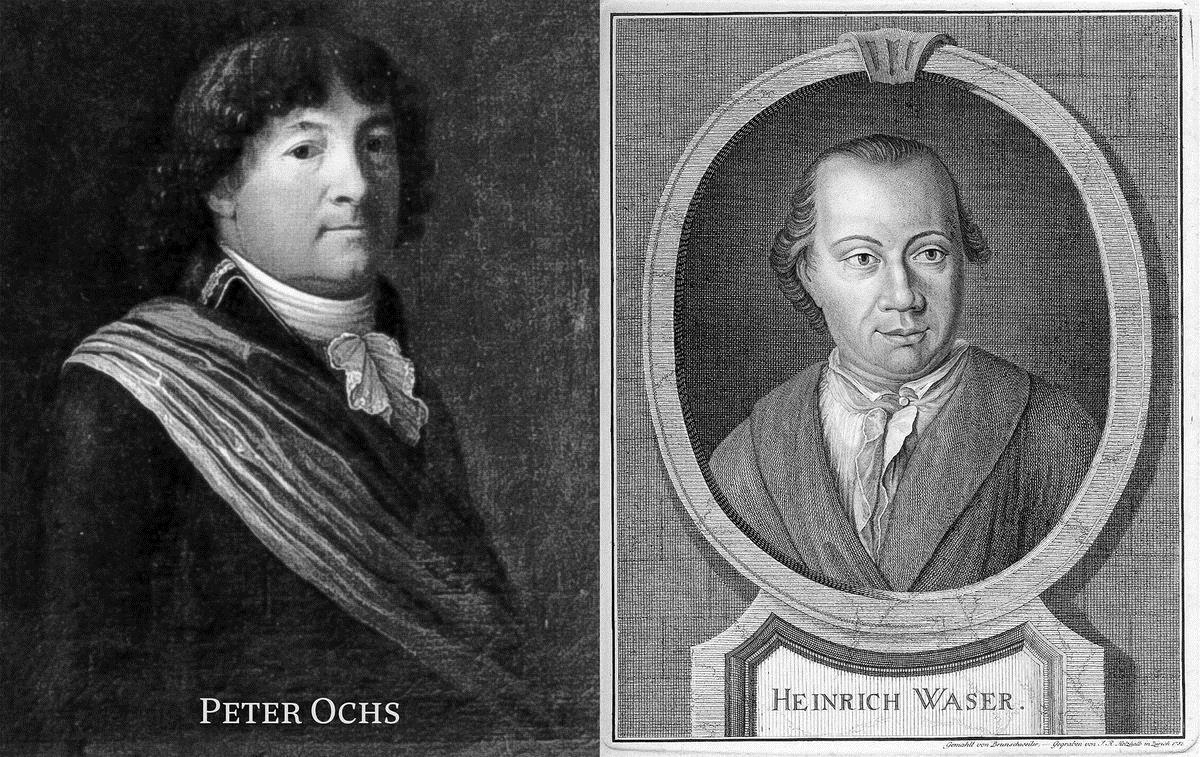
The time has come to fight for self-evident things like the rule of law, equality before the law or the separation of powers. For decades, republican institutions were almost boring. Because they were undisputed. That is now a thing of the past. Historically, this is no surprise. Because the institutions are crystallized struggle. To build them, generations of men and women - such as Peter Ochs or Heinrich Waser - risked position, honor or even their heads. Now it is the turn of our generation.
Long live the Republic!"


