
Population satisfied with broadcasting in Switzerland according to study
According to a Bakom study, the Swiss public is satisfied with radio and television programming. The SRG fares better than private broadcasters.


The Federal Office of Communications (OFCOM) has published the latest report of the continuous audience survey on the use and evaluation of private and public broadcasting in 2016. The study comes to the conclusion that the Swiss population is satisfied with the radio and television programs they use, with the quality of SRG offerings being rated higher than that of private providers. Television stations are rated more critically than radio stations. The high level of professionalism and the information content play a decisive role in the popularity of SRG offerings. In the case of local radio stations and regional television, local relevance is the decisive factor. In addition to the subjective ratings by the audience, the higher acceptance of SRG offerings is also reflected in the usage statistics.
SRG radio ahead of SRG TV and local radio in terms of quality, followed by regional TV
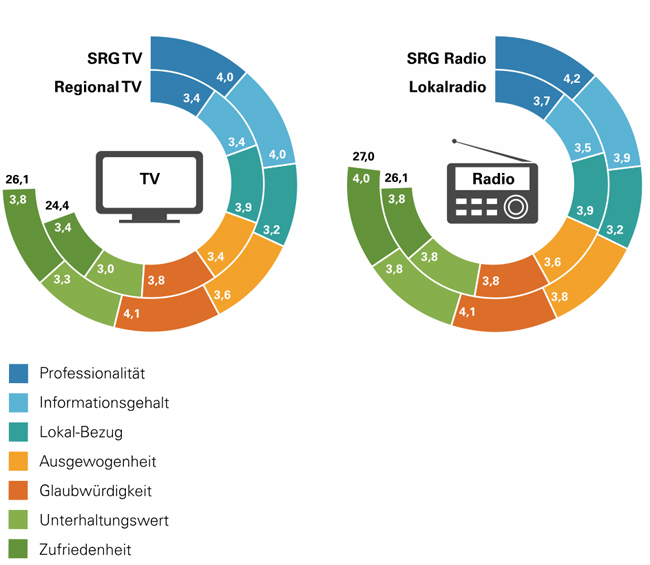
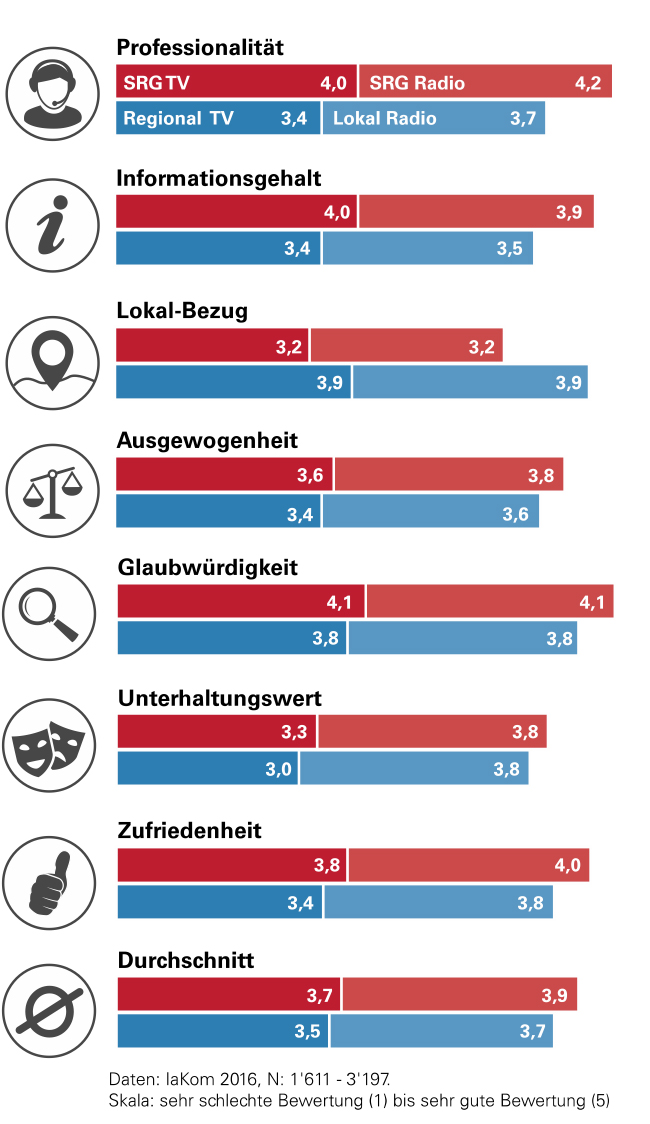
On a scale of 1 to 5, the SRG radio stations scored best on average for all the quality characteristics surveyed (professionalism, information content, local relevance, balance, credibility, entertainment and overall satisfaction) (average score of 3.9). SRG television stations and private local radio stations were rated equally well (3.7). On average, private regional television stations are clearly above the neutral scale average of 3, but behind the other service groups (3.5).
SRG stands for professionalism and information content and the private broadcasters for local relevance
From the viewers' perspective, the strengths of SRG TV stations lie in their "credibility" (4.1), "professionalism" and "information content" (both 4.0). In contrast, the "entertainment value" (3.3) is rated below average, while the low "local relevance" (3.2) follows from the license. The regional TV stations are valued above all for their "regional relevance" (3.9). The "credibility" (3.8) is seen as fairly constant for all offerings. In contrast, the "balance" (3.4) of the regional stations is rated lower, although this rating category is also lower for the SRG TV stations. Compared to SRG, "professionalism", "information content" (both 3.4) and "entertainment" (3.0) were rated significantly lower.
SRG radio performs best in terms of "professionalism" (4.2) in a comparison of all means of evaluation. Its "credibility" (4.1) is regarded as high. SRG radio is also ahead in the assessment of "information content" (3.9). Listeners of SRG radio stations rate the "balance" (3.8) of their stations better than those of local radio stations (3.6). In line with the license, local radio stations scored significantly better in "local relevance" (3.9) than SRG radio stations (3.2). The "professionalism" (3.7) and "information quality" of local radio stations, on the other hand, is rated significantly lower than that of SRG stations. Radio stations are generally rated as more entertaining (both 3.8) than television stations.
About the study
The findings are based on a representative telephone survey (CATI) conducted by the Demoscope survey institute in spring 2016 with 3,680 people aged 15 and over in all regions of Switzerland (random sample). The study was designed and analyzed by the Institute for Applied Communication Research (IaKom) on behalf of OFCOM. The margin of error of the mean values given is (95% significance level) a maximum of ±0.1. Differences in mean values are all significant from a difference of 1.5. The complete report can be downloaded at Bakom.admin.ch can be viewed here. The volume of tables with breakdown groups and the graphic files can be requested from Benjamin Fretwurst ([email protected]). The study cost CHF 155,628. As part of the research program to investigate the program quality of radio and television, this audience survey complements the program structure and content analyses carried out in the other modules by other research institutes.


