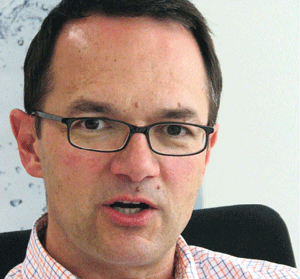
You have been CEO of CCS for just over a year, and so far few people know who you are.
Jürg Rötheli: This has changed a lot in the past few months. The fact that I am not yet known everywhere in the marketing and communications scene is due to my professional history. Before Clear Channel, I was a member of the Group Executive Board at Swisscom, where I was responsible for the associated companies.
Where do you see your strengths? What are your weaknesses?
I am a very open and communicative person who believes very strongly in the performance of his team. I compare my job as CEO of Clear Channel to that of the conductor of a large orchestra. We rehearse the individual parts, and I put them together with all the musicians to form a harmonious whole. Of course, I set the tempo. But the concert is only really good when the whole orchestra joins in.
Do you have a leadership principle?
If you want to talk about a principle, then I would call it the "trust principle. As a matter of principle, all my employees have my trust. They don't have to spend years proving it. I always try to give my people responsibility across all hierarchical levels. This responsibility should also motivate people and leads to good performance.
What about your weaknesses?
I have a tendency to push forward quickly, to want to achieve a lot in a very short time. That can exert a certain pressure and overwhelm the people around me. That's where you have to proceed with a lot of sensitivity and make changes gradually and gently, without taking away people's enthusiasm and motivation.
You came to CCS from Swisscom - what was your motivation for the change?
I joined the Swisscom Executive Board at a very young age, 35, and worked there for ten years. After this rather long period of time, I felt the need for a change. In addition, as CEO of Swisscom's subsidiaries, I had to manage a lot of different companies: Nine companies in nine different markets, including real estate, the telemedicine company Medgate, an international software company, a customer card company, all the collection companies, including Billag. Today at Clear Channel, I like being able to focus on a single industry.
15 months ago, you joined CCS as CEO. What state did you find the company in?
I found a motivated team. This was not a matter of course, as the employees had just come through a crisis at the parent company Clear Channel International. My focus in the first twelve months was therefore on structural issues such as organization and personnel, in order to be able to tackle the major challenges in this market - keyword: digitization of advertising space - in the best possible way. I also held many talks with agencies, advertising clients and contractual partners on the real estate side, where we have our advertising spaces.
They touted it: In 2008, private equity firms Thomas H. Lee Partners and Bain Capital joined Clear Channel International, the financial crisis hit, and the company was about to be split up. The uncertainty was great.
Yes, the Group went through a difficult phase - but not in Switzerland: CCS was always solidly financed. Today, Clear Channel International is also doing very well again, and the investors want to expand the business. Of course, private equity investors always have the goal of exiting at a profit at some point. But this is not in sight in the next two to three years.
Your predecessor Beat Roeschlin always had to secure his position at the top first. How is that today?
The situation back then cannot be compared with today. The Group gives us a lot of freedom to develop the business locally. In Switzerland, we benefit from the fact that Clear Channel is active in 27 countries on four continents, for example in purchasing and the development of innovative products. The European headquarters in London supports us. I see that as very positive.
Your competitor APG generated sales of 259 million Swiss francs in Switzerland last year, 3.6 percent more than in the previous year. Where does CCS stand?
As a company listed on the US stock exchange, we do not publish sales figures at national level. But I can say this much: with 200 employees, we generate an offer volume of around 200 million Swiss francs in Switzerland. Our operating margin has been significantly better than that of our main competitor for years. With around 20 percent of the advertising space, we achieve a market share of around 30 percent.
I thought CCS had 20 percent market share, APG 75 percent?
I tend to assume a ratio of 30 percent CCS and 65 percent APG. The rest is shared by various smaller providers.
CCS has 20'000 road surfaces, a city contract with Bellinzona and 2 of 16 so-called lots in Zurich. You also have an exclusive contract with Zurich Airport. The latter is probably your cash cow?
Zurich Airport is an outstanding, absolutely innovative partner and a clear "flagship" for CCS. Nevertheless, our main revenues still come from the "roadside locations".
You mentioned expansion and digitization before. What steps do you have in mind?
We have three thrusts in digitization: First, we are already expanding digital advertising at Zurich Airport this fall. The second initiative concerns the POS (Point of Sale): Today, we are number one in terms of POS volume in Switzerland, including contracts with shopping centers and gas stations. We want to expand this market digitally as well. In the third initiative, digital outdoor advertising in cities, on the other hand, we are only at the beginning: It was a "regulatory" taboo for a long time. We also have other growth projects.
For example?
We want to expand business with direct customers who are not represented by media agencies. In addition, there are many companies that do not advertise with posters but through other channels. Today, outdoor advertising has a market share of only about 11 percent. We want to develop this with new technology. Our focus is therefore not on the classic competitors, but on the genres of print, TV, and online.
Back to digital advertising for cities: What does it look like in concrete terms?
We are thinking of soundless screens in the common formats F12 and F200, which easily allow moving images and can also be installed "outdoors". We are already in contact with some big cities with the aim to build up a pilot project.
What arguments do you use to approach the cities?
For example, that digital surfaces concentrate advertising in public spaces in those places where a strong advertising effect can be achieved, and that in return some unpopular places may disappear. Advertising in public spaces is always part of the cityscape. If a city wants to appear modern or innovative, digital advertising can be a building block for this. There are also studies that show that digital advertising does not impair traffic safety any more than conventional advertising.
CCS has had little success with conventional billboard submissions in cities. Recently, you also lost the tender in Geneva. What goals are you setting yourself in this area?
Until now, the city inventory has usually been awarded exclusively to one provider for several years. However, we are in favor of a model like in Zurich, where a public tender with so-called lots was carried out in 2006. This means that the city inventory was put out to public tender and divided among several providers, which led to a win-win situation for all sides, including the city of Zurich. Our goal is not necessarily to win entire cities.
These are new tones. Until now, CCS had the image of a sore loser, regularly challenging decisions in favor of the competition through all instances.
That was yesterday and is not the way of the future for me. We want to convince the cities that we are a competent partner for the management of advertising space and that a balanced distribution of inventory and a healthy competitive situation has its advantages for the cities.
Does this mean that your ears are open?
Yes, I sense that this partnership approach is being positively received. I expect that not only Zurich will again tender in lots, but that other cities will also go this way.
A cooperation trial between CCS and the Geneva transport companies has been running for nine months. What is the next step there?
We are managing 100 F12 and F200 advertising formats there at the rear and on the side of buses. Our goal is clear: we want to turn this pilot into a longer-lasting partnership. In the important Geneva area, we currently have an insufficient presence. With transit advertising, we could expand this presence.
CCS has no other means of transport advertising. So is Geneva supposed to serve as a showcase for you?
Correct. The concept can easily be transferred to other transport companies in Basel, Bern or Zurich.
You recently joined the Swiss Outdoor Advertising Association (AWS) with CCS. Why?
Even if you look at the competitive situation of the two main market players, I don't think we should just fight each other. There are a lot of things we can do together.
For example?
There are similar interests, for example when it comes to regulating outdoor advertising, as well as advertising bans or the exclusion of certain advertising categories. But here, too, it cannot simply be a matter of pushing through our ideas against the sensitivities of the population. We have to take them seriously and try to deal with them sensibly.
CCS has been in the headlines twice recently - for tobacco advertising around schools and for advertising a brothel in a residential neighborhood.
As far as tobacco advertising in schools is concerned, the case is clear to me: we were wrong. With political or erotic advertising, on the other hand, the boundaries are less clear. Moreover, as an advertising service provider, we must not allow ourselves to be forced into a censor role.
Back to the AWS: Poster research could also be a topic there.
Yes, we are working intensively on this. Together with APG, for example, we are considering whether and how CCS can once again become involved with the SPR+ research company. The goal must be to have only one "industry currency" in outdoor advertising.
Is this change in strategy coming from you or from London?
It comes from me and Affichage. Our joining the association and the new collaboration were made extremely easy because both companies are under new management. The new Affichage CEO, Daniel Hofer, and I are unencumbered and get along well personally.
But leaving SPR in 2005 was not a whim of your predecessor Beat Roeschlin, but a directive from Clear Channel headquarters. The same applies to the fact that you invested in your own research system called More. What caused the turnaround?
I don't know the background, and for me this belongs to the past. Let's look ahead. More has been replaced by the "Mobility Atlas," a project of ETH Zurich, the Federal Statistical Office, Affichage and CCS, and other partners. It allows us to map mobility flows. Specifically, we get a system that tells us where and how people move and with what intention. The question will be how we can bring this groundbreaking innovation together with SPR+ to create an "industry currency."
But the main problem is that CCS has been a free rider on SPR+ since the phase-out: SPR+ collected all the CCS areas and designated them, but CCS paid nothing for them.
That is precisely the crux of the matter. The trick will be to find a solution - be it via a partnership or participation - that takes into account what has been done at SPR+ since then, but conversely also accommodates those things that we can bring to the table. Achieving such a result is not easy.
Is this an issue in AWS, and will a solution be under the roof by the end of the year?
Yes. And based on the players I met there, I believe that bringing the two approaches together can succeed.
Your predecessor's research advisor was Urs Zeier, former project manager of the free newspaper Metropol. Is he also at your service?
Yes, he has been working for CCS on a mandate basis for many years and manages some strategic projects for me. Due to his many years of experience, he is an excellent sparring partner for me and the entire management team.
Is Toni Jarvis, the former head of research at Clear Channel International, still in the mix as well?
No.
Interview: Markus Knöpfli