
"We have a new cooperation with almost all newspapers"
Hanspeter Rohner, President and CEO of PubliGroupe, explains in an interview with *Werbewoche* how far the new business model has progressed.


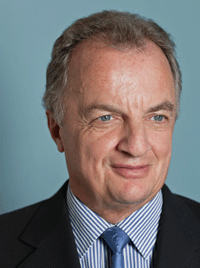
Two years ago, PubliGroupe CEO Hanspeter Rohner announced a new Publicitas business model with the following key points: 1. Publicitas (P) charges cost-covering prices for (small) advertisements. 2) P offers services "à la carte", publishers choose what they want. 3) P stops universal placement: publishers only receive from P what they pay it a commission for. 4) P sets up a digital settlement platform.
WW: Mr. Rohner, how much of the announced business model have you been able to implement to date?
Hanspeter Rohner: The targets we had set ourselves in this regard for 2010 have all been achieved. Around 95 percent of the plan has now been implemented. What the new Publicitas crew under CEO Beat Roeschlin has achieved since May 1, 2010 is impressive: it was able to conclude cooperation agreements with all major publishers on the new commercial basis.
What exactly has changed?
There have been fundamental changes. The main point is a new pricing model. Our commission now consists of a so-called base amount per advertisement, plus, as before, a volume- or turnover-dependent share. The base amount is, for example, 60 francs per advertisement - regardless of its size - which is of course a huge amount for a small advertisement of 200 francs, but almost nothing for an advertisement of 10,000 francs. In short: from the publishers' point of view, small advertisements have become massively more expensive in percentage terms, while large advertisements have become cheaper. Previously we had the same or similar commission rates for both types of advertisement, but now they are far apart.
How do you justify this basic amount?
With our business realities. If a professional advertiser in Sion provides us with a ready-made PDF for a full-page advertisement in the NZZ that we can send with a click, we actually have less to do than if a private individual comes to us with a hand-knitted small advertisement for the Tages-Anzeiger, which we may still have to translate and layout.
Do the small ads now cover your costs more than before?
They are now just as attractive as other advertisements across the entire P-Net, across all titles and media categories - newspapers, magazines, online. This was not the case before.
Do all publishers in Switzerland pay a uniform basic amount?
We use the same calculation principles everywhere (including a transaction fee), but then of course apply these to the individual negotiation situation. Depending on the order volume, sales mix of advertising types, etc., our offer differs from publisher to publisher. We also calculate on this basis for the still numerous directing contracts.
What does this mean for local newspapers, for example, where a single-column small ad might only cost 50 francs?
In individual cases, our commission is actually higher than the insertion price. We no longer do it for less. However, as local papers only have relatively few small ads, this is not a significant factor for us. More important to us are the 20 or so large daily newspapers, which absorb around 95 percent of the small ads market.
Meanwhile, is the modular service offering for publishers also in place?
Yes, we still have an umbrella agreement with the large publishing houses, but at the same time we have specific contracts with their individual titles with an emphasis on job advertisements and local or national advertisements. Generally speaking, the big publishers want to work with the big advertisers and agencies themselves. In the classified section, however, they have realized that the higher P-commission for the small ad from Sion is still cheaper than doing the work themselves. That's how we found each other again.
Are there publishers who do without advertisements via P altogether?
Not in the area of relevant media. But some trade journals actually no longer wanted to work with us.
And if a customer still wants to advertise in such a title?
Then our employee calls the title and says that we will process the order for a certain commission. If they refuse, we cannot process the order.
So universal mediation is dead?
In principle, yes, but it is pleasing that we have a new cooperation with almost all newspapers. In contrast, things look very different for some of the trade journals.
More and more publishers are offering advertising placement services for third-party publishers, such as Tamedia, Basler Zeitung Medien or AZ Medien. Can you feel this in the market?
In individual cases, it has happened that a publisher who found the P-offer too expensive then approached large publishers with their own marketing organization. It is also possible that their offers are cheaper than ours. However, a small publisher must then ask himself how this is possible and whether the big publisher is simply trying to make him dependent. With P, he knows where he stands and that we are not interested in buying up his title.
No more...
(smiles) We have never bought up titles...
Let's move on to the digital settlement platforms: What is the status here?
Of the 1.5 million advertising transactions that went through P in 2010, we processed 70 percent digitally via the myPublicitas, PrintOnline and Publisherconnect channels. In the meantime, we have invested a lot of money in developing another platform for much larger volumes, which is now ready for operation. It would also be able to handle the proprietary volumes of large publishers. As Tamedia also needs a processing platform, we offered to let their volumes run through our platform as well - in order to utilize it more, but above all to implement an industry solution. Of course, it makes a difference whether 95 percent or only 60 percent of the Swiss print volume is processed via the platform. Discussions are now underway.
Would you set up a joint company with Tamedia for this purpose?
No, we would do this as a service provider for Tamedia.
Which means that you have won back the largest independent publisher as a customer.
We have that anyway, the cooperation agreement is in place. But we can also handle the entire volume of advertisements for you.
And you would have tied Tamedia back to you through the back door.
(laughs) Such an agreement only comes about if it is profitable for both parties.
What's next? Publicitas now has 600 employees and 25 fewer branches than three years ago. The more you cut back, the less you can serve the market and the more publishers ask themselves why they should work with P at all.
We still have 65 branches and are still present in all cantons. However, the online platforms are now the largest P branch, so to speak, and the trend is increasing. At the moment, we are very happy with this solution. In the medium to long term, I could theoretically see us further reducing the number of our own branches, but at the same time massively increasing the number of drop-off points/entry points - for example in drugstores or post offices. In Ticino, a trial is underway with Swiss Post.
Where will P position itself in the value chain between clients, agencies and media providers in the future?
There are no longer any reserved places along the entire value chain. This applies to us as well as to the media and advertising agencies and also to the clients. Take Migros: it is one of the five largest media companies in the country and at the same time a very large client. With e-commerce and online platforms, the roles are shifting more and more. It is possible that Migros will suddenly have completely new needs that no one is meeting yet. The question then arises as to who will be the first to do it. This requires creativity. We have the ambition to be at the forefront.
How does the new business model change Publimedia's relationship with agencies and clients?
We will offer our major clients the full range of services, in particular all digital-oriented services. This expanded range of Publimedia services is intended to strengthen our market position and also bring economic benefits to clients and agencies that cooperate with us extensively.
When does this apply?
This is the Publimedia philosophy that is now being implemented and will be an important part of our new service concept. Our partners will soon be informed about the strategic reorientation.
Interview: Markus Knöpfli


