How to Make the Leap Across the Border
This year, Lucerne University of Applied Sciences and Arts is offering the CAS in «International Marketing and Communication» for the third time. We’ll explain what the program is all about—and share how participants in last year’s CAS experienced the course.



A Swiss food manufacturer wants to make its products appealing to U.S. consumers; a pharmaceutical company wants to supply the Chinese market with medicines; and an industrial company wants to carry out a construction project in India. For some, the small domestic market is driving the search for new sales opportunities. Others hope to benefit from economic growth in emerging economies.
The scenarios and motivations behind local companies expanding beyond Switzerland vary. However, crossing the border is always a challenge: choosing the right market, deciding on the form of market entry (should I work with a trading partner, establish a joint venture, or set up my own subsidiary?),, the right strategies for market development, the selection of distribution partners, legal factors (e.g., environmental regulations, tax burden), and communication.
Anyone who plunges into an international venture unprepared reduces their chances of success. Some companies are not sufficiently aware of the consequences of expansion, says Anja Janoschka, a professor at the Institute for Communication and Marketing (IKM) at the Lucerne University of Applied Sciences and Arts (HSLU). Since 2012, the university has offered the annual CAS program in «International Marketing and Communication,» equipping marketing and communications professionals, salespeople, and executives for their international endeavors.
The Program: Over the course of 16 class days in Switzerland and a one-week study abroad program, participants gain the knowledge needed to develop international marketing and communication strategies. They will learn about market entry strategies for key Swiss export markets, examine various distribution channels and cultural differences, and explore the requirements and implementation options of the marketing mix in an international context.
Do you have sufficient human and financial resources? Are your own employees motivated to work abroad? Can you absorb a failure without jeopardizing the company in its home market? Such questions are often given too little attention, says Janoschka, who heads the CAS. Cultural differences are also frequently underestimated. Unpleasant surprises can arise not only in areas such as work practices, resources, or staff. In China, it’s quite common for entire teams to switch to another employer, as Janoschka explains.
There are additional hurdles at the communication level. On the one hand, there are translation errors or literal translations that are interpreted differently in a different cultural context. On the other hand, depending on the market, the visual elements must also be adapted. This is particularly true for Arab countries, where there are strict regulations governing how women may be depicted in advertising.
Global, local, or glocal?
A key concern for many companies as they expand: finding the right balance between global and local thinking. «A global strategy makes sense above all for consumer goods that appeal to homogeneous target groups and show little or no cultural variation,» explains Janoschka. Perfumes, for example, or high-tech products like computers and chips—products that are identical worldwide or differ only marginally.
A hybrid approach, known as “glocal,” is also possible. For example, a global brand promise that is culturally adapted in communications. According to Janoschka, razor blades or ice cream are well-suited for global or glocal advertising. For example, a global approach when grouping similar markets, but adapted to different consumer behaviors and needs.
The cost savings achieved through a global strategy are often substantial, though this comes at the cost of not reaching the entire target audience. «It’s not uncommon for perfume manufacturers to advertise worldwide using a French slogan—without expecting it to be understood,» says Janoschka. Rather, the aim is to evoke certain associations with France, the perfume’s country of origin, through the language. Anglicisms, on the other hand, are frequently used to suggest scale and modernity. However, caution is advised when targeting specific audiences. «Older consumers, in particular, sometimes react negatively to Anglicisms.»
However, a local strategy is important for products with regional roots or sociocultural characteristics, such as food and luxury goods. As an example, Janoschka cites the chocolate manufacturer Lindt, which has adapted its product line to the tastes of American consumers for the North American market.
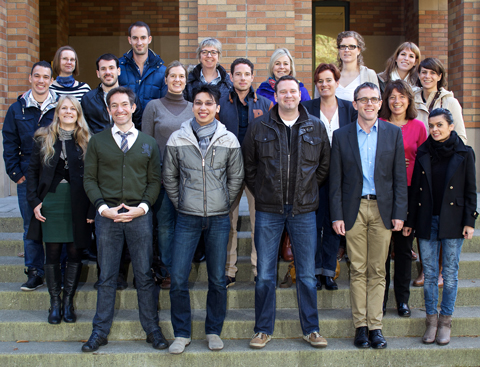
Theory and Practice
«We have two goals,» explains Janoschka. «On the one hand, to impart knowledge that participants can put into practice right away. On the other hand, we want them to have at least once engaged with the key theories and approaches.»
The CAS program isn’t limited to the lecture halls, either. In addition to a field trip to Schindler, a manufacturer of elevators and escalators, the CAS participants visited the headquarters of the Starbucks coffee chain and the Boeing aircraft manufacturing facilities—where the new Dreamliner is built—during their study week in Seattle.
At the partner university in Seattle, the focus was once again on theory and practice. In addition to lectures, a panel discussion with industry professionals explored the use of social media in marketing communications. And when it came to developing market strategies for Swiss companies in the U.S. market: For example, one group developed a scenario for the Swiss Nail Academy, a beauty school, outlining how it could gain a foothold in the U.S. Another group considered how to expand marketing efforts for Hocoma, a manufacturer of therapeutic devices already well-known in the U.S.
The CAS instructors also bring this blend of practical experience and theory to the program. They are professionals with academic backgrounds—or academics who have gained practical expertise through professional experience or consulting engagements. This year’s course featured, among others, a marketing director from an international consumer goods company, a B2B expert from a technology firm, a communications manager from a foreign trade organization, and a strategist from an international advertising agency.
«There’s no getting around the trial-and-error method when companies expand into foreign markets,» says Janoschka. «However, decisions in international marketing shouldn’t be made solely on a gut feeling.»
Isabel Imper
IN BRIEF
The CAS in «International Marketing and Communication» is designed for professionals working in international marketing, communication, or sales, and covers both the B2B and B2C sectors. The focus is on the four operational marketing tools, the 4 Ps: Product (product design), Price (pricing policy), Place (distribution), and Promotion (communication). A class typically consists of around 15 participants (maximum of 24 students). The CAS can be enrolled in individually or as part of the MAS in Communication Management. Cost: 11,500 Swiss francs (plus travel and accommodation expenses for the study week).
For information and registration for the fall semester of 2014, visit: bit.ly/1mqtrZR. You can find the participants' blog posts at: Blog.hslu.ch/internationalmarketing.