How AI and LLMs Are Transforming the Information and Communication Ecosystem for Brands and Publishers
The new central question in brand management is not only: What do people think of us? But also: How do intelligent systems interpret, evaluate, and recommend our brand?


Brands in the AI-Driven Information Ecosystem
For over thirty years, each technological advancement has changed the way brands attract attention and convey informationtteDigital displays made digital reach scalable. Search engines structured access to information. Social media distributed attention through recommendation algorithms. Programmatic advertising automated large parts of media buying, while marketing automation streamlined communication throughout the customer journey.
The New Interpretive Authority
Large Language Models (LLMs) are not just changing yet another channel. They are transforming the very architecture of information...ttlGenerative systems don't just search for documents; they synthesize content into answers, comparisons, and classifications. This creates a new interpretive entity between the brand and the user. It shapes the characteristicsfte...is linked to an organization whose voices are considered credible and on whose evidence a brand image is based.
The Fragmented Brand Image
As a result, the focus of brand management is shifting. It is no longer enough to simply communicate...fteto position the brand and maximize its reach. Brands must be presented as clear, verifiable, and consistent sources of information—readable by both people and machines. The website, media reports, expert articles, öffePublic statements, guidelines, and entries in trusted data repositories collectively form a distributed brand image. LLMs can reconstruct a narrative from this that does not necessarily align with the desired self-image.
In Switzerland, this is already widespread behavior
Change is not a distant futureftsScenario. According to the IGEM Digimonitor 2026, four out of five people in the Swiss population aged 15 to 75 who use the Internet use AI at least occasionally. 57 percent use AI-based...ttf77 percent use AI mode specifically for searching; 77 percent use AI mode within traditional search engines. ChatGPT is used at least occasionally by 67 percent, or about 4.3 million people. The representative online survey included just under 2,000 people.[1]
The Linguistic Framing of the Brand
It is particularly relevant for brands that this shifts the focus of information searches to top-levelfläshifted to, which Queselect relevant information, synthesize content, and frame a response linguistically. The brand frequently engages with its audiencefighe said in a presentation drafted by AI. Brand management must therefore not only monitor the reach of its own communications, but also the Quathe quality of this algorithmically generated representation.
Synthesis Instead of Search
The classic search organizes links: Users select a result, visit a Que... and form their own judgment. Generative response systems shorten this process. They synthesize multiple Que... formulate a response and, in doing so, can visit a brand's website directly viaflümake it easier. This reduces friction for users, but increases the importance of the upstream selection and interpretation logic.
From Ranking to Representation
This shifts the WettbFrom rankings to representations. AI Visibility—that is, whether a brand appears in generative responses—remains important, but it is only the first metric. What matters most is the context in which the brand appears: Is it described as innovative, expensive, sustainable, reliable, or risky? Which WettbAre buyers mentioned in the same breath? What sources support this account? And is the brand merely mentioned, or is it actually recommended?
The Connected Information Ecosystem
Brand management thus becomes the process of building an information ecosystem. It continues to encompass positioning, design, and emotional meaning. Added to this are information architecture, structured organizational data, knowledge management, corporate publishing, PR, and the Pflehigh-load-capacity DrittqSources. Google, for example, explicitly points out that structured organizational data can help to understand and unambiguously identify an organization. While this is not proof of general LLM optimization, it does illustrate the basic principle of machine-readable unambiguity.[2]
Consumer Trust and Machine Trust
Brands reduce uncertainty. This function remains, but now has a second target audience. Consumer trust describes people’s trust: brand awareness, reputation, experience, identityfikation and the expectation that a performance promise will be kept. In this context, “machine trust” does not refer to an emotion or a...ffeThe officially disclosed internal confidence value of a model. The termff is a strategic framework: It describes how well a brand of information systems is perceived as unique, consistent, and Quecan be processed based on all of the above.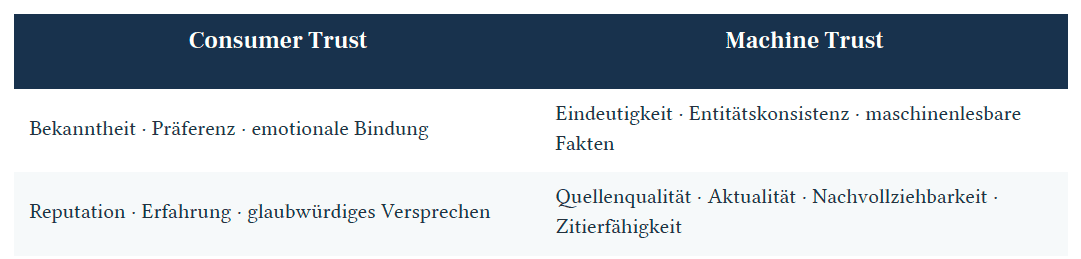
Both forms of trust influenceflucontradict each other. Contradictory statements, unclear responsibilities, or unsubstantiated sustainability promises not only weaken automated classification but also undermine credibility with people. Conversely, a technically perfect data structure alone does not create a strong brand. Without relevance, DiffeWithout context and concrete application, it remains semantically sound but meaningless.
The leadership task, therefore, consists of linking these two levels. Communication and the knowledge structure must be aligned. Claims require evidence. Corporate information requires clear lines of responsibility. Important facts must be up-to-date, accessible, and available through both internal and independent Quebe consistent across the board. This marks a shift from the traditional brand book,ttwWe are introducing a proprietary operating system that integrates language, data, evidence, and governance.
Narrative Intelligence as a New Field of Measurement
Traditional brand measurement tracks awareness, image, preference, reach, and impact. In the generative information space, these tools are not sufficient. Brands must also monitor how response systems reconstruct their meaning in specific usage situations. Narrative Intelligence is well-suited as a new discipline for measurement and management.
Methodology Instead of Ranking Drama
It combines repeatable prompt scenarios with a qqualitative and qQuantitative analysis of the responses. Metrics that can be measured include presence, share of voice, and descriptive Attribute, Quellen, Wettbbusiness environment, propensity to recommend, factual errors, and changes over time. A rigorous methodology is crucial: models, versions, locations, languages, and wording all influencefluThese are results; individual responses are snapshots. Narrative Intelligence must therefore not become a ranking spectacle, but rather requires samples, benchmarks, documented test sets, and human interpretation.
The Control Loop for Brand Managers
A closed-loop system is ideal for control: First, the desired brand narrative is testedfbatranslated into statements. Second, relevant decision-making situations are tested. ThirdtteGaps between the target and actual narratives will be identifiedfizFourth, content, data, supporting documents, and external authority are improved. After that, the measurement process begins again. In this way, Narrative Intelligence becomes more than just reporting; it serves as an integrated management model for brand management, communications, GEO, data, and knowledge management.
Agentic AI is accelerating development
Agent-based systems can process informationftinot only summarize, but also complete tasks involving several stepsttework around. For this article, it is not so much technical autonomy that is crucial as its impact on brand management: The more systems presort information and establish contexts, the more important a clear brand narrative and robust QueClear and consistent public messaging. Agentic AI thus reinforces the shift already driven by LLMs—though it is not the primary focus of strategic brand work.
The Strategic Opportunity for Publishers
Publishers find themselves in an ambivalent but significant role. Generative systems can reduce direct traffic to news sites. At the same time, the value of up-to-date, verifiedfbawell-organized and professionally categorized information. Journalistic QuaData becomes the infrastructure for credible answers—provided that the sourceft,Use and compensation are regulated.
Initial Market Trials for Monetization
This requires more than just technical accessibility. Publishers need control over which systems are allowed to use content for search, inference, or training. In addition to copyright law, direct licensing partnerships are emergingften, ZugriffsControls and usage-based compensation models. OpenAI, for example, has partnered with...ften announced to media companies that the current reporterttung with QueIntegrate help information and links into ChatGPT.[3] Cloudflare initially introduced «Pay per Crawl» in 2025 and further developed the approach toward «Pay per Use» in 2026.[4][5] Such models are early market trials, not an already established industry solution.
CoMP: Technical Interface for Licensed Access
Another component is being developed at the IAB Tech Lab. It is being...ffeIn June 2025, it launched the «LLM Content Ingest API Initiative» to provide publishers and brands with standardized, machine-readable access for LLMs and AI agents. This approach gave rise to the broader «Content Monetization Protocols» initiative, or CoMP for short. CoMP Version 1 was released on April 28, 2026 finrealized.[14]
The standard describes how an AI system requests permission from the rights holder to use the content for the intended purposetteilen and, under an existing agreement, access toffscan receive tokens as well as appropriately packaged content. CoMP definThis establishes an interoperable technical interfacettsOffice for Licensed Accessffe. However, it is neither a licensing marketplace nor a pricing model, nor does it replace accessffscontrol. Its potential value lies in the technical foundation that allows rights, contracts, and various compensation models to be implemented in a scalable manner.
SPUR: Traceability Through Telemetry
One particularly significant development is SPUR, the «Standards for Publisher Usage Rights» coalition. According to an industry update from the Independent Media Association dated August 6, 2026, its membership grew from 36 at the beginning of June to nearly 60. At the same time, the initiative held more than 150 discussions with interested publishers and was on the verge of finalizing the legal framework for its industry-specific nonprofit structure.[6] SPUR is thus moving from coalition-building toward the establishment of operational standards.
The focus is on the Content Telemetry Standard. Its purpose is to make it possible to track whether content has been accessed, used to support an answer, cited, displayed, or reused by users. The
SpezifikThe standard can also link usage events to a license reference. This would make it possible, for the first time, to measure the use of journalistic content across different systems, thereby making it easier to license. The standardfinHowever, it is still in the preview and consultation stage; broad acceptance by publishers, search engines,ttlhe and AI-PlattfThis standard has not yet been achieved.[7]
Swiss Media Companies in the New Ecosystem
Strategically, this could give rise to a market infrastructure for licensing between publishers and AI providers—provided that further markettteParticipants adopt the standard and link it to viable contracts and compensation models. Ringier is already involved as a standard member and is contributing all of its international media brands to the initiative.[8] Swiss publishers thus have direct access to the development of a potential common framework for retrieval, grounding, citation, presentation, and compensation. Such an infrastructure could foster a more symbiotic relationship: AI systems would gain legally compliant access to high-quality journalism, while publishers would gain control, transparency, and a fair balance of value. Whether this will actually lead to a businessftsHowever, whether this model becomes a reality depends on governance, technical implementation, and acceptance on the part of AI providers.
CoMP and SPUR address different levels of the same ecosystem. CoMP standardizes the request, authorization, and delivery of content for licensed AI systems. SPUR’s Content Telemetry Standard is designed to track how content is actually accessed, used to support a response, cited, or displayed. Taken together, both approaches could map the path from rights clearance through controlled access to measurable usage. However, a functioning market will only emerge once publishers, search engines, and other stakeholders adopt these standards.ttlHe and AI providers should implement these standards on a broad scale and tie them to viable contracts.
The Swiss Copyright Reform: AI Becomes the Litmus Test
Technological developments trifft in Switzerland to an offeA legal question. Current copyright law does not contain any provisions specifically tailored to generative AI.tteA regulation. According to the Swiss Federal Institute of Intellectual Property, it is argued that the right of reproduction may cover the use of protected works for AI training. However, it is not clear in all scenarios how existing rules apply to training, fine-tuning, retrieval, summarization, and output.[9]
Petra Gössi's Motion
This is where Petra Gössi's political initiative comes in. Formally speaking, it is not a postulate, but rather Motion 24.4596«Better protection of intellectual property against misuse by AI.» The Council of States adopted it in March 2025. The National Council voted in September 2025 to approve an offein the version drafted by the National Council; the Council of States followed suit in December. The Federal Council is thus...ftrsays that the conditions for comprehensive protection of journalistic content and other copyrighted works when used by AI providers must be createdffen, without research, innovation, and the economyftsSwitzerland's Position in the International...ttbdiscriminate against businesses.[10]
The Time Risk in the Legislative Process
The IGE is drafting a preliminary bill to amend the Copyright Act. According to the currently announced timeline, the bill is scheduled to enter the consultation phase by the end of 2026.[11] At the same time, a separate bill establishing a neighboring right for media companies was rejected by Parliament and returned to the Federal Council in June 2026. It had originally focused on the use of journalistic excerptsttehosted by major online services. Now, an additional check is to be conductedft explore how generative AI influences the functioning of Plattfhow standards and search engines have changed, and what consequences this has for the value of journalistic work.[12]
The logical connection between these topics is clear: snippets, AI training, and AI-powered responses involve different technical processes but all address the same fundamental question of value assignment. However, this poses a significant time risk. During the parliamentary deliberations, there was talk of a delay of approximately
two years ago.[12] For an information market whose products, forms of use, and businessftsIf models change every few months, that's too long.
Care, yes; standstill, no
Legislation should be guided not by a tectonic timescale but by a technological one. This does not mean shortening due process or hastily enacting rigid special laws to...ffen. It means starting consultations earlyffn... to continuously incorporate technical expertise and keep pace with international developmentsqto reflect and verifyfbato design the rules in such a way that they can be adapted to new forms of use.
Clear Distinctions Instead of Blanket Rules
The regulatory framework mustffedistinguish: between training and actual queries, between mere indexing and the substantiation of an answer, between quotation, summary, and substitute reproduction, as well as between research and commercial exploitation. Equally important are practical tools for access, transparency, and remuneration. The formula «Access, Remuneration, Transparency» used by the IGE succinctly describes this balance.[13] Technical standards such as CoMP and SPUR can facilitate controlled accessffeenable and make usage events measurable; however, they do not replace statutory rights or enforceable contracts.
Why Media Quality Is Becoming a Matter of Survival for Brands
For brands, this debatetteby no means a problem limited to the media or publishing industry. The QuaThe quality of generative responses depends on reliable, verifiablefbaand current Que... all of them. Is the economy eroding...ftlWithout the fundamental principles of professional information services, the digital brand ecosystem also loses its solid foundation of evidence. Brands then frequentlyfigIt is reconstructed within a context where original research, independent analysis, and responsible publishing are less prevalent.
The Dilemma of the Open Web
This is where the opportunity for a sustainable symbiosis lies: AI systems gain legally compliant access to high-quality journalism; publishers gain control, transparency, and fair compensation; brands and Öffepublicity perfitto ensure a better information base. To prevent this regulatory framework from being established only after market structures have already solidified, the Federal Council should submit the announced preliminary draft on time and consult with Parliament, the administration, and the affectedffein various industries, accelerate the subsequent legislative process as a high priority.
This also presents an opportunity for the Open Web. When high-quality content is...ffinprintable, citable, and economicftlIf it remains sustainable, its journalistic authority can also be effective in the generative information space. Without sustainable incentives, however, there is a risk of erosion of the very knowledge base on which effective response systems depend.
Conclusion: From Visibility to Decision-Making Capacity
LLMs aren't primarily changing advertising. They're changing the architecture through which information is selected, condensed, and translated into recommendations. This presents brands with a twofold challenge: They must continue to build meaning and trust with people...fba— while at the same time ensuring that intelligent systems can correctly process their identity, performance, and evidence.
Successful brand management therefore combines consumer trust with machine trust and traditional brand measurement with narrative intelligence. Its goal is not to manipulate a model, but to create a consistent, verifiablefbato maintain a comprehensive and relevant information ecosystem. The key question going forward isftiIt's not just a matter of whether a brand is visible. The question is whether the brand is correctly understood and credibly taken into account in the decision-making processes of both people and machines.
Sources and Further Reading
[1] IGEM/WEMF: Digimonitor 2026; usage figures based on the publication dated August 25, 2026, and a representative online survey of the Internet-using population aged 15 to 75.
[2] Google Search Central: Organization structured data – for machine-readable descriptions and disambiguation of organizations.
[3] OpenAI: Strategic Content Partnershipsft with Grupo Folha and Grupo UOL, May 25, 2026.
[4] CloudflaRe: Introducing Pay Per Crawl, July 1, 2025.
[5] CloudflaRe: Pay-Per-Use and Agent-Based Access to Information, July 1, 2026.
[6] Independent Media Association: SPUR Expands Global Publisher Coalition as Work on AI Standards Accelerates, August 6, 2026.
[7] SPUR Coalition: Content Telemetry – offeA Preview SpecialfikAppointment of the rapporteurttung on the use of journalistic content by AI systems.
[8] Ringier: Ringier tritt the international SPUR Coalition, June 3, 2026.
[9] Swiss Federal Institute of Intellectual Property: FAQ – AI and Copyright, as of 2026.
[10] Swiss Parliament: Motion 24.4596Gössi – Better Protection of Intellectual Property Against AI Misuse; Resolutions by the Council of States and the National Council in 2025.
[11] Federal Chancellery/IGE: FAQ – AI and Copyright; Preliminary draft amendment to the Copyright Act, with a planned public comment period through the end of 2026.
[12] Swiss Parliament: Parliament Sends Media Ancillary Copyright Protection Back for Further Review, June 17, 2026.
[13] Swiss Federal Institute of Intellectual Property: AI Regulation in Copyright Law—Access, Remuneration, Transparency, August 13, 2025.
[14] IAB Tech Lab: LLM Content Ingest API Initiative and Content Monetization Protocols (CoMP), updated on April 28, 2026.
Editor's note: «Machine Trust» and «Narrative Intelligence» are used in this article as strategic frameworks. They do not refer to standardized or cross-model uniform definmeasured variables.
About the author
Martin Radelfinger is the founder of Net Gain, a strategic consultant, and an author. His work straddles the linettsthe role of digital publishing, media economics, and ad tech, as well as the growing importance of artificial intelligence for digital brand and corporate communications.
His international career took him to New York, among other places, where he served as Vice President of New Media at Editor & Publisher Company and as Vice President of Market Development at Real Media. He then served as Managing DirectorftsHead of Wirz Homepage AG, an agency for digital corporate communications, and a partner at Wirz Partner Holding. As Managing Director and Chief Strategy OfficAfter leaving Goldbach Audience, he went on to head the agency's digital and advertising marketing businessft the Goldbach Group.
RadelfinHe taught at Temple University in Philadelphia and at the HWZ University of Applied Sciences for BusinessftZurich. He was the founder of IAB Europe and was named honorary president of IAB Switzerland in recognition of his many years of service.