Advertising impact: TV top even without online?
Many brands today rely on a cross-media approach to reach their target audiences. The combination of TV and online advertising, in particular, is often seen as a «dream team.» But are integrated communication strategies that combine TV and online really more successful than single-media approaches?


Consumers' use of media is becoming increasingly diverse. Companies are trying to take this fact into account by relying on cross-media communication strategies - and in particular the combination of TV and online advertising. The associated reach and sales effects are much discussed and not yet understood in detail. A team of researchers from the University of South Australia has investigated this question. The study attempts to shed some more light on this darkness by correlating the media use and purchasing behavior of around 6000 European consumers. The data, which the Australian researchers examined together with Mars, was taken from the GfK Media Efficiency Panel and relates to five brands each for staple foods and impulse products. The result: TV continues to achieve top reach and is clearly ahead in terms of sales stimulation. What is particularly interesting is that the combination of TV and online does not necessarily have a stronger sales effect than TV alone.
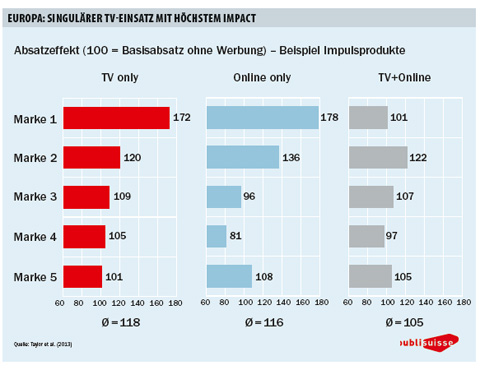
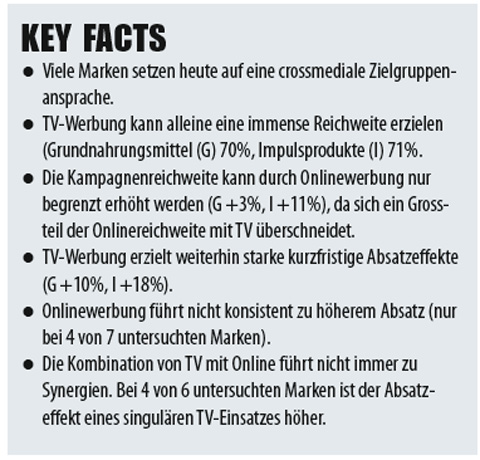
First of all, the analysis shows that the reach achieved by TV advertising remains immense, despite the increasingly diverse media usage patterns. In the case of staple foods, TV advertising achieved an average reach of 70% in the period under review. Many consumers (57%) only had contact with TV advertising, plus 13% who had contact with TV and online advertising. It is interesting to note that online advertising only increased the reach of the campaigns examined by 3% to a total of 73% - i.e. hardly at all. A large proportion of the online reach of 16% overlaps with TV. The results were similar for impulse products - here too, a large proportion of online reach overlapped with TV (32% duplication, 11% unique reach). According to the study, TV advertising not only achieves large reach, but also strong short-term sales effects. For the staple foods examined, TV advertising increased the propensity to buy by up to 35% or an average of 10%. In the case of impulse products, the maximum sales effect was 72% and the average was 18%.
However, the picture was not quite as clear for online advertising. Online advertising was able to achieve positive sales effects for four out of seven brands for which corresponding data was available. For the impulse products examined, online advertising increased the propensity to buy by an average of 16 percent, whereas for basic foodstuffs it fell by 3 percent compared to a situation without advertising. Online advertising therefore often, but not always, generates positive sales effects. But what effect does the combined use of TV and online advertising have on sales? Interestingly, the study found no significant synergies.
For 4 out of 6 brands for which corresponding data was available, TV advertising alone was able to achieve a higher sales effect than the combination of TV and online. Even for the two brands where the TV/online combination was superior to the single use of TV, the cross-media campaign had an impact advantage of no more than 4 percent. Another fact: for the impulse products analyzed, the single use of TV advertising led to an average increase in the propensity to buy of 18%, while the sales effect of the TV/online combination was only 5% on average for these products.
Clemens Koob