Advertising impact: it's all about the approach
How should advertising be designed to promote a close relationship between brand and consumer? Many companies rely on advertising language that postulates a personal relationship between consumer and brand. A "we", as expressed by the cantonal banks, for example, in the slogan "Growing together".


However, a new study conducted in the USA under the auspices of Stanford University shows that this is by no means always the ideal approach. Sometimes an approach that is somewhat more distanced, such as UBS's former You & Us, is more likely to achieve the goal.
The way in which people communicate with each other reflects the relationship they have with each other. Pronouns play a particularly important role in this. A we expresses a close relationship, whereas an I and a you emphasize one's own identity. Research shows that the use of these pronouns not only reflects the current relationship between people, but also shapes the future relationship. Against this background, communication managers could come to the conclusion that an advertising approach that focuses on a shared "we" leads to a closer relationship between brand and consumer. In a series of experiments with a total of more than 1000 consumers, an American research team has now been able to show that this is only correct under certain conditions.
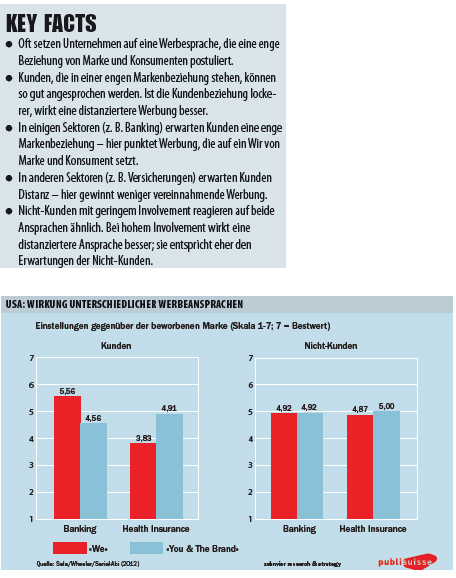
In one of the experiments, a group of consumers was presented with a situation in which they had a close customer relationship with a mobile phone brand. Another group was asked to imagine a more casual customer relationship with this brand. Consumers were then presented with either an advertisement that focused on a "we" or a campaign that signaled more distance. In the case of the closer relationship, the collaborative "we" led to a significantly more positive attitude towards the brand (6.07 vs. 5.61 on a 7-point scale with 7 as the best value), while the more distanced approach had a greater effect on the more relaxed customer relationship (6.26 vs. 5.92).
Which approach works better therefore depends on the intensity of the relationship. And this can vary from sector to sector. Further experiments showed that consumers expect a relatively close relationship with their bank, for example, but a distant relationship with their insurance company. In the case of bank customers, it was therefore possible to achieve a significantly more positive attitude towards the advertised brand through a shared "we" in the advertising than through more distant advertising (5.56 vs. 4.56). The opposite was true for insurance customers: Here, a more distanced campaign led to more positive brand effects (4.91 vs. 3.83). And what about consumers who are not yet customers of a brand? This question is of course of considerable importance for customer acquisition. For non-customers, the study showed no statistically significant differences in impact between an approach that postulates a close relationship with the brand and a more distanced advertising design (banking sector: 4.92 in each case, insurance sector: 4.87 vs. 5.00). If non-customers engage more closely with advertising, this picture can change. Often, non-customers are not so attentive to a brand's communication that they notice minor differences in the way it is addressed. However, if non-customers are persuaded to take a closer look at an advertisement, a more distanced advertisement clearly works better than a campaign that relies on a "we" of brand and consumer.
Advertisers should therefore communicate in line with expectations: Only if customers expect a close brand relationship will advertising that relies on a close relationship pay off.
Clemens Koob