
What Programmatic Advertising Can Do - and What It Can't
Programmatic advertising has been touted for some time as the savior of online marketing. In fact, programmatic delivery opens up new possibilities for display marketing. However, it is also burdened with unrealistic expectations. Andre Mornhinweg of Ad Agents highlights the opportunities and limitations for the Swiss market.


Programmatic advertising as far as the eye can see. For months now, "PA" has been the topic of the future in the online industry. At the same time, it is still not clear to many marketing managers what programmatic advertising can actually do - and what it cannot. This is understandable given the technical complexity, misleading terminology, and sometimes unrealistic expectations that are being stoked.
What is Programmatic Advertising?
Programmatic advertising refers to the fully automated buying and selling of advertising space in real time. Software takes over the decision of when and, depending on the transaction model, where to buy ads. Any number of data can flow into this decision via a so-called data management platform (DMP). For example, ad slots can be booked depending on the weather, user interests or geographical characteristics. The entire process, from the sender of the order (demand side platform/DSP) to the recipient (sell side platform/SSP), is automated within technology platforms.
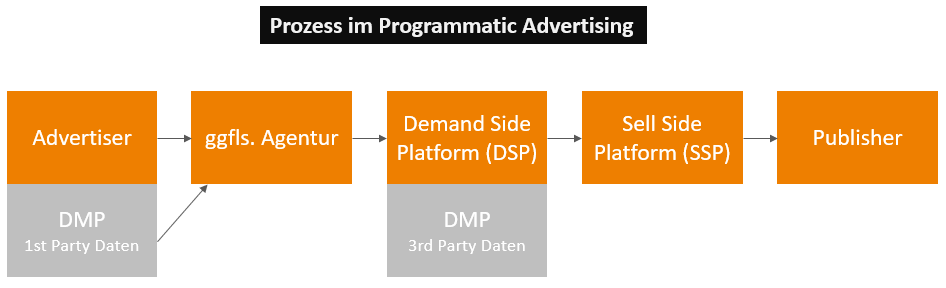
Programmatic Advertising = Real Time Advertising
The term "programmatic" has become established in linguistic usage against the synonymous term Real Time Advertising (RTA). Real-time bidding (RTB), on the other hand, is to be distinguished as a technical process that is often part of programmatic advertising when the ad spaces are allocated in a real-time auction. RTB reduces costs in display marketing because the software is more likely to find advertising spaces for us on the World Wide Web that meet our price expectations. Even in a direct comparison of two identical placements, the programmatic approach can be significantly cheaper than manual booking because we always have the chance of a "bargain" away from the fixed price lists.
Programmatic advertising can also take place via other transaction models, such as private deals between publishers and advertisers (automated guaranteed). Here, playout can be linked to certain conditions that are queried in real time. For example, our banner is only played if women over 30 who are very interested in sports visit the website. This means that the banner is also played out programmatically, but not in an auction process.
Programmatic enables user-centric targeting
But what can programmatic advertising do that display marketing couldn't before? Programmatic advertising enables us to check the characteristics of a visitor at the moment he or she visits a website. Within milliseconds, a decision is made on the basis of the available data as to whether a particular user meets our targeting criteria. Only if this is the case do we play out our advertising or, in the case of an auction with real-time bidding, enter the real-time auction for the advertising spaces.
With the usual environment targeting, we infer the user and his interests from the content of certain pages. The programmatic era opens up the possibility of truly user-centric targeting in display marketing. This is because we replace or supplement the "place of playout" criterion with the decisive facet of to whom we play out the advertising. We can make our playout dependent not only on the demographic characteristics of the user, but also on his interests, his surfing behavior or geographical information, to name just a few possibilities. This approach allows us to target exactly the people we want to reach via display marketing. This extends the perspective of the former branding discipline of display beyond remarketing to include a performance facet, because wastage is effectively curbed.
Performance Display as a new subdiscipline
Media use is increasingly taking place in the digital environment. Whether reading the daily newspaper, streaming series or researching products, digital media are firmly anchored in people's everyday lives. Users' search and surfing behavior creates a gigantic mountain of data. Programmatic marketing now allows us to use this powerful knowledge about our users in display marketing.
For the advertiser, this not only reduces wastage, but also opens up new facets of display marketing: the achievable goals no longer lie solely in image enhancement, but in the targeted acquisition of new customers through to the triggering of specific user actions, from the download of a white paper through to newsletter registration and the sale of a product - because it is highly likely that we can reach users who already have a certain level of involvement with our brand or our topic.
Our experience shows that data-driven campaigns in Switzerland can achieve better results than traditional ambient flags. However, one should not think that display marketing is suddenly a performance channel that drives up sales figures. It remains a channel that has tremendous strengths in the early stages of the customer journey and a springboard from which other channels benefit. For pure performance purposes, other channels are better suited, for example search engine advertising. However, display marketing is evolving towards brand performance, a mix of branding and performance channel.
Similar Audience: Leveraging knowledge about our customers
One example of how customer data can be usefully interwoven with display marketing is the targeting of "Similar Audiences". We can make existing user or customer data available to a DMP. New users are then matched with the data patterns and addressed if there is a similarity. In a sense, we are addressing "statistical twins," whereby these are formed not only on the basis of demographic characteristics, but also of interests and other information. This approach enables us to run high-reach prospecting campaigns, whereby the new contacts are of high quality, which is reflected in a strong conversion rate.
The big players have the best data
To make reliable assessments about users, we need a good data basis. The big players like Google, Facebook, and most recently Amazon have positioned themselves here. Due to the user login, they have advantages in tracking and in cross-device playout in their far-reaching publisher networks. Google and Amazon in particular have an advantage not only because of the mass, but above all because of the significance of their data. Amazon has the knowledge of real purchasing behavior. At Google, users also send clear signals via their search queries about which topics, brands or products they are interested in. In addition to the valuable 1st-party data of the advertisers, in our experience there is enough high-quality 3rd-party data available in Switzerland to set up good programmatic campaigns.
Where does Programmatic Display stand in Switzerland?
Programmatic ad delivery in Switzerland is below the global average, but has been picking up speed for several years. In the current "Programmatic Barometer," 90 percent of respondents said they plan to increase their investments in 2019. Of the 40 percent of Swiss companies that do not yet use programmatic, three out of four are prepared to spend money on it in the future. The fact that only 30 percent of respondents were able to provide a precise definition of Programmatic is on the one hand understandable as described above, but on the other hand surprising. In our experience, the Swiss market has its finger on the pulse. The lion's share of our display campaigns in Switzerland has been running programmatically for some time. With a few exceptions, all major publishers are connected to the programmatic platforms. So everything is set for the successful use of programmatic advertising in Switzerland.
Is classic display marketing dying out?
If you want to reach a clearly defined target group, there is no way around a data-driven, programmatic approach in display marketing. If we can incorporate high-quality data into our advertising decisions, we can significantly reduce wastage and run better-performing display marketing campaigns. But narrow targeting is not suitable in every case. If target groups are too specific and too small, we recommend broader targeting - and this applies even more to the comparatively small Swiss market. In some cases, a classic flight via topic-relevant environments may ultimately perform better because the price premium for data-driven delivery eats up performance.
It is therefore recommended to set up campaigns on several tracks and to compare the different variants in each individual case. It is always important to find the balance between reach on the one hand and little wastage on the other. Finally, we would like to encourage you to get to grips with programmatic advertising - it is not witchcraft and can achieve great results if it is used correctly and the right targets are set.
Andre Mornhinweg is an expert in the field of display advertising. As Head of Social Media & Display Advertising at the online and performance marketing agency Ad Agents, he is responsible for the strategic use and further development of both disciplines.


