
Beware of the death spiral of strong brands
Bastian Schneider, Strategy Director at Hotz Brand Consultants, explains why strong brands fall into a death spiral - and how they can get out of it.


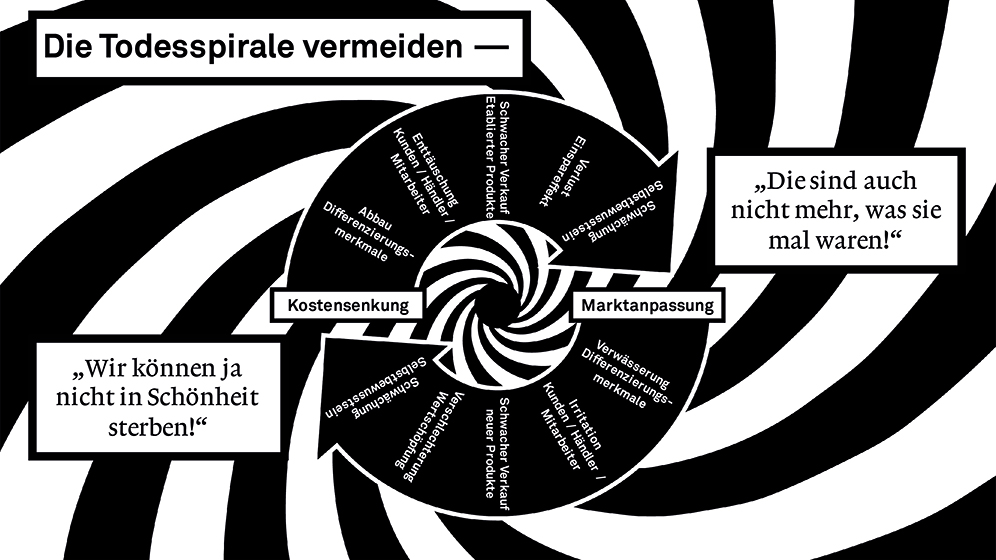
"We can't die in beauty!" Have you ever heard this sentence in your company? Then you should pay attention now. Because your brand could already be in a death spiral. Without realizing it, many companies today are characterized by two programs that run counter to the sustainable development of a strong brand: The exaggerated market orientation as well as the excessive increase in efficiency. In an effort to optimize their own business, many companies oscillate back and forth between the two extremes. In the process, the differentiating features that are fundamentally important for business success are gradually eroded.
Too much market orientation is like poison for self-confidence
Market orientation is a very positive thing in itself. Its aim is for a company to align itself as closely as possible with the needs of its customers and to offer the most relevant services possible. However, our experience is that market orientation can quickly turn from a means of achieving a goal into a goal in itself and that companies become too one-sidedly and uncritically market-oriented.
The result is an increasingly short-term focus on the needs and wishes of customers, which can be ascertained through market research, the new activities of competitors and the many trends in the industry. An assessment of whether all this is in line with the company's own positioning, strategy and capabilities and whether sufficient sustainability is guaranteed is often neglected.
We have observed this many times: Market information is turned into direct decision-making parameters, unfiltered and without critical self-assessment. The company's actions are increasingly externally determined. The company is limited to reacting. An own, active momentum is lost. Under high sales and growth pressure, the product range is broadened. New categories are developed without being able to present clear distinguishing features.
Since all competitors make their decisions in a similar way on the basis of very similar information, over time this leads to them all creating increasingly similar offers that are difficult to differentiate.
Increasing efficiency too much is a major threat to uniqueness
Increasing efficiency is also essential if you want to offer your customers competitive prices and still earn something yourself.
In some companies, however, pure cost-cutting has become an all-important program that is no longer questioned. Automated in this way, it leads to a reduction in valuable qualities and differentiating performance peaks that have made the company special from the customer's point of view. The consequence of this is that, sooner or later, customers' willingness to pay decreases and sales of products and services come to a standstill.
The result: the brand falls into a negative spiral
A company's competitive strength can be severely restricted by an unreflective market orientation and an unconditional increase in efficiency. The dangerous thing about this is that both activities in turn trigger massive pressure to act on the other side and a company can fall into a dynamically intensifying negative spiral: The market side tries to compensate for the lack of growth in the cost-optimized range with new (and weaker) products in new (and non-brand) categories. The cost side tries to compensate for the dwindling attractiveness of the products with even lower costs - and sacrifices other special features. Market adjustment follows cost reduction follows market adjustment follows cost reduction. The forces of differentiation are lost.
If there is a noticeable drop in performance - usually not abruptly, but gradually over time - the company is competing with blunt weapons. Customers and retailers react with disappointment to the company's offerings. This leaves its mark on the management. The self-confidence of the people in charge begins to crack. The perspective from which decisions are made is changing: They are even more focused on the competition. They are even less critical of further downsizing measures. "We can't die in beauty," is then often said.
The mantra of many agencies: "Your services are interchangeable. You can only differentiate yourselves through communication." seems like a confirmation that you are heading in the wrong direction. Instead of developing substantial distinguishing features, the focus is increasingly on the pure staging of what is supposedly special. The advertised illusory world and the actual reality are drifting apart. This does not go unnoticed by customers, retailers and the public! The trust built up in the company dwindles. The good reputation suffers.
What needs to be done?
A company can interrupt this death spiral at both poles: Before cost-cutting, one can become aware of which differentiators are relevant to the business and which have the potential to be mobilized for the future. When focusing on the "market", one should develop a critical attitude towards market research data, competitive activities and trends with much more self-confidence. Above all, you should not try to please everyone.
In short: a company can protect itself effectively with a brand program. A brand program prevents a company from accepting the market as a given and limiting itself to reacting. It enables a company to develop its own innovative thrusts on the basis of its own strengths and to become a force for change that drives the market in a positive sense.
This requires a great deal of courage, consistency and a good understanding of the feasibility and relevance of one's own opportunities. In other words, precisely the virtues of entrepreneurial thinking and action - without which a company cannot survive successfully on the market, even in this day and age. In the end, good brand management is good corporate management.
Bastian Schneider
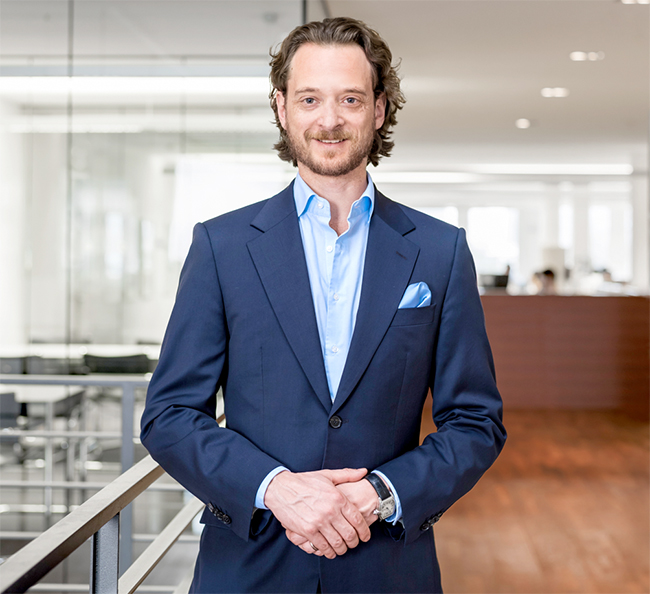
Bastian Schneider has been advising management teams on strategic and operational brand management in 40+ industries in Switzerland, Germany and Austria for many years.
His clients include international corporations and medium-sized family businesses: Roche, Oerlikon, Deutsche Post / DHL, Swiss Post, Unilever, Coop, Dätwyler, Helsana, Wüest & Partner, Sennheiser, Silhouette, Hirsch, Bauerfeind, Hochland, Admeira, Energie 360°, Nidwaldner Kantonalbank, Compass Group, Coca-Cola HBC Switzerland, Kantonsspital Baselland, Interroll, Mobilezone, Street One and many more.
His consulting specialties are: Brand-oriented strategy development, brand analysis and brand positioning, brand and product range architecture, brand mobilization concepts, employer branding and the implementation of holistic brand development processes in complex organizations.


