
From relationship crime to social media
The Swiss sponsorship market is caught between long-term commitments and the fast-paced nature of social media. Integrating social networks and designated websites has proven to be a particular challenge.


Improved brand awareness
The witty comedy starring Matthias Gnädinger and Nikolaus Paryla received a grant from the photo lab Ifolor, which in turn benefits from classic product placement in the form of poster advertising in the film and a marketing campaign with Matthias Gnädinger as the figurehead. "We support the film comedy because we are convinced of its likeability value" says Philipp Schwarz, Chairman of the Board and owner of Ifolor. "Switzerland's most popular actor, Matthias Gnädinger, certainly contributes a lot to this. Our involvement came about because we were approached to place a poster in the film, to which we spontaneously agreed. We would do it again at any time." Axa-Arag, the legal protection insurance company, also had itself featured in a pleasingly original way. In the film, it sponsors the TV search show "Notruf Live," which is modeled on "Aktenzeichen XY" and leads like a thread through the criminal events in the black comedy. "Our product placement is so clumsily used and is in the picture for so long that it's funny again," says Thierry Luterbacher, managing director of Axa-Arag, describing his company's involvement, which also had a short commercial produced using scenes from the film. Luterbacher used the opportunity to increase brand awareness, because no sooner had the filming been completed than the decision was made to change the name from Winterthur Arag to Axa Arag. Thus, during post-production work, the old logo was replaced by the current Axa Arag logo. "This meant that we were already able to get the new name, which was planned for 2011, on track by the end of the year," says Luterbacher.
Stable Swiss sponsorship market
The example of "Living Longer" (see interview opposite) may be one of the more original Swiss sponsorship projects of the past year, but where does our country stand in an international comparison? "As a result of the rapid recovery of the economy, the sponsorship market in Switzerland has stabilized. New, important contracts have been signed in recent months," says Ms. Bortoluzzi Dubach, author of "Sponsoring The Practical Guide." As in international comparisons, long-term commitments in the sports sector have remained stable, especially in football. One example is the Axpo Superleague. For smaller events and sponsorships for clubs and individuals, on the other hand, acquiring sponsors has become more difficult. As far as culture is concerned, larger organizers have been successful in acquiring sponsors, for example the Avo Session, but here too, smaller institutions in the regional area are suffering. For them, however, interesting financing opportunities are opening up via the foundation market. According to estimates, the distribution volume of foundations in Switzerland amounts to 1.5 billion SFr. Substantial sums go to the benefit of culture. In my opinion, the funding foundations in the area of culture have become very important as partners for cultural institutions in this submarket over the past two years.
Biedermann and Arsonist
Looking beyond national borders, a heterogeneous picture emerges: "Markets in which the conclusion of long-term sponsorship agreements has a tradition suffered less from the effects of the crisis. And: countries where international events were held were able to benefit more than average." According to the Sport+Markt Institute, banks and insurance companies dominate the top 10 new sponsors. AON, a global provider of insurance services, and Standard Chartered Bank are the leaders among all soccer sponsorship newcomers in Europe. Both companies are letting their sponsorship rights cost them around 24 million euros. Sports betting providers have also successfully positioned themselves in the world of soccer. BetClic, for example, has invested around 20 million since 2010 as the official shirt sponsor of Juventus Turin, Olympique Marseille and Olympique Lyonnais. The total spend of the top 10 soccer sponsorship newcomers is around EUR 120 million.
Hollein inspires donors
Finding the right tone with conservative institutions in particular, while remaining bold and innovative like Max Hollein in Frankfurt, Switzerland lacks such a figure of light. The son of renowned Viennese architect Hans Hollein, Max Hollein can look back on a stellar career in which he combined his innate understanding of culture with a flair for self-dramatization and business acumen. Der Spiegel called the exceptional talent "the youngest and currently biggest star in the museum business," and the lifestyle magazine GQ profiled him. The Handelsblatt praised him: "The hermaphrodite Hollein, half manager, half art man, has the trust of bankers and managers. He speaks their language, knows their codes and rules of the game, and doesn't make a millionaire banker look like a cultural ignoramus." With innovative campaigns that, as Hollein admits, "hardly cost anything, but attract a lot of attention," he inspires not only the potential audience of the three museums he now runs in Frankfurt, but also the donors. Eight years ago, for example, the 41-year-old turned Frankfurt's Kaufhof department store into a branch of the Schirn Museum for the exhibition "Shopping 100 Years of Art and Consumption," which was critical of consumerism. The department store management not only gave the green light for a 2200-square-meter poster by American artist Barbara Kruger on the facade, but also financed a brochure in the same consumer-critical style that promoted the exhibition and department store products. The bill paid off: Over 56,000 people visited the exhibition, and Kaufhof sold more products than with its usual advertising.
Swiss SMEs rely on tradition
It's one thing to find such original approaches, but then to have them gilded is truly the high art of sponsorship. Getting such daring and sometimes provocative projects off the ground in Switzerland is probably practically impossible. Risk-taking is not exactly one of the main characteristics of the Swiss SME landscape. They prefer to rely on solidity and tradition, which of course also has its value. It is therefore all the more painful when, for reasons of international political correctness and marketability, a pairing like Davidoff and the Basel Indoor Tennis Tournament comes to an end and its organizer now has to hope that Roger Federer will personally reach into his pocket. The organizers of the Arosa Humorfestival can count themselves more fortunate, having been able to rely on their main sponsor Axa for 12 years, just as one would expect from a reliable insurance company. "We feel we are in very good hands in Arosa," says then Tom Markwalder, Head of Sponsoring & Marketing Services at Axa. "It's a great end-of-year event for good customers and is ideal for deepening customer loyalty and emotionalizing the Axa brand. We are already looking forward to 2012, the 20th anniversary."
Long-term relationships pay off
It is these long-standing relationships that ultimately pay off for both parties. "Experience has shown that it takes some time for a sponsor to really benefit from its involvement and for stakeholders to even perceive the messages," explains Elisa Bortoluzzi Dubach. Over the years, the collaboration is optimized, the unique selling points of the partnership are honed and the implementation is improved. "We have many opportunities to get involved and have a say in many topics," says Markwalder, pointing to the Axa Lounge offers, which Axa has specially produced and makes available to Arosa Tourism free of charge every year.
But one trend runs counter to building long-term relationships. Digital media are characterized by extreme fast-moving nature and represent a challenge for the sponsorship market. This impression is also confirmed by Ms. Bortoluzzi Dubach: "It requires quite a bit of personnel and financial effort to keep an eye on all possible relevant platforms on the one hand, and on the other hand to get involved with content there where it is necessary and makes sense." It is also costly to always be up to date with the latest knowledge about technologies. At the Sport Forum Switzerland, which took place in Lucerne in mid-November, Stephan Schröder from Sport+Markt noted that Nike is one of the few brands that serves practically all important social media platforms, but: "There is no attempt to transfer the content of the Nike website 1 to 1 to all social media platforms, but rather to see which content makes sense depending on the platform.
It goes without saying that such an approach entails enormous know-how and no less effort. But "social media is becoming increasingly important in everyday life and, of course, also in sponsoring," says Patrick Seitter, Head of Marketing and Sales at ESB European Sponsoring Exchange, with conviction. A clear trend is discernible, Seitter finds: "Companies are placing more and more value on direct interaction with target groups than on pure contact numbers. Here, social media creates a simple and efficient feedback channel." But who can benefit and to what extent, and where the use of social networks may not be worthwhile, the next few months will show. And: "New concepts are also needed in evaluation and success monitoring in order to be able to work efficiently with the new tools," finds the sponsoring specialist.
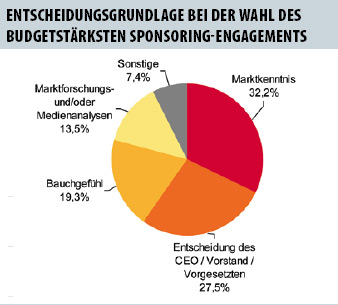
Social media may be the new playground of sponsorship, but the decision-making processes have changed little in recent years. This is also confirmed by the latest figures presented by Pascal Schulte, Sales Director Switzerland Sport+Markt. In just under 20 percent, gut feeling serves as the basis for decision-making, while in around 27 percent of cases, the CEO or the board of directors decides on the sponsorship commitment. "For sponsorship to have a successful impact, commitment from the boardroom is essential," explains Elisa Bortoluzzi Dubach, pointing to BSI's cultural commitment. "This would never work so well if there wasn't a CEO who stands for the credibility of this commitment with his person and his name." In that sense, a company's management is the first stakeholder that a sponsorship department must not only convince with its proposals, but inspire. "I also have absolutely nothing against so-called relationship offenses if this results in recognizable added value for the company," interjects the sponsoring specialist. It is interesting to note that according to Sport+Markt, market knowledge, at a good 32 percent, does not carry much more weight than "relationship offenses." In general, it can still be said that "sponsorship and sponsorship recipient must always fit together," says Ms. Bortoluzzi Dubach. "Typology of the project, level of sponsorship (top, medium, low, etc.), shared values, as well as the ability to address the same target groups and generate measurable added value for one's stakeholders are crucial factors."
What does this mean for the future? Both the market research institute ZMS Analytics and the Swiss Sponsorship Barometer assume that the crisis period is over and that budgets are very likely to increase in the next two to four years. Not dramatically, but slightly upward, but that is at least something. Marc Bodmer
Interview with Lorenz Keiser and Adriano Viganò
WW: How do you imagine the financing of "Live Longer" and how long did it take to get it up and running?
Lorenz Keiser: Adriano Viganò drew up a kind of shareholders' agreement with which we went to (mainly small) investors and offered shares.
Adriano Viganò: The investors saw that there was a good chance that they would get their money back, as well as how great the chances of winning were and how great the risk of default was. With this "going public" we had financed the film within three months.
What was the decisive element that motivated the donors to make their contributions? Their commitment, producer Viganò, the actors, the story...?
Keiser: Of course, an interplay of all these elements. On the one hand, the contract must be clear and promising, on the other hand, the possible success depends decisively on the script, the actors and the production. And then the personal involvement in such a story should not be underestimated for credibility. But it is important that the production costs are in reasonable proportion to the size of German-speaking Switzerland.
In what order of magnitude were the contributions from companies? Of private individuals?
Viganò: We have only private individuals as investors. The investments are between 20,000 and 200,000 francs.
There were people who injected money à fond perdu, others profited from product placement. Were there other models?
Viganò: The investors are real investors, which means they can get the invested amounts back from the revenues of the film and earn something on top when the film runs.
Did the commitment of the supporters change over the course of the shoot? Did more enthusiasm emerge when you saw the direction the rough cut was taking?
Viganò: The enthusiasm was there from the beginning and grew. There was an incredible team feeling among everyone involved, because we were making a film entirely on our own without the overlord state. And the more it became clear that we could do it, the better the mood became.
Were there any ideas that were considered for the film due to the scarce funding but could not be realized?
Keiser: If we had a lot of money, we would have shot the film much more technically expensive, of course. That means tracking shots, film instead of video, expensive lighting, more remote locations, breaking a few cars in the action scenes etc etc. When it was clear that we were financing the film privately and repayably, we as producers decided to shoot the film as economically as possible in the interest of the investors (and thus also in our interest).
Would you take such a path again? If so, what have you learned from "Living Longer"?
Keiser: It's definitely too early to answer that. If the film is a success, then we will certainly have developed a viable model.
Interview: Marc Bodmer


