
Study: Ad blocking is becoming mainstream, but offers opportunities for good creation
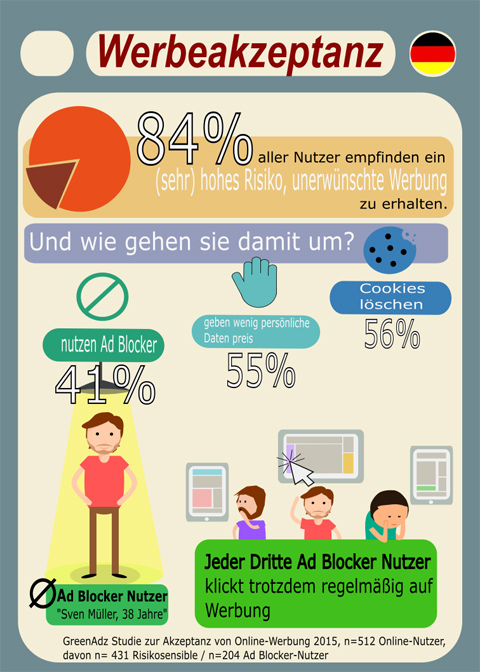
According to a representative online user survey, unwanted advertising is just as unpopular as spam. Despite a high ad-blocker adoption rate of 40 percent, one in three ad-blocker users regularly clicks on online ads.


The study was carried out by on the acceptance of online advertising and the use of ad blockers the Hamburg-based market research company Greenads. The most important results at a glance:
Perceived risk of unwanted advertising higher than the risk of viruses
84% of users consider receiving unwanted advertising to be at least a high risk when using the internet in general. This puts advertising ahead of the perceived risk of email spam (83%), data misuse (82%) or computer infection by viruses (64%).
Ad blockers establish themselves
In addition to the traditional methods of firewalls and anti-virus software (85%), a total of 40% of respondents stated that they use an ad blocker to protect themselves from the risks. This brings the prevalence of an ad blocker closer to that of deleting cookies (56%) and the considered disclosure of personal data (55%). Based on the socio-demographic data, it can also be deduced that ad blocker users do not exhibit stereotypical characteristics, but can be found in the broad masses. "Ad blocking is moving mainstream", as the IAB UK stated in the Ad Blocking FAQs published in October last year.
"Sven Müller, 38 years old" represents the ad blocker mainstream
But what does the ad blocker mainstream look like? This much is clear: an ad blocker plugin is not a tool specifically for tech nerds in their 20s, but is widely distributed across all socio-demographic characteristics. The average ad blocker user can be described as male (59 percent), with an above-average formal education and an average age of 38. The study has christened him Sven Müller: He is effectively the big brother of the average social media user "Christian Müller, 36 years old" published by Jung von Matt and Facebook in a joint study.
Ad blocker users do click on advertising - but it has to be good
Good news for advertisers: marketing decision-makers worried about the high prevalence of ad blockers can nevertheless breathe a sigh of relief, as the Greenadz study shows: According to the study, one in three ad blocker users still regularly click on ads. But only on advertising that they accept on sites that they trust. Sandra Gärtner, Managing Director, Greenadz, explains the results: "With 5,000 advertising messages hitting every consumer every day, annoying, slowing down and irrelevant online advertising in particular gets on users' nerves. A high prevalence of ad blockers is only a logical consequence. However, the high willingness to click even among ad blocker users is an indication that there is a good chance of winning back users' favor - with good creation and high relevance and in environments in which it can exploit its full potential."
About the study:
The study was conducted on the basis of 512 online users in April 2015, recruited via Lightspeed GMI's online access panel, representative according to socio-demographics and cross-quotated according to age and gender. Further results include the most popular incentives for online surveys, acceptance of online advertising and the prevalence of ad blockers.


