Social media analysis: listen, analyze, act
Mit Social-Media-Analyse-Tools erfahren Unternehmen, was Kunden über das eigene und über marktbegleitende Unternehmen denken. Die Mehrheit dieser Tools stellt jedoch keine Verbindung zu den betriebswirtschaftlichen Kern-Applikationen her. Erst durch eine Kombination von Daten aus internen CRM- sowie ERP-Applikationen mit Daten von Social-Media-Plattformen erhalten Unternehmen ein vollständiges Bild.


Social media platforms from Facebook and Google+ to LinkedIn and Twitter are not one-way communication - or at least should not be used that way. Sometimes, however, this impression can arise when companies are only guided by the number of comments on their presence, the number of likes or followers. The Olympic motto does not apply here: "Being there is everything, someone will get in touch with sales." Those who only use the new communication channels in this way are missing out on the real potential.
Comments and posts on social media platforms are one of the most important ways for customers to express their opinions on company products and services. And these opportunities can be used extensively. Companies are gradually discovering the wealth of data in social media. However, they quickly realize that they are dealing with an incredible flood of data produced by customers and interested parties on an almost daily basis - from blogs and comments to likes and tweets with important information about the behaviour, opinions, wishes and needs of users. Marketing managers and those responsible for CRM, customer service and product development have their hands full filtering out what is really important for their own company.
Which areas of marketing, customer service or sales benefit most from social media analyses? Do customer comments provide suggestions for product improvements? Can indications of consumer trends be derived from them? Does customer feedback provide ideas for new products? Is damage to your image slowly becoming apparent? Social media analyses offer revealing insights into customer satisfaction that cannot be obtained through conventional methods such as market research or focus groups. Social media analysis provides more context to customer behavior because customers explain their behavior in their own words - and sometimes very emotionally.
Here are a few examples of how important context is:
- A newly launched product is selling very well: Is it also proving itself in use by customers? Is it recommended or criticized?
- A call center meets its performance targets in terms of waiting times, call duration, etc.: Do customers feel that they are treated well and professionally or do they have the impression that they are just being put off?
- The customer churn rate has reached an all-time low: is this because customers are genuinely satisfied, or are there just no better alternatives on the market? Given the influence of those who use social media channels, knowing how to positively influence customer satisfaction plays a huge role. To put it in a simple formula: A handful of satisfied or dissatisfied customers is enough to convince a large number of people. And if a shit storm is brewing, you have to react very quickly to avoid permanent damage to your image.
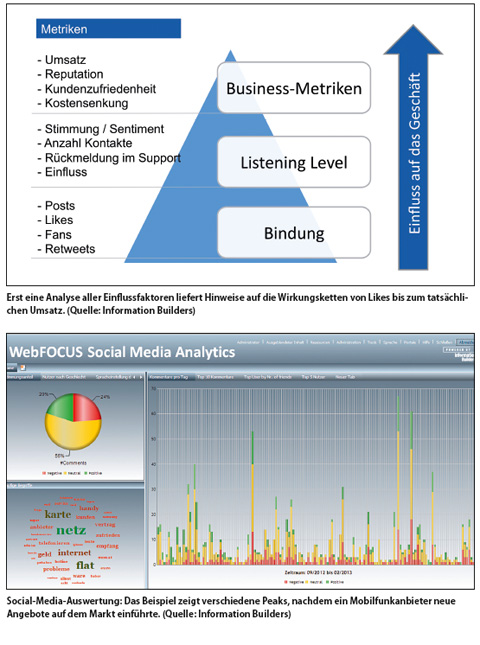
Campaign planning and management, for example, are attractive areas of application for social media analysis. When companies launch a campaign on Facebook - such as discount codes that can be obtained by simply "liking" a page - it is important to measure the success of the campaign. Conventional tools for social media analysis record how many likes an advertising campaign has generated. This information is important for the campaign manager. However, the number says nothing about how high the sales actually were, how many likes turned into a real order and which products were purchased with the discount code. Such information is only available when social media analyses are linked to consistent, company-wide business analytics.
Social media analyses alone are not enough
Social media feedback alone does not provide a complete picture. Important supplementary information is also available in other internal systems that record customer interactions. For example, information on lost alerts from sales information systems can reveal product deficiencies. When customers complain about faulty or defective products, the information is often stored in helpdesk or call center applications. Ideas for product improvements may be contained in the results of surveys or focus group analyses conducted by external market research companies. Such data cannot be accessed by traditional or home-made social media analysis tools - and this is a key reason why it is so important to combine social media analysis with existing business intelligence and CRM/ERP systems to achieve optimal results.
The first step is to correctly record the variety of entries, posts and comments from the various social media channels. One solution for this is provided by functions for analyzing sentiment and opinions (sentiment analysis), such as those offered by WebFocus Social Media Analytics from Information Builders. The technical basis for this is the Wand Taxonomy Server (www.wandinc.com), which provides a multilingual vocabulary for the automatic text analysis of opinions and attitudes. The aim is to determine the tonality of the contributions (positive, negative, neutral). Manufacturers of consumer goods, for example, are interested in the opinions and attitudes of interested parties and customers towards their own products as well as those of their competitors.
Networking with business analytics
The second step is to process this unstructured data in such a way that it can be correlated with existing internal data - which is usually customer data. This makes it possible, for example, to determine which products and services a (dissatisfied) customer has previously purchased. The real value of social media analyses only comes from linking external and internal data, i.e. from analyzing how the comments and opinions of interested parties and customers in the social media channels affect the company: For example, is an increased number of comments or tweets the direct result of a particular sales campaign or promotion? What impact do positive and negative sentiments have on sales? Does Facebook support help to reduce customer service and support costs? Are customers who post frequently more loyal? Are there differences between the opinions and emotions of customers on social media channels and those that reach a company via call center or email?
The crucial point is that data from social media channels should not be analyzed in isolation from the information available internally. It must be part of a broad-based business analytics strategy that combines, correlates and compares social media data with customer data from a variety of other sources. Social media content alone does not provide a complete picture of customer attitudes and opinions. Social media data adds a new dimension to business analytics that, when combined with other sources, provides a more accurate picture of customer desires, opinions and behaviors and how these actions and sentiments impact business success. Achieving this goal requires powerful BI platforms that enable the efficient collection, processing, consolidation and analysis of these large volumes of data - regardless of where it is located, what format it is in and how extensive it is.
Giuseppe Scattarreggia