
Social Collaboration Summit: Communication at eye level - not in functional silos
On Tuesday, the Social Collaboration Summit took place for the second time at the Kulturhaus Helferei in Zurich. The event, still in its early stages, was very well attended, and the audience was refreshingly diverse and down-to-earth. Rather than focusing on job titles and positions, the event placed much greater emphasis on the individuals themselves, and the informal, first-name atmosphere fostered dialogue among the participants right from the start of the conference.


The summit was organized and held by the still young Open Mind Academy and its co-initiator Manuela Palla. In a personal conversation, Manuela positions the Academy as a platform for self-reflection for managers combined with thought provocation.
The Academy creates a hierarchy-free space beyond superficialities, so to speak. The launch of the Open Mind Academy is also a consequence of Manuela Palla's assessment that executive education must meet new demands. Traditional topics and formats have become outdated.
So it was interesting to see how this event would live up to these expectations. And indeed, the form and content felt significantly different and many things were practiced in an exemplary manner. For example, two large time slots were scheduled in which participants could present topic pitches. Priorities were then determined in an uncomplicated voting process and the selected topics and people were then able to take part in their short workshops. This can certainly be described as an agile conference model.
"Helferei" - the name says it all
At first glance, the Helferei venue took some getting used to - the location is easily accessible but not outstanding in terms of room layout and infrastructure. The summit format and the relevance of the topics absolutely made up for any shortcomings in this respect. And in terms of "helping", there was a spirit of meeting at eye level and helping each other depending on the issue at hand.
So not just music from the front, as we all know it, but an open learning platform. The keynoters also moderated workshops and thus became more tangible with their topics.
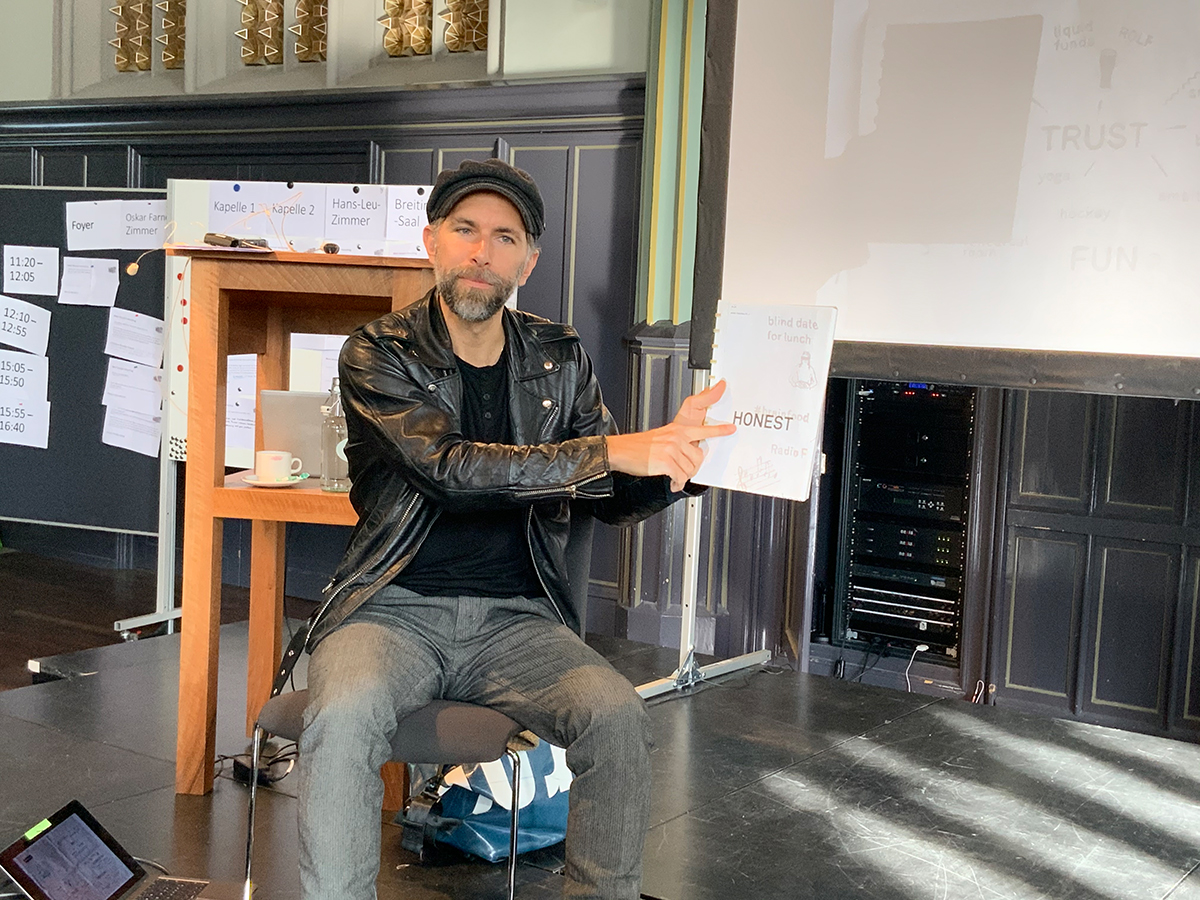
Secret Tools for Social Collaboration: Case Friday
Pascal Dulex (photo), responsible for Culture, Communications & Organization at Freitag, was one of the pitchers who then moderated an exciting workshop. Practical, transparent and impressively innovative, he was able to show how Freitag has transformed itself from a traditional hierarchy and organizational structure into a flat organization.
Pascal gave an unvarnished account of the challenges and flops that had to be overcome along the way. Even after 25 years of existence, Freitag has lost none of its creativity and courage. The fact that Pascal, as a former member of the Executive Board, has disempowered himself with this change process is exemplary.
With its interesting format and well-chosen topics, the second Social Collaboration Summit stimulated lateral thinking and lateral action. The summit can therefore be seen as a greenhouse for new ideas and solutions to meet challenges such as complexity and agility.
With international speakers, topics such as unlearning/ relearning, network vs. hierarchy, transformative hierarchy were discussed. This conference can be said to have made good use of the collective intelligence in the room. It will be interesting to see how the third summit on November 10, 2020 will go.
* Christoph Oggenfuss is CEO of MarkITing.


