
SBB bans swastika poster
SBB has immediately pulled the poster featuring a swastika symbol, which was created by Zurich-based advertising executive Parvez Sheik Fareed. Back in mid-February, BDP President Martin Landolt caused a stir when he shared the image on Twitter.


The poster had deeply hurt the feelings of numerous customers and played down their personal past, SBB said on Wednesday. This was shown by the vehement reactions it had received over the past two days. The poster, which shows a white swastika on a red background, promotes a No vote to the enforcement initiative, referencing Nazi Germany and apartheid in South Africa. It went up on e-boards at Zurich's main train station on Monday and at Geneva station on Tuesday.
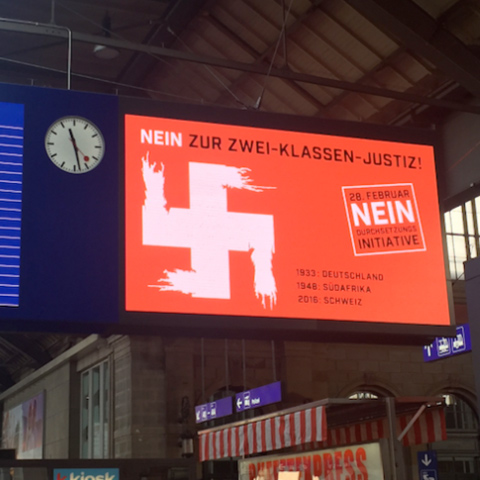
SBB is not interfering in the referendum campaign and is offering the advertiser the opportunity to run his poster without the symbol, the statement continues. It will not allow the poster with the swastika to continue. According to a federal court decision from 2012, public areas in train stations are public space. SBB must therefore allow political advertising in principle. SBB assumes "that with the swastika symbol in such a prominent place, the limits of the aforementioned Federal Court decision have been exceeded." The poster is a "blatant individual case".

Uproar about tweet of the BDP president
The subject had already made headlines in mid-February. BDP President Martin Landolt published the image on Twitter without comment, showing a Swiss cross distorted into a swastika. His tweet triggered fierce reactions on Twitter, many of them negative. Landolt said at the time, when asked by news agency SDA, that he had not actively sought the provocation. The picture, however, "gets to the heart of the matter." The central message, he said, was that the enforcement initiative would create a two-tier justice system. He spoke of provocative imagery, but did not see it as a Nazi accusation against the SVP. On the contrary, Landolt said he was surprised by the furor that had arisen, since the poster was not new. One day after the tweet of the BDP president, the consequence followed from the French-speaking part of Switzerland. Christine Bussat, founder of the Marche Blanche organization, resigned from the party with immediate effect. She did not appreciate the message. Landolt had an abysmal hatred of the SVP. It was a fight against a party and not for a cause, she said at the time. However, Bussat also justified the resignation with differences of opinion - especially on the enforcement initiative. She supports the initiative contrary to the BDP's slogan. (SDA)


