Travel on the rise
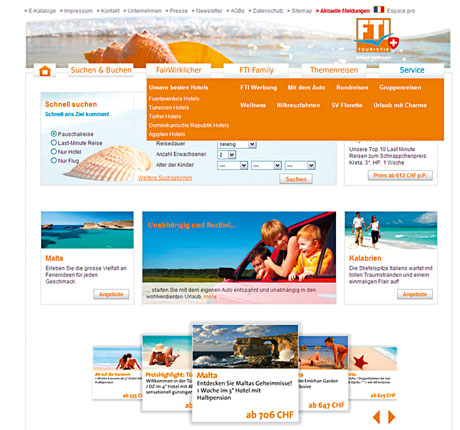
In 2008, the Zurich-based digital marketing agency Adisfaction won the online marketing account for the travel provider FTI Switzerland. After two years of work and a boost in revenue for FTI, the agency is now also taking over online marketing for FTI Austria and the car rental company Drive FTI.


A major boost in sales - there can be no better conclusion for online marketing. The Zurich-based digital marketing agency Adisfaction has more than fulfilled the mandate of tour operator FTI Switzerland. FTI's aim was to significantly increase its sales on the Swiss tourism market with online marketing. In a pitch, the company chose Adisfaction as the right partner for this project. "The fact that we can offer search engine and media marketing from a single source obviously convinced FTI," says Daniel Hünebeck, Managing Director of Adisfaction. "We also know the specifics of the Swiss market, not only in terms of language, but also in terms of travel destinations." After all, there are different travel passions from country to country, and not every country flies to the same destinations.
Adisfaction took the path to success in several steps: First, the agency focused on Google. "We put together Adwords and have used it to feed several Google accounts to date," says Hünebeck. Google keywords or Adwords are keywords that are found exactly or similarly when searching in Google. The Adwords are defined word by word and then linked to the offer to be advertised. At FTI, for example, these are terms and combinations of terms such as "Caribbean trip", "Antalya Hotel", "Hotel Club Paradiso", "Cala Ratjada" or even "Turkey cheap travel", "Book Canary Islands holidays online", "Family vacations Mallorca" and similar.
Online media and performance marketing
"We were able to take over adword lists with countries and hotel names from FTI's German parent company," reports Hünebeck, "but of course we had to adapt them to the Swiss market. The more detailed the Adword lists are, the greater the success." A Google account contains 100 so-called campaigns, each on one topic, for example winter or summer destinations. The campaigns in turn contain individual ad groups - for example "Rhodes vacations", "Greek islands vacations" or "Rhodes last minute" - as well as the list of keywords that trigger the placement of the ads. Adisfaction has so far created 150,000 keywords in six Google accounts.
In the second step, Hünebeck and his colleague Alexander Tysl approached selected Swiss media: "We placed advertorials with special offers and brief information about the travel destination on Bluewin and on the travel pages of 20-Minuten-Online, classic banners on MSN and a booking mask on Blick.ch," reports Hünebeck. On the homepage of Blick-Online, Adisfaction prominently placed a booking window in the top right-hand corner with the look and feel of Blick. Here, readers could enter their desired destination and a time period and were forwarded directly to the Fti.ch booking screen. But placing banners, advertorials and booking masks is not everything - you also have to maintain them and switch them off quickly if necessary: "If a hotel is fully booked, an attack happens somewhere or, as recently, a volcanic eruption makes travel difficult or impossible, then of course we have to make sure that no offer advertises this destination," emphasizes Hünebeck. What Adisfaction does is therefore not only technically demanding, but also in terms of content. And it only works because the agency thinks its way into its client's business.
How to book a trip ...
FTI and Adisfaction monitor the benefits of all marketing measures very closely: Is a trip booked or not after clicking on the banner or booking screen? This tracking is carried out by specialized software that delivers detailed results. However, foresight is required when evaluating the data. After all, a click on a banner or advertorial rarely leads directly to a purchase - which does not automatically mean that they are superfluous. This is because users who have previously clicked on a banner or a booking form often search Google later for similar offers or often even specifically for the provider of the previously seen offer. This is understandable: People who book a trip first get inspiration, for example from an offer. Then they discuss their plans with colleagues or family. And only then do they actually book. "This is typical booking behavior," emphasizes Hünebeck. "The strength of media marketing is branding and the initiation of a purchase. The strength of Adwords is clearly sales. The fact that this works better with Adwords is also due to the fact that, unlike with media marketing, the interest comes from the user at this moment. But: If you don't book the whole thing, no one will search for your offers or your company name. If you want to be successful with online marketing, you should therefore always combine all channels." Hünebeck obviously knows the score: the campaign that Adisfaction designed and implemented for FTI exceeded the travel company's targets by a double-digit percentage. Adisfaction will now also implement Google Adwords for FTI's Austrian subsidiary and the company's car rental division, Drive FTI.
Anne-Friederike Wilhelm