Mobile promises more growth than the computer in its revolutionary start-up phase
A new association has gotten off to a successful start. SMAMA, «the Swiss Mobile Association,» represents companies involved in the mobile business in Switzerland. The first annual event at ETH Zurich attracted a high-profile audience.


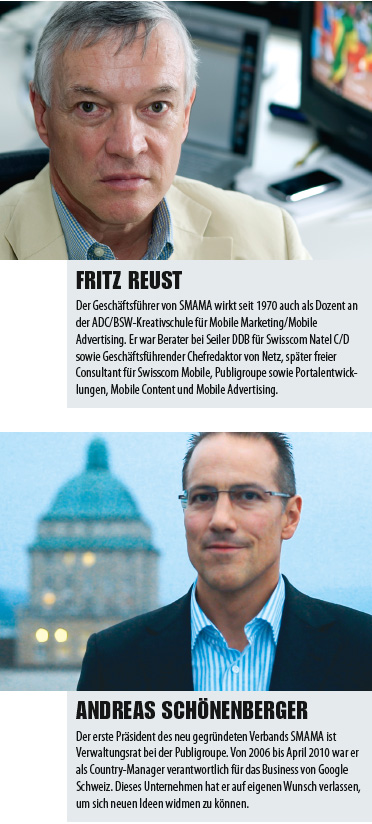
In the still young mobile association SMAMA, "the swiss mobile association", the companies Coop, Migros, Ringier, Tamedia, NZZ, SBB, Swiss Post and the Publigroupe subsidiary Publicitas are already represented after half a year. Publigroupe board member Andreas Schönenberger serves as association president. Fritz Reust serves as Managing Director.
The SMAMA association wants to be an information broker in the mobile business and representative of its members towards authorities and other organizations. "The mobile market should be professionalized by an efficient generic marketing", the initiators think. Thus, the association has already set up various working groups on mobile marketing and mobile advertising to strengthen the channel. The SMAMA management has also already made contact with representatives of the BSW. For the time being, however, the "leading Swiss agencies" do not want to know anything about joining. "A wait-and-see attitude that surprises us a bit. For us, it's not about the membership fee, but about an exchange of experience," Fritz Reust wonders.
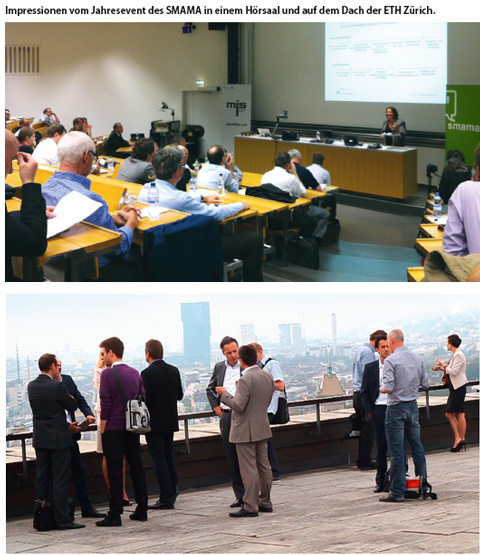
Accordingly, there were few advertisers or even top creatives in the audience at SMAMA's first annual event in ETH Zurich's lecture hall HG F5 on September 4. On the other hand, among the more than 176 interested people, numerous other big names in the currently fastest-growing segment of new media were informed about future developments. Strikingly, only about 10 percent were women. On the other hand, the mix of speakers was quite equal.
Telecom companies are also not yet members of the SMAMA association. The fact is, however, that according to scientific estimates, data traffic will grow by 26 percent annually in the near future.
Impressive numbers
As Fritz Reust said in his welcome address, 2.2 million people in Switzerland are currently online every day. An estimated 800,000 to 1 million iPads are in use. In addition, there are more than 8 million cell phones, according to the latest calculations by OFCOM. 74 percent own a cell phone with Internet capability. The market share of smartphones and iPhones is 50 percent each. On average, iPhone users have downloaded 60 apps each onto their devices. They spend 48 minutes a day using them. Another interesting fact is that 63.1 percent of all Facebook calls are made via mobile. At Google, we find that 30 percent of all search queries are made via mobile. One may wonder why, according to the statistics, users of Apple devices make more use of the new possibilities than Androids. The development of smartphones is growing ten times faster than the number of computers in the early years of the PC revolution. As a result, the PC may soon be relegated to the sidelines. "We are living in a smart phone era."
These and many more details and latest findings can be found on the association platform www.smama.ch. Twice a week, this website is updated. You can expect at least 40 new technical articles per month. Much of this info is freely accessible. Other research, studies and news from around the world are open only to SMAMA members. These also have access to four additional professional meetings per year. Membership is open to "interested parties without commercial interests" from 300 Swiss francs. Students pay 100, companies from 1000 to 3000. A deliberately futuristic strategy of SMAMA: start-ups are admitted to the association "for free".
Support for start-ups
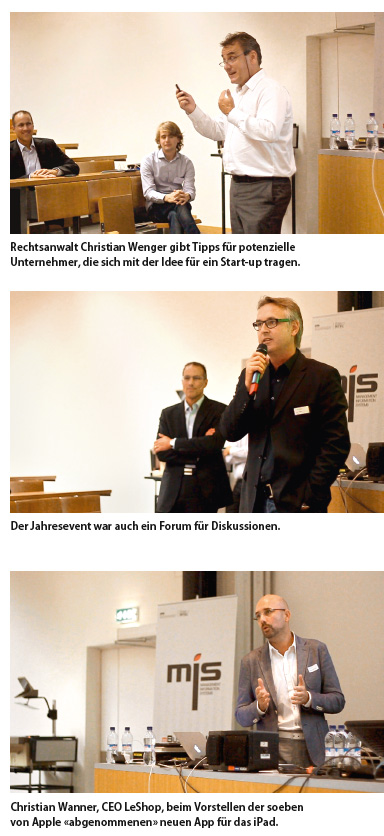
In his presentation, Christian Wenger explained what else one should know when founding a start-up. The lawyer and partner of Wenger & Vieli specializes in IT companies. He was able to show that the five largest IT companies in the world today together generate more revenue than the entire economy with all the major industries in Germany. And all these companies like Twitter, Google, Facebook were founded later than 1970. Wenger regretted that start-ups are not promoted enough in Switzerland. The exciting people are migrating to Berlin, where they are well on their way to becoming "Silicon Valley number 2.
Another speaker, Juliana Sutanto, explained how, as a lecturer at the ETH Zurich, she is currently conducting research on the much-anticipated "mobile payment". For this study, which is being conducted in collaboration with Italian scientists, Sutanto is working with 40 stores in Varese and the bank BNP Parisbas.
Lack of harmonization
With a bow to advertising, it became apparent in the discussion rounds that there is no harmonization in formats for the advertising media currently used in the mobile sector. Even for different titles in Tamedia's publishing house, different formats have to be submitted. This makes work more difficult, which would actually no longer be necessary with constructive cooperation. And it is precisely at such points that SMAMA wants to come to play with its mediation. "We want to bring together all the people who move in this space." As a further goal, the association wants to "also critically question the development," was defined at the annual event.
The adoption of mobile marketing apps
Katarina Stanoevska from the University of St. Gallen provided information on the state of play of a study on branded apps. How are such apps from companies like H&M, Red Bull, BMW or Nike accepted by the target group? "Such channels are becoming increasingly important. Advertising, however, has not yet grasped this," Stanoevska dared to claim. From the field of numbers, she was able to point out that 30 billion apps have been downloaded worldwide to date. Half a million of such gadgets can be found in the Google store. An additional 150,000 can be purchased through Apple. The most sought-after apps at the moment are still games. This is followed by entertainment, travel, books and lifestyle. Surprisingly, more apps are used in Switzerland than in Germany and Austria. On average, Mr. and Mrs. Swiss have downloaded 34 apps, according to Stanoevska. Of these, 18 are paid for. The perception of advertising on an app can be rudimentarily measured by how many of these apps are updated later on.
"Make IT sexy"
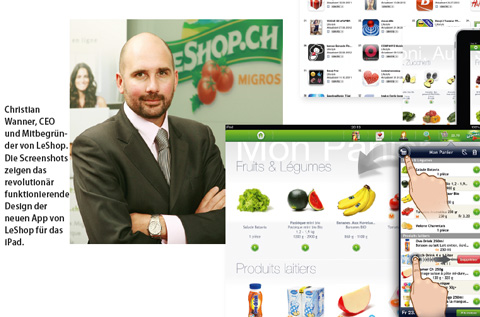
Christian Wanner was able to come up with concrete figures and projects at the annual event. The co-founder and CEO of Switzerland's largest online supermarket presented the LeShop iPad app as a preview. It has only been officially available in the Apple iTunes Store since September 6 and is now at the top of the iPad app hit list. A customer survey conducted by LeShop.ch in May 2012 showed that 36 percent of LeShop.ch customers already own an iPad - and of the remaining 64 percent, one in three said they planned to buy one by the end of 2012. Le- Shop.ch therefore invested in the development of a new iPad supermarket. Today, almost one in five orders is already placed via smartphone or tablet.
Christian Wanner showed why the app just developed for the iPad could not simply be a "blown-up" version of the already successfully used app for the iPhone. LeShop.ch's briefing to the developer made it a condition that the graphic layout should be ideal for a 3.5-inch screen. 62 different items should be able to find space in the shopping cart. These are selected from over 10,000 products. Such a "weekly bulk purchase" takes on average no longer than 12 minutes.
Faster than the web
Because uploading the images for 62 different products over the network would take far too long for a purchase, with the apps for the iPhone and iPad a catalog with the entire LeShop.ch range is downloaded once and installed quickly on the device's hard drive. Each time the app is started, any price changes are later synchronized automatically - but this only takes a fraction of a second. The customer can then click, view and select their goods offline. They only go back online when they submit their order. With the new app, LeShop has placed great emphasis on a graphically very easy-to-read display.
An additional advantage of the new app for the iPad is that the shopping basket can be kept open for longer periods of time. "Multichannel" is the name of the concept with the mobile shopping basket. In concrete terms, when I brush my teeth in the morning, I can order a new tube of toothpaste in the bathroom via the iPhone. Then, in the kitchen, I use the iPad to order new coffee capsules - because I realize that they're about to run out. Later, in the office, I use the PC on the desk to order a few more items - which are added to again on the train ride home via the iPhone or iPad, until the order is finally sent off at home with further additions from the rest of the family.
Unstoppable boom
LeShop.ch sold goods worth CHF 77 million in the first half of 2012 and delivers 200 tons to its customers every day. The largest Swiss online supermarket sees growth potential primarily in new channels. At the beginning of the year, 12 percent of orders were placed via mobile devices. In the last two months, 19 percent or 15,000 of a total of over 90,000 orders were placed via mobile devices. Soon, one in five purchases will come from the mobile Internet. Christian Wanner is delighted: "The fact that the mobile share is developing so rapidly exceeds our expectations. The share of sales via mobile applications has grown from 12 percent in the first quarter of 2012 to 19 percent in the second quarter. We are convinced that this trend will intensify even further."
LeShop.ch customers buy online at LeShop.ch and have their purchases conveniently delivered to their doorstep. Delivery is made the next day by express mail. The trend toward mobile web use supports this development. At LeShop-Home, customers can choose from 10,000 products, more than half of which are M products at M prices. The minimum purchase is 99 francs. Depending on the value of the purchase, delivery costs range from 7.90 to 15.90 francs. Delivery takes place the day after the order is placed, between 5 and 8 p.m., and on Saturday morning. LeShop now also operates a LeShop.ch drive-in in Studen in the Bernese Seeland region. LeShop.ch is the Swiss market leader in Internet retailing. LeShop SA was founded in 1997 as a pioneering company by private entrepreneurs. Since January 1, 2006, the Federation of Migros Cooperatives has held the majority of the share capital of LeShop SA.
Andreas Panzeri