Benchmark for mobile marketing
With a focus on mobile advertising, we’ll highlight best practices from abroad and launch a community platform on the topic.



App for brand management
The American sporting goods supplier Converse used augmented reality for its campaign, which won an award in the brand care category. With "The Sampler App", sports shoes can be tried on virtually. All you have to do is point the camera of your smartphone at your own foot, adjust the shoe size and you can try out different models, i.e. display them. Once a suitable model has been found, a snapshot can be saved and shared with friends on Facebook, for example, to get their opinion. Of course, the shoes can also be purchased via the app.
Creative until the contract is signed
One of the largest banks in Turkey, Garanti Bank, wanted more of its customers to use online banking. Over the years, the bank had acquired 1.6 million online customers, but was unable to increase this figure any further. So the customer database was searched for customers who had an e-mail address but had never used online banking. Using their name, email address and cell phone number, a personalized email was created for each of these customers, which they found in their inbox one fine morning. It contained a link to a video with a news spot in which the last person in the world who does not yet use online banking is reported in all seriousness: And it is the recipient himself - the displayed name leaves no doubt about it. But it gets even better: while the video is running, the customer in question is called on their cell phone so that the news presenter can interview them. If the caller answers, the commercial continues with the question of what they have to say. And then comes the question: "Do you promise to use Garanti online banking to save time and money? Yes or no?" This answer is sent to a voice recognition system, which evaluates it and then sends the customer a suitable e-mail. Result: 21 percent of customers surveyed in this way gave a technically recognizable positive answer and signed up for an online banking contract.

Mobile marketing for promotion
The "Find Red" campaign for M&M (a competitor to the chocolate lentils known as Smarties) received a Smartie in Canada. The five colorful talking candies are looking for their outspoken colleague Red. In anticipation of Google's Streetview images, the advertisers hid a head-sized portrait of Red thirty times in the Greater Toronto Area so that he would be captured by the camera vehicles. Three of them worked and were available on Google Maps. But where? That was the main challenge of the campaign. The latest clues were shared and discussed via social media channels such as Twitter and Facebook. And Red checked in at various locations in the city via Foursquare and left clues as to his whereabouts. This also included wild posters with QR codes that could be analyzed by smartphones for further clues. And further clues could be read from the barcodes on the packaging. The main prize for participants in this digital treasure hunt was a red Smart (sic!). But the campaign also won: not only three Lions in Cannes, but also 15.6 million impressions across all media channels in thirty days. The remarkable thing about this campaign, however, is that not a single dollar was invested in conventional media (TV, radio, print, etc.), but it was carried out where the target groups are most frequently on the move: on social media and on the street.
Maddy brings industry overview
How does mobile advertising in Switzerland compare with the showcase examples from abroad? Maddy was created to investigate this question journalistically. On this web platform (www.maddy.ch), creators and professionals who specialize in mobile advertising can register their companies and campaigns. This creates an online overview of the various mobile advertising players and their activities, which is useful for the entire industry. If particularly interesting aspects or individual cases emerge on Maddy, these will be presented in more detail in future articles on the current focus topic of mobile in separate articles. We hope that this crowdsourcing attempt will find broad support and will report on Maddy's progress on the Online News website of Werbewoche.
Christoph J. Walther
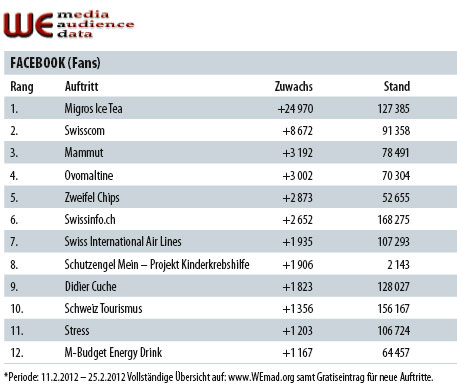
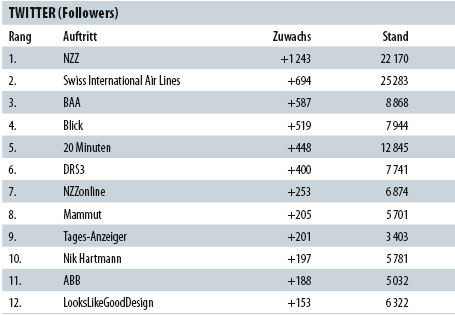
The current social media high flyers